Sunday, November 1, 2020

ONE OF EVANSTON'S HAPPIEST AND MOST SUBSTANTIAL CITIZENS - Max Fell

An obituary appeared in the Evanston Review on March 17, 1960.  It said in part, 

"Max Fell, who with his horse and wagon was known to generations of Evanstonians, died Wednesday of last week in Evanston Hospital.  He was 86.

His business was collecting and selling old paper, scrap iron and miscellaneous metal.  Up to the beginning of this month, when he became ill, he had been doing it for 54 years."


When I was a boy, most mothers worked at home taking care of their families.  Periodically a man pushing a large wooden cart would stop us children when we were out playing and say, "Tell your mother the knife sharpener man is here."  Our mothers were always happy to see him, and they would gather up all their knives and scissors and take them out to him to be sharpened.  They then paid him - in cash of course - and he walked on to another block and started his routine all over again.  We never knew his name.  He was always "The knife sharpener man."  After all, that's what he called himself.

Max Fell, on the other hand, was what we used to call a "junk man."  He went up and down Evanston's many alleys in his horse-drawn wagon looking for "good junk" that he could collect and sell.  His acquisition cost was virtually nil, so everything he collected and sold was almost 100% profit.  Unlike the Knife Sharpener Man, I never knew Max Fell but he is an interesting character nonetheless.  Before we take a closer look at junk found in Evanston's alleys, let's see what we can "dig up" about Max Fell.

Max Fell was born May 15, 1873 or April 25, 1875 (he reported both dates) in Lithuania, although when asked he usually said "Russia."  As a young man he learned to handle horses as a member of a Russian artillery battery.  This skill was to prove useful to him later in life as we will see.  

In about 1900 Max married Rose Kutok (1881-1964) and she, of course, traveled with him to his new life in the United States.  

As he did with his date of birth, Max Fell gave different answers when asked when he immigrated to the United States.  Sometimes he said 1901, sometimes 1903.  When he applied for US Citizenship he said that he had arrived in the US on October 14, 1904.  None of these dates hold up to scrutiny when other factors are taken into consideration.  Max and Rosa told the 1910 US Census taker they had five children:  Nine year-old Ahren/Aaron (1903-1955), seven year-old Morris/Maurice (1905-1982), three year-old Ruth/Fannie (1906-1996), two year-old Edith (1907-2004) and six month-old Jacob/Jack (1909-2008).  They said that Aaron and Maurice had been born in Russia; Fannie, Edith and Jacob had all been born in the United States.  Since Aaron was born in 1903 and Morris was born in 1905 a more likely immigration date for them was 1905/1906.  Of course Max and Rosa had used the Jewish calendar when they were living in Russia and there was often confusion when trying to remember the dates of past events recorded using a different calendar.  No matter when they actually arrived, they moved to Evanston within a year at the urging of an uncle, the late Elias Rubin, who at that time operated a second-hand business in Evanston.  Max and Rosa do not appear in the 1905 Evanston Directory, but they are listed in the 1909 Directory.  

In the 1910 US Census, Max Fell and his family were living at 2016 West Railroad Avenue in Evanston.  West Railroad Avenue became Green Bay Road in 1936:

2016 West Railroad Avenue (Green Bay Road), Evanston, Illinois

Current residents will recognize 2016 Green Bay Road as the home of the Windy City Garden Center.


Max said he was thirty six-years old, and that he was in his first marriage.  He had been born in Russia.  He said he had been married for ten years.  He said he had immigrated in 1903 and that he had filed papers to become a US Citizen.  He reported his native language was Yiddish, and that his occupation was "Junk Peddler."  He said he could both read and write.

Max's wife Rosa, said she was twenty-nine years old and also in her first marriage.  She had been married for ten years.  She had given birth to five children and said they were all alive in 1910.  Like her husband she had been born in Russia but unlike Max she reported her native language as Russian.  She also could both read and write.

Max Fell became a naturalized US citizen on April 5, 1912.  He used to say that the best thing he ever did was come to the United States.  "America's the best land of all.  You are free here and you can always make a good living if you work hard." 

On November 17, 1914, the last of Max and Rosa's children was born:  Toby Sophia Fell (1914-1977).

Like all good Americans, Max registered for the draft on September 12, 1918.  His address was still the house on West Railroad Avenue in Evanston.  He said he was a Junk Dealer and self-employed.  The Registrar said Max was of medium height and stout build, with grey eyes and black hair.  They also reported "Part of 3rd finger on right hand missing."

The 1920 US Census found the Max Fell family still living at 2016 West Railroad Avenue in Evanston.  The family consisted of forty six year-old Max, forty year-old Rosa, eighteen year old Aaron, seventeen year old Morris, and twelve year old Ruth.  No mention of Edith, Jacob or Toby.  They reported they had immigrated in 1905 and were naturalized in 1909.  When doing genealogy research remember that years ago peoples' recollections of dates and places were often inaccurate.  It is never a good idea to use the Census as a primary source because people could tell the census taker anything without having to back it up.

Getting back to the 1920 Census, Max reported that he owned the house on West Railroad, and that his occupation was "Junk Dealer."  Morris reported that he was a "wagon boy" at the "Fields store."  Max and Rosa said the could neither read nor write.  This contradicts the 1910 Census when they both said they could read and write.  In the 1920 Census they reported that all of their children were able to both read and write.  All of them reported that they could speak English.

In 1926, Max Fell and family moved from Green Bay Road to a beautiful nine room home at 2310 Ridge Avenue in Evanston:

2310 Ridge Avenue, Evanston
  

I guess there's money to be made in junk.  After the family moved to the Ridge address, Max ran his junk business from the Green Bay Road location.  

The 1930 US Census reflected the Fell family's new address at 2310 Ridge in Evanston.  The family consisted of: Max Fell, age 56; his wife Rose, age 48, and children Maurice, age 26; Ruth, age 23; Edith, age 21; Jake, age 20; Robert, age 16; and Sophia, age 15.  I am glad to see that the children who had been "lost" in the 1920 Census had been "found."  The family left the "Own a Radio?" field blank but I am sure with all those young people in the house they must have owned a radio - probably several.  Max said he owned the house and it was worth $30,000.00.  He was a "Proprietor in Junk" and not a Veteran.  Maurice was a "Chauffeur in a Private House,"  Ruth was a "Bookkeeper in a Bakery," Edith was a "Stenographer for a Publisher" and Jake was a "Butcher in a Market."

The 1940 US Census was not substantially different for the Fell family.  They were, of course, still living at 2310 Ridge in Evanston.  The family now consisted of:  Max Fell, 66; wife Rose, 57; children Maurice, 35; Ruth, 33; and Toby, 25.  There was also a new addition to the family:  Bernard Fell, 5 - Grandson.  Max was now a "Buyer in a Junk Business," Ruth was a "Clerk in a Bakery," Toby was a "Floor Clerk in a Department Store," and Maurice was a "Chauffeur for a Private Family."  They had all lived in the same place in 1935.  The Great Depression had taken place since the 1930 Census, and Max said his $30,000.00 house was now only worth $12,000.00.

The 1940 US Census asked for the first time the "Highest Grade of School Completed."  Max said he had gone as far as the 7th grade; Rose had 4 years of high school; Ruth had gone as far as the 8th grade; Toby had 4 years of high school, and Maurice had gone as far as the 8th grade. 

What was it like to be a junk dealer in Evanston, Illinois?  A 1955 interview with Max Fell said:

"Jaunting all day by horse and buggy through the alleys of Evanston is Max Fell's idea of a satisfying and healthful life.  He has been doing it for 49 years in which he has reared a family of seven prosperous children, made many backyard acquaintanceships with charming families and enjoyed the companionship of many sympathetic horses.  Max's business is collecting and selling old paper, scrap iron and miscellaneous junk.  When prices were better, be bought old paper and junk,  Now he usually charges a fee for removing the stuff from the premises and makes calls by appointment.  He admits it's love of horses and outdoors that keeps him on the go past retirement age for most men.  He tried indoor life, couldn't stand it and returned to the alley routine."   

As I mentioned above, Max had grown up with horses in his native Lithuania  and learned how to handle them as a member of a Russian artillery battery.  Horses would play a big role in Max's life in Evanston.  He told an interviewer that he had owned about 75 horses through the years.  The number is large because when he was younger he was a horse trader as well as a junk dealer. Horse swapping and colt breaking were two of his favorite pastimes.  Once an Evanstonian offered Max the meanest wild west colt in his corral plus $10.00 if he could put a bridle on the horse.  Max bridled the colt, tamed it, rode away with it and later sold it for $150.00.  Max kept his horses on a lot he owned at Ridge Avenue and Central Street in Evanston (approximately where the Cos Building is located today).  

Later in life Max's constant companion and best friend was a horse named Jim (no relation to your author).  The Evanston Review used to run a column called "The Evanston Revue" by editor Walter Lovelace who called himself "The Saunterer."  In 1955 he wrote about Max Fell and Jim:

"Should an anxious horse wearing a nosebag poke his head into a coffee shop to inquire about a man, chances are the horse is Jim, the man is his owner and closest friend, Max, and the nosebag is empty.  That's what happens when Max Fell, one of the town's happiest and most substantial citizens, ties a luncheon bag on Jim's nose and then drops in for a cup of coffee and lingers too long.  When Jim finishes, he is anxious to get going."  


Max Fell took pride in never letting weather prevent his daily journeys through the city.  But it was not all work.  In below-zero weather, he would hitch up his horse to take Northwestern students for hayrides, continuing this custom until shortly before his death.

Max Fell refused to join the rest of the world in mechanizing his equipment, chiefly, he would say, "because I love horses."  One of his evening rules was to never sit down to a meal until his horse was fed and bedded down.  His reason for not retiring years ago, he would say, was his love for the horses and for the outdoors.

The one time he did try using a truck, it stalled in 10-below zero weather, and two of his toes were frozen while he waited for a tow car.  So Max gladly sold the truck at a $1,000.00 loss and went back to his reliable horse.

Also, he once tried hitching his wagon to a mule.  The mule jovially hee-hawed as it kicked Max in the forehead, nearly fracturing his skull.  No more mules for Max.

Once a woman accused Max of driving an unshod horse.  He invited her to lift Jim's foot and see for herself.  She declined and called a policeman.  The policeman also declined to inspect Jim's footwear and walked away.  This was lucky for the policeman, Max said because when a busybody tries to life Jim's foot he always gets a kick in the face.  Actually Jim wears rubber shoes.  He is fitted to a new set every month by a farrier who travels to the barn by auto and charges $14.00.   

Sadly, the Fell's oldest son Aaron, died on September 16, 1955.  We was fifty-three years old.  He had been living and working in Waukegan, Illinois as the plant manager of a paper company.  I was unable to determine the cause of his death, but I was able to verify that he was buried at Westlawn Jewish Cemetery in Norridge, Illinois:


Jim, Max fell's constant equine companion since 1945 died in February of 1960.  There is no record of where Jim was buried.  After Jim's death, Max Fell no longer felt like he wanted to scour the alleys of Evanston for "good junk."

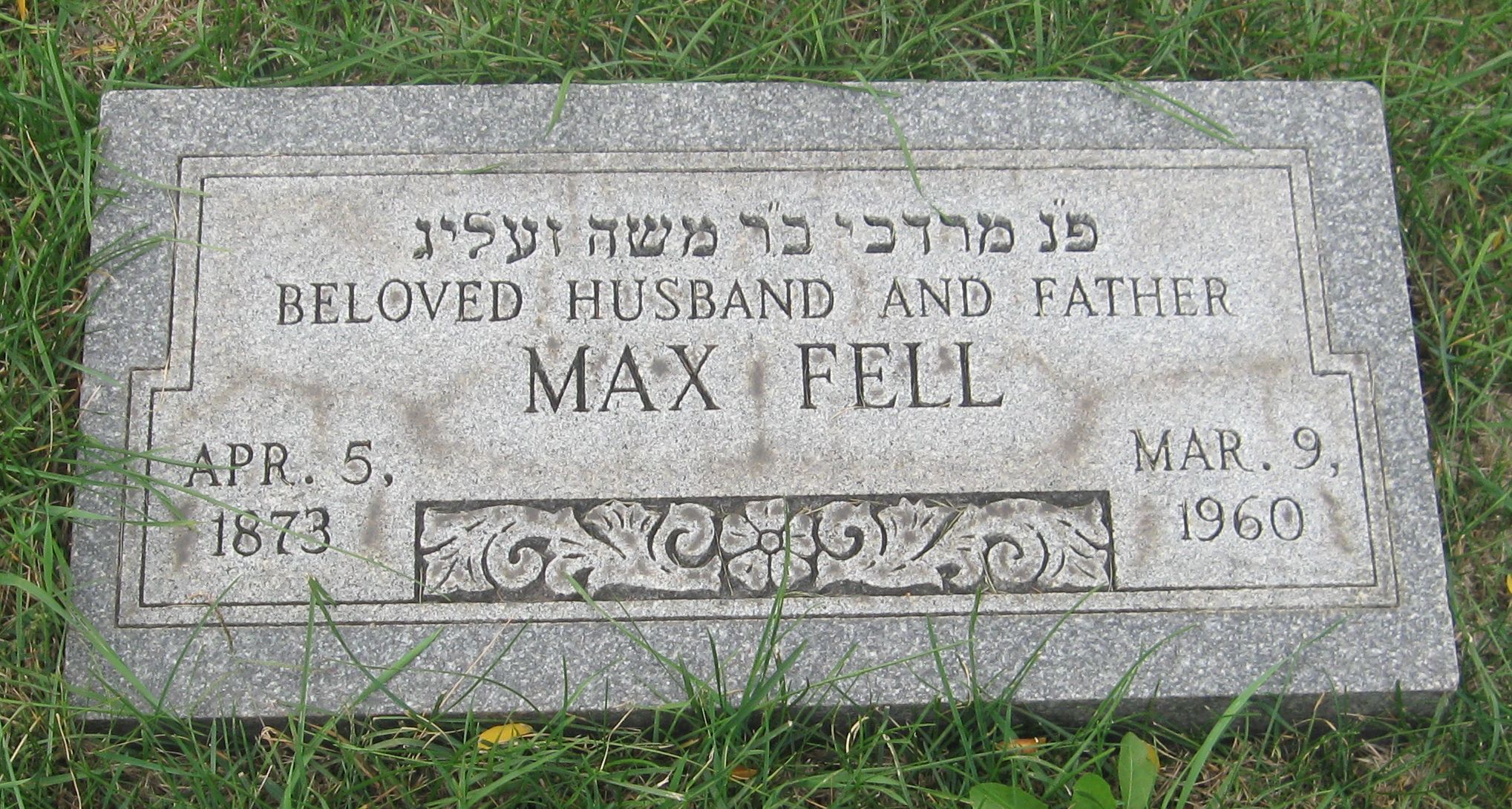
Max Fell died shortly after Jim on March 9, 1960.  He was at least 86 years old.  Here is his death notice from the Chicago Tribune from March 11, 1960:


Like his son Aaron, Max was buried at Westlawn Jewish Cemetery in Norridge, Illinois, in the Rose Section, Block 15, Lot 1, Grave 5:


Max Fell lived the American Dream.  Through honest hard work he provided for his family and made many friends along the way.  I think it is appropriate at this point, to restate Max's comments about his adopted country:

"America's the best land of all.  You are free here and you can always make a good living if you work hard." 

I never met Max Fell, but I'm sure that if I had, I would never have forgotten him.

Max Fell - one of Evanston's happiest and most successful citizens - may he rest in peace.


Special thanks, as always to Mike Kelly who brought the story of Max Fell to my attention then provided much of the research material for this story.

Saturday, October 3, 2020

PHOTOGRAPHERS, PISTOLS AND PARASOLS - Mabel Sykes Podcast

Long-time readers of this blog may remember that in June of 2013 I told the story of Mabel Huxley Sykes, noted Chicago photographer and the favorite photographer of silent film superstar Rudolph Valentino.  I was recently contacted by Lee McIntyre who hosts an interesting podcast called "Photographers, Pistols, & Parasols" which tells the stories of early women photographers - women who were professional photographers between 1840-1930.

Lee wanted to to an episode about Mabel Sykes and asked if she could reference my blog story about Mabel.  I was, of course, more than happy to agree.

On October 1, Lee presented her podcast about Mabel Sykes.  You can listen to it here:

http://p3photographers.net/p3p059/

Notwithstanding the fact that she heaped praise upon my blog and my story on Mabel Sykes, Lee has done an outstanding job of presenting Mabel's life and work from her viewpoint.  I really enjoyed listening to it and I'm sure you will too.  


Thursday, October 1, 2020

THE CARLSON BUILDING ELEVATOR OPERATORS - Anna Beckman and Hildur Beckman Bernardi

Most young people of my generation wore braces at one time or another to straighten their teeth.  I certainly did.  If you grew up in Evanston, Illinois there is a good chance that your orthodontist had his offices in the Carlson Building at 636 Church Street.  In those days wearing braces meant almost weekly visits to the orthodontist. The Carlson Building is a multi-story office building that provided elevators to get to the correct floor.  A big difference though was, that even in the 1960s and 1970s the Carlson Building still had elevator operators, as opposed to automatic elevators.  If you were an average Evanstonian you may have visited the Carlson Building hundreds of times over the years and probably never even thought about the ladies who operated the elevators.  They were part of the "fixtures" of the building and quietly performed their function year in and year out.

As you entered the elevator you told the operator the floor of your destination (hopefully adding "Please") and no matter how many people were in the elevator the operator only stopped at the floors that had been requested.  As you exited, you may have said "thank-you" but probably did not.  The Carlson Building elevator operators were two sisters, Anna Beckman and Hildur Beckman Bernardi and until their retirement were considered as necessary to the operation of the Carlson Building as the elevators themselves.  So let's take a trip down memory lane and find out about those two irreplaceable "fixtures."    

Anna O. Beckman and Hildur Victoria Beckman were both born in Rice Lake, Wisconsin.  Anna was born December 3, 1907 and Hildur was born April 9, 1910.  They were two of the daughters of Ernest Christofer "Frank" Beckman (1882-1964) and Anna Christina Naslin (1875-1960).  The family name was sometimes spelled "Backman."  Ernest and Anna both came from Skorped, Västernorrland, Sweden.  They both came to the US in July of 1902 aboard the SS Ariosto, and were married when they arrived in Boston, Massachusetts on August 1, 1902,  Ernst told the immigration officials their final destination was Rice Lake, Minnesota.  He may have misspoken or the officer may have misunderstood because Ernst and Anna ended up not in Rice Lake Minnesota, but in Rice Lake, Wisconsin. 

Ernst and Anna were blessed with seven children:  Garlade/Gustaf Frederick (1902-1991), Ernest Theodore (1904-1959), Anna O. (1907-2002), Oscar W. (1908-1971), Hildur Victoria (1910-1989), Agnes Lennaea - Mrs. Walter Erhart (1915-2008), and one unnamed child who died in infancy. 

The first US Census records for Anna and Hildur were in the census of 1910.  The census taker visited the Beckman family at their home in Barron County, Wisconsin on April 26, 1910.  Ernst said he worked as an employee on a farm that they owned, but they did have a mortgage.  Anna reported that she had given birth six times and that five of the children were still alive.  Their daughter Anna was 2 and the yet unnamed Hildur was 1/12.  

By the 1920 US Census many changes had taken place for the Beckman family.  First of all, Ernst and Anna reported that they had become Naturalized Citizens in 1911.  They were still living in Barron County, Wisconsin on the farm that they owned that was still mortgaged.  The family had grown and now Ernst and Anna had six children.  Everyone in the family except five year-old Agnes could both read and write.   

Anna Beckman came to Evanston first, "at the encouragement of friends," as she reported years later.  In a short time she was hired as the first full-time elevator operator in the newly constructed Carlson Building at 636 Church Street.

I have previously related the story of Victor Carlson and the Carlson Building:

https://undereverytombstone.blogspot.com/2015/10/he-left-his-mark-on-downtown-evanston.html

In a nutshell the Carlson Building was a ten-story 200 unit medical office building built in late 1925.  In addition to its location in downtown Evanston, the Carlson Building was one of the first office buildings to be constructed especially to house medical offices - doctors, dentists, etc.  Each suite was completed with the additional electrical power and additional plumbing that medical offices would require.  Although some suites were leased to other types of tenants, the Carlson Building remains to this day primarily a medical office building.


When the Carlson building was built it 1925 in was outfitted with two elevators.  Most elevators of that period required an operator as opposed to the "automatic" or "self service" elevators of later years.  During this time automatic elevators were illegal in many parts of the country because they were thought to be unsafe.  Victor Carlson's elevators required operators and so Anna Beckman was hired by Victor Carlson in 1926.  According to the sisters, Anna then "enticed her sister to join her (in Evanston)".

But Hildur Beckman did not immediately join Anna in the Carlson Building.  In 1928 while living in Evanston, Hildur met Dominick Thomas Bernardi (1908-1959).  Sometimes he went by "Thomas D. Bernardi."  Love bloomed and the couple was married.  In 1929 they were blessed with a daughter, Betty Belle - Mrs. James Mattson (1929-1992).

The 1930 US Census finds Hildur, her husband and daughter renting an apartment at 2115 Ashland in Evanston.  A parking lot occupies that space today.  Their rent was $22.00 per month.  Twenty two year-old Dominic was a "Laborer in a Greenhouse."  Twenty year-old Hildur and one year-old Betty did not work outside the home.  They were all US citizens, and Dominic and Hildur could both read and write.

I could not find Anna Beckman in the 1930 US Census, but the Evanston Directory for 1929 shows her living at 1612 Central Street in Evanston.  A parking lot occupies that space now.

The Evanston Directory for 1931 shows her living at 7521 N. Sheridan Road in Chicago:


7521 N. Sheridan Road, Chicago


The directories show her as an elevator operator but not as an employee of the Carlson Building.  Instead her employer is listed as "Renting Serv Corp." perhaps an umbrella company for employees of Victor Carlson's various properties.

In March of 1930 Victor Carlson's creditors forced him into bankruptcy.  The stock market had collapsed in 1929 and caused many empires to fall apart, including Victor Carlson's.  Ultimately Carlson lost the building that bears his name, but that did not seem to affect Anna Beckman who continued to work as an elevator operator.

By 1936 Hildur's husband Dominic Bernardi was unemployed.  The Great Depression was underway, and work for laborers was very hard to find.  So Hildur went to work - first as a maid at The Elmgate Manor apartment hotel in Evanston and then as an elevator operator.  Not with her sister at the Carlson Building, but according to the Evanston Directory at Lord's Department Store in downtown Evanston.  Perhaps Hildur needed to gain some elevator experience because in a 1975 interview the sisters reported that Hildur joined Anna in the Carlson Building as an elevator operator in 1936.

But the 1940 US Census does not bear that out.  According to the Census, Hildur Bernardi was an "Addressograph Operator" for a "Retail Department Store," probably Lord's.  Hildur and Dominick and Betty were renting an apartment at 1010 Main Street for which they paid $38.00 per month. 

1010 Main Street, Evanston

Dominick Bernardi was employed again - he was a "Laborer" for a "Manufacturer of Weatherproof Nails."  It is interesting to look at the family's educational status.  Dominick had gone as far as the seventh grade, Hildur through the second year of High School, and eleven year old Betty had completed fourth grade.

I was successful in locating Anna Beckman in the 1940 US Census.  She lived in the "Claridge Hotel" at 319 Dempster Street in Evanston.  


The Claridge Hotel - 319 Dempster Street, Evanston


She said she was thirty two years old, that she worked all year as an "Elevator Operator" in an "Office Building."  She also said that she worked forty-eight hours per week.  Finally, she said she had been living in the same address in 1935.

We don't know exactly when she left Lord's Department Store, but it is safe to say that Hildur Beckman Bernardi joined her sister Anna Beckman as an elevator operator in the Carlson Building sometime in the early 1940s.

The 1975 interview with the Evanston Review gave us an insight into what the sisters were like.

"We love our jobs."

"We must know more people in Evanston that anyone."

"When we walk down the street we get 'helloed' to death."

They talk in tandem, one completing a statement, the other adding to it...never interrupting, merely juxtapositioning their comments as they do their elevator departures at 636 Church Street.

The two sisters admit that they have greeted two generations, maybe three generations of doctors' patients.  "We see them grow from babies, to mothers and fathers, then to grandparents."

An oft-reported phrase is "Oh, I remember your father when he was your age."

Some of the old familiar faces move away, then come back to find that Anna and Hildur are still on the job.  Hildur and Anna like it that way.  They enjoy their jobs.  Anna says: "We work hard, mentally and physically.  We must make thousands of trips up and down per day."

Hildur: "And we answer hundreds of questions a day.  People who don't see the building directory, ask us where to find doctor so and so.  Some even ask how much a doctor charges.  We know the doctors' hours and their days off, information one won't find in the directory."

Anna:  "Many of the passengers tell us their complaints - their problems, their ailments."  They listen but don't gossip.

"Some people complain about the parking, as they rush in late for their appointments."  But the loyal Carlson Building employees add, "that the same people are lucky they can shop and have lunch in the same area.  Oh, and the doctors.  We know them pretty well, too.  We know their habits, their moods, when they have something on their minds."

And the sisters insist they don't discuss their aches and pains to the doctors on their way up and down.

"There was one doctor," Hildur recalled, who is retired, "who, if he thought we weren't feeling well, would insist on our coming right to his office for a check-up - no matter how busy he was, or how many people he had waiting."  

Anna and Hildur are grateful they are in pretty good health.  When they have been away for illness the receptions they received on their return were "unbelievable" they chime.

One year, after Hildur returned after being hospitalized, she was surprised with a luncheon in the Orrington Hotel.  And Anna, after a similar absence, was treated to a luncheon arranged by a dentist's wife in the Dominion Room.

Two years ago one of the dentists and his wife invited them to their 50th wedding anniversary reception in Lake Forest.  "We had more fun," recalls Anna.  "We knew everyone there," adds Hildur.

One year they spent 11 days in Hawaii as guests of the former owner of Lyman-Sargent's drug store and his wife.  "We have a standing invitation to visit," they tell.  Each Christmas we receive a card saying, "Isn't it about time you girls came back?"

On the job, the sisters are always ready for the unexpected.  "We've had lots of people faint," comments Hildur.  "And we've taken down a few dead ones," adds Anna.  She explains that they didn't die in the elevator, but of heart attacks elsewhere in the building.

"Once we had a young woman faint after coming out of a dentist's office.  We laid her down on the elevator floor and called the dentist she had just left.  It helps if we know which doctor to contact."

Anna:  "We can tell right off by looking at a person if he is going to faint or be sick.  We try to find out right away who his doctor is.  Then we summon him right away."

The sisters help the arrivals on crutches, in wheelchairs, with canes or walkers.  "It is sad," says Anna, "to see some of the people we remember as young and vibrant and at their very best."

Everybody who knows the sisters calls them by their first names. But some call Hildur, Hilda.  She doesn't seem to mind.  She is merely surprised because Hildur is on her name tag.

As I mentioned at the beginning of this article, I wore braces on my teeth as a teenager and remember going to the Carlson Building countless times during those years.  I was of course aware of the two elevator operators and it was obvious they were sisters but frankly I never paid much attention to either of them.

That changed in the late 1970s when my dentist retired and I didn't care for his replacement.  I needed to find a new dentist and at first didn't know how to go about it.  Then I realized that there was a resource right in the Carlson Building!   One morning I approached one of the sisters (I don't remember which) and said "I need to find a new dentist.  I figure you know all about all the doctors and dentists here so you would be the best source to recommend a good dentist for me."  Hildur (or Anna) responded "We are not really supposed to recommend one particular dentist over another but perhaps I can help you.  Would you be willing to go to a female dentist?"  (Remember, this was the 1970s).  "Sure," I responded, "as long as she is good."  Then Hildur (or Anna) responded, "there is a new dentist in Dr. Hodur's office.  She's brand new - her name is Marguerite Kelly and she's very nice.  We've heard nothing but good things about her."  I told Hildur (or Anna) that my great-grandmother was named Margaret Kelly so that was a good omen, and I called Dr. Kelly for an appointment.  She turned out to be every bit as good as her recommendation and I stayed with her until she moved her practice to the far southern suburbs of Chicago.  

As automatic elevators became more commonplace some people recommended that Hildur and Anna be replaced.  Bruce Goodman, who owned the Carlson Building in the 1970s, 1980s and 1990s was asked if the building ever considered putting in automatic elevators.  He responded, "Yes, but we couldn't give the people the type of service we do without Anna and Hildur, who are our greeters, our front door, our P.R.  They are beloved people - a great asset to the building, and because of them we have tight security.  If they notice anyone or anything suspicious they report it immediately.  They are the main reason we haven't put in automatic elevators." 

But life goes on for Anna and Hildur, as it does for all of us.  Anna never married, but Hildur's husband Thomas D. Bernardi died in 1959 and is buried in Memorial Park Cemetery in Skokie:


I was not able to find out exactly when Hildur and Anna retired but it was probably around 1980 when Hildur would have been 70 and Anna was 73.  They both wished to remain together and to remain in Evanston, so they moved into the Presbyterian Home at 3200 Grant Street in Evanston:

The Presbyterian Home, Evanston, Illinois

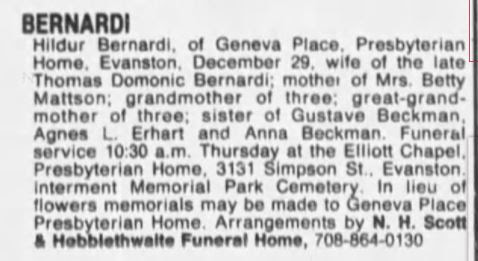
Hildur Beckman Bernardi died December 29, 1989 in Evanston.  She was 79 years-old.  Here is her Death Notice from the Chicago Tribune of January 2, 1990:


Hildur was buried next to her husband Thomas at Memorial Park Cemetery in Skokie:


Anna Beckman died May 27, 2002 in Evanston at the age of 94.  Here is her Death Notice from the Chicago Tribune of May 29, 2002:


I was originally unable to locate where Anna Beckman had been buried.  her Death Notice said the interment was private and she has not been dead for 20 years so I couldn't get her Death Certificate.  I reached out to the N.H. Scott & Hebblethwaite Funeral Home and they told me that Anna was buried next to her sister in the Mausoleum Annex section, West ½ of Lot 5, Block 12.  Unfortunately her grave is not marked:


Here are Anna and Hildur in the place we remember them best:


Scripture tells us that there is a ladder that reaches from heaven to earth (Jacob's Ladder).  But that was a long time ago.  Perhaps modernization has taken place and there are now elevators carrying men and angels from earth to heaven.  If that is the case, I'm sure that Anna Beckman and Hildur Beckman Bernardi have taken up their positions as the Heavenly Elevator Operators.

May Anna Beckman and Hildur Beckman Bernardi rest in peace.

Special thanks, as always, to Mike Kelly who provided valuable research materials for this article.

Thursday, August 27, 2020

THE FIRST BURIALS AT ACACIA PARK CEMETERY - Mary M. Lord and Frank J. Lord

In the past I have written about the first burial at Chicago's historic Rosehill cemetery:


and the first burial at Skokie's Memorial Park Cemetery:


A friend recently asked me if I was aware of the first burials at Acacia Park Cemetery, the formerly Masonic cemetery in Chicago.  They then told me the story of Mary M. Lord and her husband Frank who were both originally buried elsewhere but ended up being the first and second burials at Acacia Park.  I shall now pass the story along to you.


Before we look at their lives together we must look at them separately.  We'll start with Frank.

Frank Jerome Lord was born in February, 1859 in New York, the son of Jerome S. Lord (1833-1909) and Mary Elizabeth Kline (1833-????).  Jerome and Mary had six sons:  Frank J. (1859-1909), Luther S. (1861-1926), Charles V. (1863-1946), Egbert Lockhart (1868-1951), Robert Hubbard (1874-1945) and Leroy Chetwynd (1873-1944).

Frank's first US Census was in 1860.  The record shows the Lord family as living in Castile, New York.  Jerome Lord was a carpenter; Mary Lord was a Milliner, and Frank was of course a baby.  The family had personal effects worth $85.00.  

By the time of the 1870 US Census the Lord family was living in Almond, New York.  Jerome was still a carpenter; Mary was "Keeping House."  Frank was 12 years-old and "at school."  Frank was now joined by Luther, Charles and Egbert.  The family owned real estate worth $500.00 and personalty worth $2,500.00.

By the 1880 US Census, Frank had left home.  He was a "Farm Laborer" working on a farm in Jewett, New York, and was a Boarder with the family of Horace W. Towner.

In 1886 Frank Lord married Mary M. Myers in New York.  The Bride was 23, the groom was 27.

Now let's take a look at Mary.

Mary M. Myers was born in April, 1863 in Pennsylvania to Jacob J. Myers (1823-1882) and his wife Mary "Polly" Secrist (1832-1902).  

Mary's siblings were:  John Abner (1846-1932), Elizabeth Delray -  Mrs. Samuel B. Furry (1848-1883),  Jacob Martin (1850-1868), Anne Marie (1852-1853), Mary Catherine (1854-1854), Alvey Nelson (1857-1859), Annie E. - Mrs. Henry B. Martin (1860-1900), Samuel A. (1865-1886), Eulalia Myrtle - Mrs. Edward N. Pedicord (1867-1936), and William Newton (1869-1877). 

Mary's first appearance would have been in the 1870 US Census.  The family was living in Warren, Pennsylvania.  Mary's father said he was a "Clerk in a Store."  He had real estate worth $2,000.00 and personalty worth $300.00.  The real estate was in Mary's mother's name.

The 1880 US Census would be Mary's last census before she married Frank Lord.  The family was now living in Indian Spring, Maryland.  Mary's father listed his occupation as "Merchandising."  

As stated above, Mary Myers married Frank J. Lord in New York.  The Bride was 23, the groom was 27.  History does not tell us how Mary and Frank met, or how long they "courted" before they decided to get married. 

The 1890 US Census for that area is lost but a lot had taken place for the Lords by the time of the 1900 US Census. Frank and his family are living at 1063 Jefferson Avenue in Tyrone, Pennsylvania.

1063 Jefferson Avenue, Tyrone, Pennsylvania

Forty-one year old Frank is a "Commercial Salesman of Shoes."  Along with Frank are his wife, thirty-six year old Mary, and their two daughters, thirteen year old Edith Elizabeth - Mrs. Adolph C. Becker (1886-1978) and ten year old Margaret - Mrs. Colman J. O'Neill (1889-1967).

Frank J. Lord died in Zion, Illinois on April 1, 1909 of pulmonary tuberculosis.  He was 50 years old.  His father, Jerome Lord, had died just a short time before - on February 21, 1909. Jerome was 76.  Here is Frank's Death Certificate:


It says that he was a "traveling salesman" and that he had lived in Illinois for 8 years, meaning that the Lord family moved to Illinois in 1901 - not long after they answered the 1900 US Census in Pennsylvania. .

Now the mystery of Frank and Mary Lord deepens.  I was unable to uncover any information about how they came to be in Illinois at all let alone in Zion, Illinois where Frank died.  They are not listed in the Zion City Directory for 1908 (or any previous or subsequent directory for Zion, for that matter).  Neither Frank nor Mary were from Illinois, and their daughters did not get married until years later so Frank and Mary did not follow one of their daughters to Illinois.  This is one of the frustrating parts of genealogy research.  Sometimes you have questions that you are never able to answer.  But that makes each genealogy search a treasure hunt and adds to the fun (and frustration) of this pursuit.

Frank J. Lord was laid to rest in the Lake Mound cemetery in Zion, Illinois.  

Lake Mound Cemetery, Zion, Illinois   

After Frank's death, Mary and their daughters stayed in Illinois, but not in Zion.  The 1910 US Census shows them living in the City of Chicago at 2314 N. Powell Street (now Campbell).

 2314 N. Powell (now Campbell), Chicago

Mary reported that she was 45 years old and a widow.  She was not employed.  Living with her was 24 year old Edith who said she was a "Stenographer for a Publishing House."  Also there was 21 year old Margaret who was a "Bookkeeper for a Publishing House".  Living with the Lords as Boarders were 45 year old David B. Grigg and 25 year old Mary Thingaard.

But life was not all sad for the family of Frank Lord.  His daughter Margaret Lord married Colman Jerome O'Neill (1887-1965) on June 4, 1916 in Chicago.  The bride was 26; the groom was 29.  Colman O'Neill was a draftsman for a telephone manufacturer by trade.

In the 1920 US Census the family was down to Mary and Edith.  they were living at 4032 West Irving Park Boulevard in Chicago:

  4032 W. Irving Park Boulevard, Chicago

Mary is 58 years old and a widow.  She is now working as a Practical Nurse.  Edith is 31 years old and a stenographer in a law office.

Happy news again - on June 29, 1921 Edith Lord married Adolph Charles Becker (1881-1980) in Chicago at the First Lutheran Church of Logan Square:


The bride was 34; the groom was 40.  A.C. Becker was an pioneering automobile dealer by trade.

Mary Lord died January 4, 1923 at 2827 N. Mozart in Chicago:

2827 N. Mozart, Chicago, Illinois

The cause of death was a cerebral hemorrhage complicated by arteriosclerosis.   The family did not bury her next to her husband in Zion, instead they buried her in Montrose Cemetery in Chicago - at least temporarily:

  
Here is her death notice from the Chicago Tribune from January 5, 1923:

 
So by January, 1923 Frank and Mary Lord are both deceased.  Their remains are separated - his in Lake Mound Cemetery in Zion, hers in Montrose Cemetery in Chicago.  Normally this would be the end of the story.  But I said they were the first (and second) people interred at Acacia Park Cemetery in Chicago.  How did that come to be?

Back in 2015 I told the story of Street Lightfoot, the founder and owner of Acacia Park Cemetery:


Just to recap, in the late 1910s the Masonic Fraternity of Chicagoland decided to develop cemeteries that would be limited to Masons, members of the Eastern Star and their families.  Street Lightfoot was hired to accomplish this because of his cemetery expertise and background in Masonry. Lightfoot developed the Acacia Park Cemetery on Chicago's north side, and the Cedar Park Cemetery on Chicago's far south side for the Masons.

Street Lightfoot knew the neighborhood along West Irving Park Road just outside the Chicago city limits very well, having worked for the Irving Park Cemetery.  When the Masons hired Lightfoot to develop a north side cemetery, he made arrangements to purchase 83 acres of sloping land right across the street from the Irving Park Cemetery.  The land is bounded by Berteau on the north, Irving Park, on the south, Ozanam on the east and Pioneer on the west.  
      
The Acacia Park Cemetery was opened in 1922.  Here's a photo from the groundbreaking of the cemetery:


First of all, we can assume that someone in the Lord family was a Mason.  In the early years interment at Acacia Park was limited to Masons and their families.  Well, it turns out that Edith's husband A.C. Becker was a Mason.  Here's a mention of that in the Chicago Tribune of April 10, 1932:
 
  
A.F. & A.M. stands for "Ancient Free and Accepted Masons".

A.C. Becker decided that the time to buy graves at Acacia Park was before they were needed - in fact before the cemetery even officially "opened."  In addition to getting a good price, Becker would be helping fellow Mason, Street Lightfoot in his new financial venture.  Perhaps he suggested it, perhaps his wife Edith was the one to bring it up but they decided to buy four graves and have Edith's parents disinterred from Zion and Montrose and have them reinterred next to them at Acacia Park.  Frank had been dead since 1909 but Mary was only recently deceased.  Perhaps Mary had not been buried at Montrose Cemetery; perhaps she had been kept in Montrose's Receiving Vault until the graves were ready.  Years ago all cemeteries had "Receiving Vaults" which were places bodies were kept until they were ready for interment.  Sometimes they could not be buried because the ground was frozen; perhaps the deceased was waiting for a  family mausoleum to be constructed.  Receiving vaults were locked storage, often in the side of a hill, so that the vault would stay cool while the bodies were waiting for their final disposition.  Acacia Park Cemetery was so new in 1923 they may not have even had their own Receiving Vault.  Here are photos of the Receiving Vault at Rosehill Cemetery to give you an idea of what they are like:


As you can see, nothing fancy but satisfactory until permanent interment takes place.  Due to the newness of Acacia Park Cemetery in 1923 when Mary Lord died, it is unlikely they had a receiving vault of their own, so Mary had to spend a few days up the road at Montrose.

A.C. Becker and his wife bought 4 graves in the Barberry Section of Acacia Park.  Block 3, Lot 2, Graves 1-2-3-4.  They saved graves 3 and 4 for themselves, and made arrangements to have Frank moved down from Zion, and Mary from Montrose.

Frank Lord and his wife Mary were finally laid to rest in their new graves in the new Acacia Park Cemetery on February 26, 1923.  Here is a photo from Mary's interment on that day:


Here are their graves almost 100 years later:


Mary Lord was Interment #1 at Acacia Park:


Frank was Interment #2:


They were joined by their daughter Edith in 1978:


And their son-in-law A.C. Becker in 1980:


Here are all four of them together:


Frank and Mary were leaders of a long parade.  Acacia Park Cemetery recently had their 300,000th interment.

So now you know the story of the first burials at Acacia Park Cemetery.  Frank and Mary Lord were just "regular folks" who went about living their lives as best they could.  I think everyone at one time or another thinks about the possibility of reincarnation.  Many people have actually gone through "age regression" to see who they had been in their past lives.  Did you ever notice that none of these people were just "regular folks" in their past lives?  You hear a woman confess that she discovered that she was Cleopatra in a past life.  But no one every says that in their past life they were the person who picked up the dung dropped by Cleopatra's camels.

Many of us when we start tracing our family trees hope to find that we are related to someone famous or someone infamous.  But the fact is that most people are related to just plain folks.  I have traced the Kramer side of my tree back to 1615 in Germany.  I found nobody famous, nobody infamous.  They were just regular people who were born, married, had children, and worked until they died.  Just regular folks.  Just like Mary and Frank Lord.  
 
But actually Mary and Frank Lord are more "famous" in death than they were when they were alive, because Mary and Frank Lord were burials #1 and #2 in Acacia Park Cemetery in Chicago, and so we tell their stories today.

Mary and Frank Lord - just plain folks - may they rest in peace.