Saturday, May 1, 2021

THE FIRST INTERMENTS IN THE ROSEHILL COMMUNITY MAUSOLEUM - Franciska Hoer Lang and Michael George Lang

I have written previously about people asking "Who was the first person buried in Xxxxx Cemetery?"  I have told the story of the first person buried in Rosehill Cemetery in Chicago:

https://undereverytombstone.blogspot.com/2012/12/the-first-burial-at-rosehill-cemetery.html

the first person buried in Acacia Park Cemetery in Chicago:

https://undereverytombstone.blogspot.com/2020/07/the-first-burials-at-acacia-park.html

and the first person buried in Memorial Park Cemetery in Skokie, Illinois:

https://undereverytombstone.blogspot.com/2015/04/the-first-burial-at-memorial-park.html

Alexander Guneshoff's tombstone even states that he was the first person buried at Memorial Park:


But what about the community mausoleums?  Who were the first people interred there?  I have never encountered a crypt that said "First interment in Xxxxx Mausoleum."  In every case that I have checked, the cemetery could not tell me who the first person was to be interred in their community mausoleum.  The records must exist somewhere but as we have seen in the past, most cemetery owners/employees are not interested in events at their cemetery in the past, they are just interested in selling interment space today.  

So I did a little digging to try to find out who the first person was who was interred in the Rosehill Community Mausoleum.  I decided to look for the first newspaper obituary/death notice that said "Interment in Rosehill Mausoleum."  The first mention I found was for John Lefnestey in the Chicago Tribune of September 18, 1915, but his Death Notice only said "Services at Rosehill Mausoleum" not that he was interred there.

The first interment notification I was able to find was from the Chicago Tribune from October 31, 1915 for Franciska (Frances) Lang:


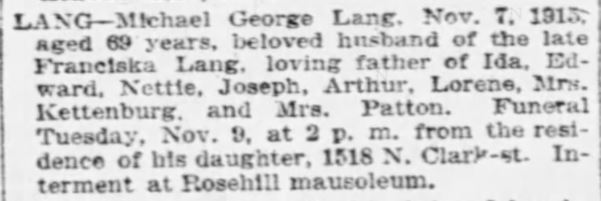
Surprisingly, the second interment was her husband, Michael George Lang.  This is from the Chicago Tribune from one week later, November 8, 1915:


So, let's see what we can "dig up" about Franciska and Michael George Lang.

Franciska Hoer was born August 24, 1847 in Gutmadingen, Germany to Bartholomeus Hör (1823-1889) and Katharina Bausch (1821-1889).  She was one of six children.  Her siblings were Anna Maria (1846-1846), Susanna (1848-1849), Johannes (1850-1860), Martin (1851-1860), and Joseph (1854-1924).  Bartholomeus Hör was a "Laborer" by trade.  The Hoer family came to the US in 1853 when Franciska was six years old.

Michael George Lang was born December 25, 1846 in New York (although some sources incorrectly say Germany), the son of Mathias Lang (1815-1903) and Margaret Stinach (1813-????).  He was one of five children.  His siblings were  George (1828-????), Catherine (1838-????), Theresa (1839-????) and Rachel (1842-????).  Mathias Lang also listed his occupation as "Laborer."

Michael Lang and Franciska Hoer were married in 1866 in Will County, Illinois.  The 1870 US Census shows the Lang family living in Chicago.  The family consisted of Michael Long (sic), age 25, a "Saddler," born in "Baiern," who was a citizen of the US.  Along with Michael was his wife "Franky" (22), children Ida (3), Edward (7/12) and Michael's mother Margaret Lang (66) also from Baiern.  Please tell me again why we should accept the US Census as source documentation to verify facts...

The 1880 US Census finds that the Lang Family has relocated - to Joliet, Illinois.  Specifically to #56 Benton Street.  A parking lot occupies that space today.  The family consisted of  Michael Lang (36) a "Harness Maker" born in New York, his wife Frances (32), and children Ida (12), Edward (10),  Nellie (6) and Joseph (3). 

The 1890 US Census for this area is, of course, lost, although we know from other sources that the Lang family was still in Joliet in 1890.  Their youngest child, Lorene Edna Lang was born in Joliet on December 11, 1890.  During his time in Joliet, Michael Lang was a Foreman for A. F. Risser & Co.  The business of the firm was that of manufacturers of saddlery, harness, collars, etc., and dealers in saddlery hardware, horse clothing, fly nets, leather and whips, so that they could furnish an entire outfit for a horse - everything except shoes.

By the time of the 1900 US Census, however, the Langs have returned to Chicago.  They were living at 349 N. Hudson Avenue (now 1935 N. Hudson).  Town houses occupy that spot today.  The family consisted of fifty-five year old Michael, a "Supervisor of a Harness Shop," his wife Frances (52), children Ida (32-Dressmaker), Edward (30-Postal Clerk), Nettie (26-Dressmaker), Joseph (23-Restaurant Cashier), Minnie (19-At school), Arthur (15-At school), Florence (13-At school), Lorene (9-No occupation listed), Frances' mother Catherine Hoer (79), and two Boarders: Matthew (18) and Annie Reich (14).  Matthew was an "Apprentice Harness Maker," and Annie was "At school."  Frances Lang said she had given birth to eight children, and that all eight were alive in 1900, but her mother Catherine Hoer said she had given birth to seven children and only two were still alive in 1900.

Now I have a real treat for you.  On September 7, 1906, Michael Lang (known then in the family as "Old Mickel") wrote down his recipe for home-made "Lang Beer."  Beer has always been a staple of the German diet, and many Germans brewed their own beer.  Here is his recipe:

(Brew House)

September 7, 1906

(Beer)

Malt & Grits mashed in ricetank with water at 35°  Steamed up to 56° R.  Stand ½ hour

Steamed to 65° in 1/2 hr (then open)

Cooks 1 hr. + ¼

(Cerealine)

Ricetank mashed in with malt at 35° R

Steamed up to 56° Re.

Cerealine comes in + then Steam it up to 56° R.

1/2 hour stand, then Steam up to 65° ½ hour then open all Steam till cooks.  Cooks 10 min. or more.

(Starch)

Ricetank mashed in at 89° R (Malt + Starch)

Steamed to 56° R 1/2 hr. Stand. ½ hr. to 65°

Open all Steam till cooks.  Cooks 10 or 15 min.

(Mashes)

Malt mashed in at 33° R. Soaks any length of time till ready.  When ready to mash off malt juice pumped in mash tank of ricetank.  When mashed off it will have 51° to 54° R.  then Steam to 59° R., then pump juice in again.  Leave Mash stand still for ½ hour or longer.  Then pump in again till it runs Clear.  When Clear, leave it go in kettle. 

17 lbs. of Grits or more, 32 lbs. of Malt or more, is used to every bbl.  

¾ lbs. Hops to every bbl.

To every 100 lbs. of stuff, one bbl. of water is used.

Lager & Bottle Beers.  

Try it at your own risk. (My note, not his.)

Things have changed quite a bit for the Lang family by the time of the 1910 US Census.  They were still living at 1935 N. Hudson, a house which they owned.  The census taker must have been drunk or whoever answered the census questions had such a thick accent they could not be understood (hard to believe - after all Michael Lang was a native New-Yorker).  The census taker reported that Michael was 43 - he was 64.  Frances was reported as being 43 - she was 63.  The census taker reported that 43 year old Michael and 43 year old Frances has been married for 43 years.  Quite an accomplishment!  The census taker reported that German-born Frances' native language was "English."  Four children were still at home:  Ida (43), Minnie (28), Arthur (25), and Lorene (19).  

Frances Lang died first - on October 29, 1925 at 3:00 in the morning.  The Cause of Death was Acute Cardiac Dilatation and Myocarditis with Chronic Nephritis and Rheumatism as contributing factors.  She was interred in the Rosehill Mausoleum on November 1, 1915.  Here is her Death Certificate:

Michael Lang died next - nine days after Frances - on November 7, 1925 at 5:15 AM.  His Cause of Death was Cirrhosis of the Liver with Cardio-Vascular Sclerosis as the contributing factor.  Michael was interred in the Rosehill Mausoleum on November 9, 1915.  Here is his Death Certificate:


Ground had been broken for the Rosehill mausoleum on April 10, 1913 and the mausoleum officially opened to the public on April 9, 1916 - after Frances and Michael Lang had already been interred there.

The private family room of the Lang Family in in the oldest part of the Rosehill Mausoleum:  Unit A.  It is in the front hall that you enter by coming through the double doors on the East side of the Mausoleum:


It contains five crypts.  Here is the door to their room with the "Lang" name on it:


Here is their stained glass window:


Interred there are:


Now that you feel like you know them, I think you would enjoy seeing photos of Michael and Franciska, so here they are:

Michael George Lang

Franciska Hoer Lang

Just as a side note, their daughter Nettie liked the family room in the mausoleum so much she bought one for herself two doors east of her parents' room and was interred there when she died in 1922:


Her room is labelled "Nettie R. Lang."

So now you know the story of the first two people interred in the magnificent Rosehill Community Mausoleum.

Franciska Hoer Lang and Michael George Lang - may they rest in peace.


Thursday, April 1, 2021

THE BLESSED VIRGIN MARY REINCARNATED - Graziana Ippolito

Many big cities have been home to religious cults, and Chicago is no different.  In 1906 an immigrant Italian barber named Giuseppe Abbate claimed that his life changed dramatically one afternoon when he saw Jesus Christ enter his barbershop on Polk Street. Sitting in the barber’s chair, the Saviour asked Abbate if he spoke “Jewish.”  Answering in the negative, Christ used Latin to convey the message that God had chosen the twenty-year-old barber as his Celestial Messenger, ordering him to preach and found a church. To be able to carry out this mission, Christ instantaneously ordained Abbate to the priesthood. In the followings years, Abbate combined his work in the barbershop with evangelization, conveying the story of his mission on earth, not least to recently arrived Italian immigrants. 

Apart from having visions and experiencing miracles while in Chicago, Abbate claimed to have an extra-terrestrial pre-existence. According to Abbate, he lived on Mars before coming to earth, but his Martian existence ended when he was just seven years old, when he was run over by a chariot. The accident took place in one of the planet’s cities as he was out walking together with his parents. Later, Abbate made a detailed drawing of the accident with explanations in both Italian and English. 


To be better able to spread his Celestial Message, Abbate founded Sacred Heart of Jesus Church at 2021 W. DeKalb Street in the old Italian neighborhood of Chicago in 1914:


Abbate's church was just like the Roman Catholic Church except that it was not under the jurisdiction of the Vatican and there was additional theology about Abbate's existence on Mars that was not taught in "real" Catholic churches.  His services were just like the ones at the local Catholic parishes: Mass, Benediction of the Blessed Sacrament, Confession, May Crownings, etc. in both Latin and Italian.

Abbate appealed to the Italian immigrants that were coming to Chicago by the thousands.  Going down to the docks he greeted ships full of Italian immigrants, many of whom could neither read nor write.  He dressed as a Catholic priest and promised anyone who came with him a free meal, a place to stay, and assistance in finding a job.  Not surprisingly Abbate began to build up quite a following.  You may wonder how the peasants were able to accept the stories of Abbate's Martian adventures.  To an uneducated Italian peasant many of the Catholic Church's teachings were hard to understand:  the Virgin Birth, the bodily Resurrection of Jesus from the dead, Jesus ascending into Heaven, the Immaculate Conception of the Blessed Virgin Mary to name a few.  The peasants could not understand these theological happenings, so it was not that hard to understand why they didn't question Abbate's "additional" theological events.      

But this article is not about Giuseppe Abbate - his story has been told in other places.  This is the story of the girl who Abbate told his parishioners was the reincarnation of the Blessed Virgin Mary: Graziana Ippolito (1915-1972).  Before we continue with the story of the strange happenings that were taking place on DeKalb Street, let's see what we can "dig up" about Graziana Ippolito.

Graziana/Grace Ippolito was born November 21, 1915 in Chicago, the daughter of Giuseppe/Joseph Ippolito (1885-1965) and Graziana Farinella (1895-1965).  

Joseph Ippolito had been born in Caterino, Italy on September 8, 1885.  He came to the United States in 1909, arriving in New York on April 8, 1909.  He ultimately moved to Chicago where he found work as a general laborer.  

Graziana Farinella was born August 12, 1895 in Santa Caterina Villarmosa, Caltanissetta, Sicily.  She came to the United States on May 15, 1905.  Ultimately she moved with her family to Chicago where she found work as a seamstress in a tailor shop.

Giuseppe Ippolito and Graziana Farinella were married in Chicago on February 2, 1913.

The Ippolitos had five other children besides Graziana/Grace.  They were:  James (1913-1993), Barbara (1918-1994), Calogero/Charles (1921-2010), Salvatore/Samuel (1923-1981) and Rosina/Rose (1925-1978).   

Graziana Ippolito makes her first "official" appearance in the 1920 US Census.  The Ippolito family was living at 727 W. Forquer Street (now Arthington Street) in Chicago.  The Dan Ryan Expressway occupies that spot today.  "Joe" Ippolito was thirty-four years old.  His wife "Grace" was twenty-four.  Their children were "Jimmy" (6), "Grace" (4 1/12), and Barbara (1 4/12).  Joe was working as a "Foreman in a Foundry."  Joe could read and write but he did not speak English.  His wife and children all spoke English and Grace and Jimmy could both read and write.  The Ippolitos owned their home and it had a mortgage.

As early as 1916, Mrs. Ippolito, Graziana's mother, became a parishioner of the Celestial Messinger Giuseppe Abbate, at Sacred Heart of Jesus Church on DeKalb.  At that time few Italian men bothered to attend church, and most of Abbate's followers/parishioners were women.  It was during this period that Abbate proclaimed that Graziana Ippolito was the reincarnation of the Blessed Virgin Mary - just another way God honored Abbate by revealing this to him.  Here is a photo of Abbate which is supposed to be from 1916 where Abbate wears a helmet, a cape, and a sword carrying the little girl, who according to the text was “the Madonna Child Reincarnated at one year of age” 


Frankly I think she looks a little big for a one-year-old.

In July of 1919 Mary Falzone, a parishioner of Abbate's was arrested for contributing to the delinquency of her two minor brothers by taking them to Abbate's church "too often."  Mary's older brother wanted to take custody of his siblings as he thought they were in dire straits under the influence of their “fanatic” sister.  The case went before Judge Irwin R. Hazen and was reported in the Chicago Tribune from July 25, 1919.

The Tribune noted that in the courtroom while his attorney spoke, Abbate held a child his followers refer to as "The Virgin Mary" in his arms until she went to sleep and was taken from the court.  "Mary" is the four year old daughter of Mrs. Graziima Sarimilla (sic) whose husband works for the Sawyer Biscuit Company.

The mother testified that "Mary" was born of immaculate conception through the "celestial messenger" placing his hands above her as she knelt in prayer.

The little flaxen-haired girl appeared in court dressed “in her robe of worship, covered with tinsel and wearing golden tinted slippers."

Here is her photo from the Chicago Tribune of July 25, 1919:


and the Celestial Messenger himself (from the same article):


Here is another photo of Graziana as a small child:


This whole story was too good to pass up, so the Chicago Tribune sent a reporter to attend one of Abbate's "Masses" held at the church on DeKalb. After attending Mass, the journalist reported that on that occasion at least, Abbate had no active role in the liturgy, but sat on a throne with the little Virgin Mary/Graziana on his lap. It was his closest associate at the time, Bishop Lumeno Monte (1896‒?), who said Mass, assisted by a deacon and a subdeacon, the latter being members of Abbate’s Order of the Celestial Messenger.  Apart from them, there were several altar boys and a group of twelve men, who constituted an honorary guard, all in colorful uniforms and elaborate hats or helmets, featuring copious amounts of medals. Some fifty other adherents sat in the pews; women in front and men at the rear end. 

As the 1920s began, everything stayed quiet with Abbate and his followers until April of  1922, when the Sacred Heart of Jesus Church was severely damaged in an explosion. In fact, the attack against the church was one of four detonations in the neighborhood that happened within half an hour. According to press reports, the chapel’s interior was devastated, as a black powder bomb was placed on the second floor, just outside the chapel doors.

In this context, Abbate testified that he had received threats on several occasions: if he did not pay a fee, the chapel would be destroyed.  In the other places, people were injured, whereas all inhabitants at DeKalb Street escaped the bombing without any physical injuries.

Shortly after the attack, the police arrested a few men related to what was known as Mano Nero (The Black Hand). The Mano Nero was not an organized group, but rather a criminal modus operandi, using extortion letters. The method was used by many individuals and small groups, which threatened, persecuted and murdered many peoples each year in the 1910s and 1920s. Their primary goal was to get money, not, for example, destroy a church which was considered heretical.

As the 1920s progressed, the press devoted numerous articles to the Italian-American Celestial Messenger, Giuseppe Maria Abbate, although no mention was made of the reincarnated Virgin Mary.  Media attention was instead focused on a long series of legal proceedings against him. The first case was in 1922‒1923 when Abbate was accused of enticing a twelve-year-old girl into his residence where he allegedly assaulted her.  This is from the Chicago Tribune of September 8, 1922:


Fannie Lombardi was a chorist (also known as a “cherub”) in his church; member of Le Figlie di Maria, the Daughters of Mary.  At about the same time, other girls, not belonging to the congregation, reported similar experiences of a man in clerical garb, later identified as Abbate, who offered them the sacrament of confirmation if they followed him to the church.  

At the legal hearing, policemen had to protect Abbate “from the vengeance of hundreds of angry former followers, who stormed the courtroom.”  When the proceedings continued after its chaotic start, every spectator was searched for weapons as threats had been received.  Among the spectators were both current and former church members, and the situation was tense. In court, Abbate began telling the story about his mission, explaining that he was the Celestial Messenger, the Reincarnated Christ and the leader of the New Jerusalem Catholic Church.  Still, the judge cut him short, stating that he did not want to listen to his theological meanderings, but only assess the case in question.

In the end, the Celestial Messenger was declared criminally insane (can you believe it took that long???) and confined to Elgin State Hospital, a large mental institution located about 40 miles from Chicago.  One Illinois journal described the hearings and the strong reactions of his adherents to the court’s decision:  Joseph Abbate, the “prophet” who was transported through space from Mars to this earth to preach the doctrine of a new and weird cult is now becoming settled in his new quarters at the Elgin State Hospital. 

The judgment of the court had the effect of a bombshell among the hundreds of followers of the “prophet.”  They stormed the offices of prominent politicians and judges in Chicago in an effort to obtain his release, but without avail. Then came the tribute to the “prophet” at the train station.  As he was placed on a train, accompanied by two guards, he was showered with flowers and was presented with scores of envelopes containing money.  With money which he was given in jail he received more than $1,000 from his followers and went to the Elgin hospital well stocked with funds.  Abbate was finally released from Elgin in 1925.  

Although the New Jerusalem Catholic Church of the Celestial Messenger survived the almost two-year absence of its leader, membership decreased, though the exact numbers are difficult to establish.  When the church was founded and even shortly before his arrest, the news media claimed that it had as many as 500 members or even a thousand.  When he was released, some 200 or 300 remained, though Abbate often claimed that they were at least double that amount. In any case, there seems to have been a rapid turnover of members. Nevertheless, there was a core group, who remained loyal to him, and this group included the Ippolito family.

Between 1925 and 1930, the press reported hardly anything on the Celestial Messenger and his church, but the religious activities at DeKalb Street seem to have continued as before. An exception to the general media silence was a couple of articles that appeared in 1926 when Abbate was accused of financial irregularities.  At this occasion, the tax authorities seized his crown and a golden pectoral cross.  If these objects were re-bought by the congregation or whether the faithful presented their leader with new regalia is not known, but later he wore both a crown, a forty-carat amethyst ring and a large pectoral cross, adorned with the same kind of jewels.

Speaking of jewels and gold, the generosity of the parishioners was not limited to Abbate alone.  On the Feast of the Assumption of the (original)  Blessed Virgin Mary, August 15, 1927, the parish presented Graziana with some pretty elaborate gifts.  The first was a gold scepter with an image of Graziana and Abbate on it made by famed Chicago jeweler C. D. Peacock:


The shaft of the scepter was engraved:


It says: 

Given to the 
B. V. M. R
Graziina Ippolito
by
Her Faithfuls
Chicago, Ill.
August 15 - 1927 

Isn't it ironic that on the feast day commemorating when the Blessed Virgin Mary was assumed bodily into Heaven, that "Her Faithfuls" decided to give her a present commemorating her being back on Earth?

But that's not all -

There was also a gold belt made by the Naples Jewelry Company in Chicago:


The belt has an elaborate gold clasp:


I do not have any indication what "G I D G V M R" stood for but I'll take a guess:

G raziana
I ppolito
D ei
G ratia

V irgin
M ary
R eincarnated 

"Graziana Ippolito, By the Grace of God, (the) Virgin Mary Reincarnated."

Don't think for a minute that Abbate's parishioners were not generous.  The scepter and the belt are made of real gold.  At today's prices, the gold in the scepter alone is worth an estimated $30,000.00.  The gold value of the belt is estimated at $20,000.00. 

Even with all the tribulation that Abbate and his followers had been through, the Ippolitos remained faithful.  In a 1927 brochure, published by the church, there was a photo that shows Abbate in his office, sitting behind a writing desk.  In the background, we see his secretary.  We can also observe the barber’s chair where Jesus was seated when informing Abbate about his holy mission.  In this photo, the Padre Celeste did not wear one of his bright outfits, but a white cassock and zucchetto, papal-style. In the foreground, there is what first looks like a life-size statue.  But, in fact, it is the girl, Graziana, whom Abbate and his faithful at that time saw as the 12-year old Virgin Mary reincarnated.


The 1930 US Census finds the Ippolito family still living at 727 W. Forquer Street in Chicago.  The family consisted of Joseph (Age 44) Grace (34) and children James (16), Grace (14), Barbara (11), Charles (8) , Sam (7), and Rose (4).  Joseph said he was a "Loader at a Foundry;" everything else remained the same.  Nothing was mentioned to the Census Taker about young Grace's "reincarnated" status. I don't believe the census forms had any options for people who said they were reincarnated. 

In 1931, several newspapers around the United States published an image of a crowned Abbate sitting on a throne under a baldachino.  To his left, on another throne was his queen, the now 15-year old Graziana.  In fact, an essential part of Abbate’s teachings was that he and his followers were incarnations of celestial characters; himself being God/Christ, the girl Our Lady and other adherents different saints.  Faithful to this belief, images of the living saints were featured in the chapel.  Here is that photo:


Here is Graziana Ippolito in her clerical garb at the age of sixteen in 1932, holding the scepter and wearing the belt:


Graziana was certainly a beautiful girl.  We do not know if Abbate ever behaved inappropriately with Graziana.

During the first half of the 1930s, there was, once again, a significant number of articles on Giuseppe Maria Abbate, not only in the Chicago press, but to some extent also in newspapers from other parts of the country.  Almost all were related to a new series of legal processes against him. This time, Abbate was accused of having raped Lucy Vitello, a thirteen-year-old girl in 1929. The articles describe the complicated legal turns, the evidence, and the discussion whether he should be sentenced   to   prison   or   be   confined   to   a   mental institution once more.  The first court hearing took place in 1931 before Judge Harry M. Fisher. The alleged victim, then aged fifteen accused Abbate of having raped her two years earlier. At that time, she lived in the nuns’ convent at DeKalb Street together with her mother.  The two had come to Chicago from New York shortly before  that   time,   leaving   their husband/father behind.

According to Lucy, one day when she was on her way home, Abbate stopped her and forced her into his residence where he locked the door and raped her.  Lucy testified that when this had happened she immediately went to her mother and told her what had taken place, [but] her mother told her it was all right and that the priest was "entitled to the first fruits."  That is that he claimed the right to deflower all teenage girls in the congregation.  In this context, Lucy added that in the community the Padre Celeste “was the ruler and his word was law.” Nobody could criticize him or act against his decisions.  She also asserted that the conditions she had lived under in the convent were prisonlike.  Being questioned   about her  daughter’s testimony, Lucy's mother denied all knowledge of the case until 1931, when they had left Chicago and returned to New York.  There, Lucy told her father, who reported it to the police.  In court, Giuseppe Abbate denied all charges made against him, stating that he was not even in Chicago on the day of the purported crime, but in a summerhouse in Michigan.  Several   witnesses, all church members, corroborated his story, but some were unsure about the exact dates of Abbate’s absence from Chicago.  Eventually, and mainly based on Lucy’s testimony, in October 1931, Abbate was sentenced to life imprisonment for statutory rape.  In his verdict Judge Fisher said: "This man is guilty of a heinous offense. The purpose of punishment is not merely the incarceration of a man. In this particular case my judgment is that he be removed from society so that he cannot again commit such an offense."

In early 1932, Abbate and his legal representative appealed to the Illinois State Supreme Court.  After revising the case, the judge declared that the evidence was too weak and that Abbate had been sentenced on loose grounds, observing that several witnesses had contradicted themselves and that there was no concrete evidence, apart from the girl’s testimony, which he found to be inconsistent.  Referring to legal precedents, he concluded that the evidence presented was “not sufficient to establish the guilt” and granted Abbate a new trial on the local level.

Interestingly enough, in this context, the Illinois State Supreme Court declared that the local judge might have been prejudiced against the defendant because of his unorthodox beliefs or because, as he, too thought: that Abbate was an evident religious hoaxer.  They wrote that the defendant was on trial on a specific charge.  He was not on trial for pretending to be a priest, or for operating a questionable institution under the guise of religion.  They said it was not necessary to consider in detail the merits of these questions.  The Celestial Father thus got a new trial, but once again, he was found guilty of statutory rape.  The judge first stated that Abbate had been sane enough when he committed the crime in 1929 and he was sentenced to ten years in prison.  However, later it was declared that he now was insane and once again brought to Elgin State Hospital, not to prison.  Towards the end of 1933, he was released from the asylum, as a judge declared that “he was but a harmless religious fanatic and had recovered his sanity.”

When he was released, the Celestial Father appeared at DeKalb Street in “a fashion befitting the archangel Michael and announced himself to be that personage.  On succeeding occasions, he appeared as other characters of the Bible.” The same reporter also noted the presence of a bodyguard of followers wearing silk tunics of bright colors, silk stockings wrapped with ribbon, overseas helmets and various medals paraded before him.  Girls  garbed as angels and women as various allegorical figures were part of the procession in the thanksgiving services.

Nevertheless,  Abbate was soon brought back to the mental institution, as medical doctors  found him dangerously insane.  This time, he remained at Elgin State Hospital until May 1935, when a court declared him sane enough to be released.  But just after he was freed, the police arrested him again.  As he was out of Elgin, the state attorney once again wanted to re-open the case, so that Abbate, whom he considered a menace to society, would be sent to prison to serve his sentence.  However, there was no further trial as Lucy Vitello did not want to testify yet another time.  This was the last time Abbate was formally accused of a crime, and it seems that he did not spend any more time incarcerated - either at a mental institution or a prison.

Whether it was because of the way Abbate treated her, or because of the testimony of others, Graziana Ippolito decided that she had had enough of being the reincarnation of the Blessed Virgin Mary, or of even being a follower of Abbate.  It appears that in the mid-1930s, Graziana severed all relations with Abbate and his "church."

Being the reincarnation of the Blessed Virgin Mary had been a full time job, so once Graziana gave that up, she had to find more conventional employment.  The 1940 US Census finds the Ippolito family still living at 727 Forquer Street, which was now called "Arthington."  The family consisted of Joseph (age 53), Grace (44), Grace the daughter (24), Barbara (21), Charles (19), Sammy (17) and Rose (14).  Joseph was a "Laborer for the Marvel Iron Company."  Grace (Graziana) was a "Stenographer for a Rubber Company."  She had completed two years of high school.  Quite a comedown from being the BVM to being a stenographer.

But life went on for Graziana as it goes on for us all.  In about 1944, Grace Ippolito married Chester Szczudlo (1918-2007) in Chicago.  The bride was twenty-nine; the groom was twenty-six.  

Chester Stanley Szczudlo was born January 6, 1918 in Cicero, Illinois, the son of Franciszek (Frank) Szczudlo (1886-1950) and Kazimiera Walewski (?-1971).  Chester's father Frank was a Tailor by trade.  Chester was a metal worker by trade.  Like most men of that era, Chester enlisted in the military in 1942 during World War II and served in the United States Army until he was discharged in 1945 for a health-related issue that he apparently had when he enlisted.  Chester Szczudlo died March 27, 2007 in Fremont, California.  He was eighty-nine years old.  

Graziana and Chester had two children:  Joseph Szczudlo (1945-1963) and Susan Szczudlo (????-????).  In 1965 Susan became a novice in the Sisters of St. Joseph, an Order of Catholic nuns.  She must have decided the religious life was not for her, because she ultimately married a man named Douglas Danielson.   

Graziana Ippolito Szczudlo died March 28, 1972.  At the time of her death she was living at 6752 Pershing Road, Berwyn, Illinois.  She was fifty-six years old.  She is buried in Resurrection Catholic Cemetery in Justice, Illinois.  You will note that her tombstone does not mention anything about her prior existence.


When I write the stories for this blog I try very hard to not judge the people I am writing about.  Giuseppe Abbate, the "Celestial Father" was obviously charismatic.  He had a number of followers from the time he opened Sacred Heart of Jesus Church on Dekalb in 1914 until his death in 1963.  I know for a fact that he still has followers today, almost 60 years after his death.  But was it fair of Abbate to bring this child up to think she was the reincarnation of the Blessed Virgin Mary?  I don't think so.

We don't know how old Graziana was when she realized that she was not, in fact, the reincarnation of the Blessed Virgin Mary.  That must have been a crushing blow for her.  She had been able to sit on a throne, wear a crown, and have people give her lavish gifts for all of her young life,  It must have been as devastating for her as it was for most of us when we learned there was no Santa Claus - that the entire story had been made up.  This was compounded by the fact that her mother fully supported the Celestial Father in spinning this fiction.  Luckily for Graziana, there did not seem to be any lasting effects.  She ultimately got a job, married and had children, although she did die at a relatively young age.    

Today as we look back at the story, both the "Celestial Father" and the "Reincarnation of the Blessed Virgin Mary" have died, and they have gone off to their reward or punishment as we all ultimately will.  All we can hope is that God was merciful to them, especially the little girl who was raised to believe that she was His mother. 


Graziana Ippolito Szuzcdlo - may she rest in peace.
  

Monday, March 1, 2021

DON'T BELIEVE EVERYTHING YOU READ - Martha Edgington

My father used to have a saying, "Don't believe anything you hear, and only half of what you see."  Like most of our parents' sayings, there is some truth to this.  For this month's story we are going to travel all the way to Compton, California, to the Angeles Abbey Mausoleum Park, to hear the story of the murder of Martha Edgington while she was visiting her daughter's crypt. 

Here is the story from the Long Beach (CA) Independent of August 3, 1976:


A horrible story, to be sure.  But even worse are all the factual errors in the newspaper account - even the name of the victim is incorrect.  Unfortunately once incorrect information gets out on the internet it is there forever, and almost impossible to correct.  But I will attempt to correct the errors and tell the story of the murder of Martha Edgington correctly.  

Before we look at the life and death of Martha Edgington, I want to tell you some information about where the murder took place - Angeles Abbey - a collection of free-standing mausoleums in Compton, California.  I have been fascinated by Angeles Abbey ever since I first heard about it, and will ultimately tell its entire story in a future blog post.   

The concept of a park of free-standing mausoleums was originally thought up by noted Long Beach, California ship builder (and my distant cousin) George L. Craig (not George Clegg as is reported all over the internet).  There is a story that Craig sent architects through India and the Middle East to gain inspiration for the design of his mausoleums.  This story is probably apocryphal, but we do know that he hired Long Beach architect Hugh R. Davies who reported that he got his inspiration for buildings of Moorish splendor during a trip to Spain and North Africa.   

The Long Beach (CA) Telegram from July 14, 1923 announced the completion of the first unit in what was named "The Mausoleum Park."  Its corporate entity, Mausoleum Park, Inc. had purchased ten acres at Compton Corner, one block east of Long Beach Boulevard, and had as its motto "For Those Who Care."  

The 1920s were booming all over the United States and Compton California was no exception.  Units in the completed mausoleums were sold almost as quickly as they could be built.  Craig proudly proclaimed that "as far as he knew" his were the only mausoleums in the country not connected to or affiliated with a cemetery.  The original plan was for eighteen mausoleum buildings, but only eight mausoleums would ultimately be built, the most famous being the "Abbey of the Angelus" which Craig had built to house Jean Francis Millet's famous painting of "The Angelus" reproduced in Art Glass.

The Abbey of the Angelus


The Memorial Chapel with pipe organ upstairs

Jean Francis Millet's THE ANGELUS in Art Glass

Now that I've told you a little bit about Angeles Abbey, let's see what we can dig up about the woman who was tragically murdered there.

Martha Ernestena Mittelstedt was born November 15, 1897 in Anaheim, California to Ferdinand Edmond "Fred" Mittelstedt (1866-1951) and his wife Louise Ernestine Hennig (1874-1961).  Fred Mittelstedt had originally been born in Russia/Poland but came to the US in 1890.  On census forms he listed his occupation as "miller," but he was employed as a street sweeper for the City of Long Beach, California.  

Fred and Louise Mittelstedt had six children:  Esther (1894-1932) [Mrs. Albert J. Brant], Martha (1897-1976), Freda (1900-1981) [Mrs. Hjalmer J. Johnson], Arthur John (1903-1999), William Fred (1906-1965) and Helen Louise (1916-2003) [Mrs. Marvin E. Ward].  

It does not appear that the Mittelstedts participated in the 1900 US Census, so Martha Mittelstedt didn't make her appearance until the 1910 US Census.  The Mittelstedt family was living at 429 Lime Street in Long Beach, California.  Modern apartments occupy that spot today.  The family consisted of  Frederick E. Mittelstedt (43 years old), his wife Louise (37), and children:  Esther (15), Martha (12), Frieda (9), Arthur (7), and William (4).  Living with them was Fred's brother John (31) who was working in a lumber yard.

On May 14, 1918 Martha E. Mittelstedt married Timothy Allan Larry (called "Allan") (1898-1987) in Los Angeles, California.  The bride was twenty years old; the groom was nineteen.  Allan was employed as a boiler maker for one of the Long Beach ship builders.  

Martha and Allan welcomed their first child, a daughter on May 8, 1919 in Long Beach.  They named her Barbara Alice Larry (1919-1988).  here is the announcement from the Long Beach (CA) Press of  May 08, 1919:


By the 1920 US Census Martha and Barbara were living with Martha's parents in Long Beach - at 427 Linden.  A parking lot occupies that parcel today.  The family consisted of Fred (54) who reported his occupation as "Teamster for the City."  With his was his wife Louise (48) and children Arthur (16), William (14) and Helen (3).  As mentioned Martha (22) and her daughter Barbara A. Larry were living with Martha's parents.  

History does not record why Allan was not living with his wife and daughter at the time of the 1920 census but any problems must have been resolved because their second daughter Margaret Louise Larry (1925-1962) was born in Alameda on April 8, 1925. 

However, all was not well with the Larry Family.  The 1928 City Directory for the City of Long Beach shows that Martha has started using her maiden name again and has moved back in with her parents. 

The separation must have been temporary however because the 1930 US Census shows Martha back with the Larry family living at 461 1/2 Twenty-seventh in Los Angeles.  Allan Larry was now a Foreman with the Gas Company.  


Martha was working in the home, taking care of their two daughters.

In 1932 the Larry family moved to Alhambra: 206 E. Graves Avenue.  A series of multi-family homes was built on this spot in 1961.

By 1935, Martha and Allan Larry had divorced and Allan had remarried.  The re-constituted Allan Larry Family was living in Eagle Rock, California.  It consisted of  Allan, his new wife May, Larry's daughter Margaret, and May's two children, Nancy and Harry Whitney.

When she registered to vote (Democrat) in 1936 Martha used the name Martha Larry.  She gave her occupation as "Waitress" and her address as 210 E. Graves Avenue in Monterey Park.  A modern apartment building occupies that spot today.   

On September 11, 1938, Martha's daughter Barbara Alice Larry married Ralph Henry Pejsa (1915-1967) in Santa Ana, California.    

By the 1940 US Census the re-constituted Allan Larry family was living in Pasadena.  Martha, now on her own, reverted to using her maiden name, Martha Mittelstedt and did not appear to have participated in the 1940 census.

By 1942 Martha had remarried - to Jesse Leigh Edgington (1875-1955).  He and Martha registered to vote together - she as a Democrat, he as a Republican.  They lived at 2613 Del Mar Avenue, in Rosemead, California.  I'm sure the difference in politics made for some spirited pillow talk.

I was unable to find out how long Martha and Jesse were married, but when he died in 1955 Martha was not still his wife - the wife he had then was named Ruth.

Martha's youngest daughter Margaret Louise died on January 30, 1970 in Los Angeles.  I found records of her having been married at least three times.  One of her husbands had been a man with the last name of  Brown.  Even though the marriage did not last, Margaret liked his last name, so she kept it - going by the name of Margaret Louise Brown.  She was not married when she died, so her parents and sister Barbara made the decision to inter her at Angeles Abbey.  She was interred in the Abbey of the Angelus on the mezzanine level:


                                             Photo courtesy of Find a Grave volunteer mns


Although her crypt plate refers to her as "Beloved Mother," I was not able to find any record of her having had any children.  Perhaps they were step-children.  Strangely it does not refer to her as "Sister."

So that brings us up to 1976 when her Mother was so tragically murdered visiting her crypt.  As I stated at the beginning of this article, much of what was reported in the newspaper was incorrect, so let's take a look at the article and see what mistakes were made:

"The body of a 76-year-old Rosemead woman who had apparently been beaten to death several days earlier was found Monday is a secluded area of a Compton mausoleum."

Just the next day newspapers reported that she had been dead only two hours when found, not "several days." 

"Compton Sgt. Robert Stover said the body of Martha Eddington of 7852 Graves ave. was found..."

Her name was Martha EDGINGTON not "Eddington."

"Philip A. Sonntag, president and owner of Angeles Abbey, said none of the employees saw Mrs. Eddington (sic) enter the stately mausoleum, which houses the crypts of her late husband, daughter and son-in-law."

Martha had two husbands, T. Allan Larry and Jesse Edgington.  Neither is interred at Angeles Abbey.  T. Allan Larry died in 1987 and is buried at Fairhaven Memorial Park in Santa Ana.  Jesse Edgington died in 1955 and is buried in the San Gabriel Cemetery in San Gabriel.

"He (Sonntag) said Mrs. Eddington's (sic) body had been found in such an area, adjacent to the room holding the crypts of her daughter and son in law.  

I was always confused by the reference to her "daughter and son-in-law."  I knew from other articles that her daughter was "Margaret Brown" and her son-in-law was "Ralph Pejsa."  How could Margaret Brown be Mrs. Ralph Pejsa?  And if she was, why didn't her crypt say "Margaret Pejsa" instead of "Margaret Brown?"  It was not until I started the research for this article that I found that Martha had two daughters: Margaret and Barbara and that it was Barbara who was married to Ralph Pejsa, not Margaret.     

The other Eddington (sic) crypt is in a corridor in the same area, he said.

There is no "other" Eddington (sic) crypt.  He may be referring to the crypt Martha Edgington purchased for herself, because there are no other Edgingtons interred at Angeles Abbey.  There is a Calvin Eddington (1911-1931) who is interred at Angeles Abbey but he is not related.

Lastly, I read in an article that subsequent to the murder, the bodies of Martha Eddington (sic), her daughter and son-in-law were all removed from Angeles Abbey and reinterred elsewhere.  Not surprisingly, this is not entirely correct.  In 1977, Barbara Larry Pejsa purchased three crypts at Forest Lawn Hollywood Hills and April 20, 1977 she had her mother's and her husband's bodies removed from Angeles Abbey and re-interred at Forest Lawn.  Her sister Margaret Brown remains at Angeles Abbey to this day.  Barbara joined her late mother and late husband at Forest Lawn when she died in 1988.


                                                 Photos courtesy of Find a Grave volunteer Linda Carole Mustion

On September 05, 1976, jiust one month after Martha Edgington's murder, the Long Beach (CA) Independent Press-Telegram newspaper offered a $2,000.00 reward for information leading to the arrest and conviction of the murderer of Martha Edgington (and they spelled her name correctly):


To the best of my knowledge, the murder of Martha Edgington has never been solved, and her murderer has never been caught.  To this day, all of the mausoleums at Angeles Abbey are locked at all times, and visitors must be let in by a member of the staff. 

Martha Edgington, Margaret Larry Brown, Ralph Pejsa and Barbara Larry Pejsa - may they rest in peace.


----------------------------------------------------------------------------------------------------------

As an aside:  For years I have been trying to find a copy of this brochure about Angeles Abbey:

There was a copy on ebay years ago before I knew anything about Angeles Abbey but nothing recently as far as I know.  IF YOU HAVE A COPY you would be willing to part with, I will pay you top dollar.  You can contact me at jwcraig11@comcast.net

Thanks~~~