Sunday, August 1, 2021

THE MAN WITH FOUR GRAVES - Edward Hines, Jr.

If you were wandering near the east gate of Calvary Cemetery in Evanston, Illinois you might notice the following tombstone:


Edward Hines, Jr.
July 24, 1896
June 4, 1918

Typically when a person dies, their body is laid into a grave, crypt or niche tomb and remains in that spot permanently.  You can't tell from looking at this tombstone that this is actually the fourth resting place for Edward Hines, Jr.  Let's take a look into his life and death and see if we can figure out why he had so many different resting places. 

Edward Hines, Jr. was born July 24, 1896 in Chicago, Illinois.  He was the first of three sons born to Edward Hines, Sr. (1863-1931) and Loretta O'Dowd Hines (1873-1938).  The other two sons were Ralph John Hines (1900-1950) and Charles Moody Hines (1901-1979).  There was also a daughter, Loretta Margaret/Mrs. Howell Hoffman Howard (1904-1982).  

The Hines Family were long-time Evanstonians and devout Roman Catholics.  Very well known to Chicagoans, Edward Hines, Sr. was called "The Lumber King".  The Hines Lumber Company maintained a large facility in Evanston on Church Street until it was destroyed by a devastating fire on March 8, 1970.

I was unable to find the Edward Hines family in the 1900 US Census, but it was easy to find them in the 1910 US Census.  The family was living at 1456 Ridge Avenue in Evanston, Illinois:


1456 Ridge Avenue, Evanston


The family consisted of Edward Hines (47 years old), his wife Loretta (38), and their four children:  Edward Hines, Jr. (14), Ralph (9), Charles (8), and Loretta (5).  Edward Hines, Sr. listed his occupation as "President of a Lumber Company;" the others listed no occupations.  In addition to the Hines family, there were eight servants: Marie Samesk (Cook), Anna Jensen (Cook), Tina Torisen (Nurse), Gussie O' Nash (Servant), Sarah Kirby (Nurse), John Geskal (Chauffeur), Stephen Gail (Chauffeur), and Vera Masek (Nurse).  I do not know why it was necessary to have three nurses living with them since there were no infants; perhaps Mrs. Hines was in poor health.  

Edward Hines, Jr. attended elementary school in Evanston then to Philips Academy in Andover, Massachusetts for high school.  He entered Yale University in the fall of 1915, taking up the Sheffield Scientific Course, and was in his second year when he entered First Officers’ Training Camp at Fort Sheridan, where he was assigned to the Third Company. Upon receiving a commission as second lieutenant he was ordered to the 4th Machine Gun Battalion, Gettysburg, Pa., sailing with that outfit for France on December 24, 1917. 

Edward Hines, Jr. loved being in the military and was well-respected.  After a few months’ service overseas Lieutenant Hines was promoted to a first lieutenancy. 

The first indication of a problem with young Hines was reported in the Chicago Tribune on April 24, 1918:

An update (although not a good one) was reported in the Tribune on May 3, 1918:


Things were starting to look better as reported by the Tribune on May 12, 1918: 


Edward Hines, Jr. had not been wounded but this was wartime and first reports often ended up being incorrect.

Two weeks later, on May 25, 1918 Hines had taken a turn for the worse:

Lieut Edward Hines, Jr. Critically Ill in France 

"Lieut Edward Hines, Jr., in critical condition.  Little hope for his recovery."

This message bearing news of his condition "over there" was received by Edward Hines of 1452 Ridge avenue, Evanston yesterday.  Mr. Hines last night said he has been receiving disheartening information of his son's condition for the last two weeks.

Lieut. Hines was attacked by rheumatism after two weeks' active service in the trenches.  He was removed to a base hospital, but continued to grow worse.  A few days ago he fell a victim also to pneumonia.  Lieut. Hines is 21 years old.

An update was in the Tribune of May 29, 1918.  Things were extremely grave:


One June 2, 1918 it was reported that young Hines was paralyzed on 1/2 of his body:


The final news came on June 10, 1918.  Hines had actually died on June 4, 1918:


Now the difficult decision had to be made of what to do with the remains.  This was wartime, and the US government had announced that no bodies of the fallen would be returned to the United States until after the war "at least.".  The Chicago Tribune from June  11, 1918 reported that Mrs. Hines had decided that her son should be buried in France and remain there among his fellow soldiers:


The grave in France was the first grave for Edward Hines, Jr.

The Chicago Tribune from June 15, 1918 reported a Mass would be said for Lieut. Hines at St. Mary's Church in Evanston, Illinois. the home parish of the Hines family. 


In December of 1918, Edward Hines, Sr. announced that he would be giving the US government $1,300,000 for the construction of a non-sectarian hospital in memory of his son:


A temporary wooden hospital had been built at Fort Sheridan but Hines was proposing to fund a permanent hospital in Maywood.  It may be hard to believe, but there was a tremendous amount of opposition to the Hines plan, mostly due to the Maywood location.

Meanwhile, Edward Hines, Jr. is resting in peace in his grave in France - or is he?

This is from the Chicago Tribune from May 23, 1919:


"Mrs. Hines declined to discuss a report that she has been successful in having the body of her son...sent back from France." 

By September of 1919, Mrs. Hines was ready to admit to the public that she had, in fact, had her son disinterred from his grave in France and that it would be reinterred in Calvary Cemetery in Evanston.  To try to address any negative publicity, Edward Hines explained their actions in the Chicago Tribune from September 17, 1919:


This is what the Tribune reported on September 21, 1919:


But even at that time the family was not sure where the final resting place for Lieutenant Hines would be.  Temporarily he was interred in the John Cudahy family mausoleum at Calvary.


Here is a photo of the Hines family standing on the steps of the Cudahy Mausoleum after Edward Hines Jr.'s body was temporarily placed there:

Author's Collection

The Cudahy Mausoleum at Calvary Cemetery was the second grave of Edward Hines, Jr.

On October 24, 1921, Treasury Secretary Andrew Mellon issued the official order that renamed Public Health Hospital No. 76 as the Edward Hines, Jr. hospital.  Hines Sr's long fight against the hospital opponents was finally won.  Here is how the entrance to Hines VA Hospital looks today:


There is a plaque in the lobby that explains how the hospital came to be named for Edward Hines, Jr.:


As mentioned earlier, Edward Hines and his family were devout Catholics.  Hines could always be relied upon to write a sizable check for any Catholic cause that needed funds.  In 1915, Archbishop George Mundelein (later Cardinal) of Chicago purchased 600 acres in the suburb then known as Area, Illinois to re-establish the Archdiocese's University of Saint Mary of the Lake, also known as the Mundelein Seminary.

In 1926, the seminary opened a new campus church, designed by Chicago architect Joseph W. McCarthy.  The institution became known throughout the world in 1926 as the site for the 28th International Eucharistic Congress.  Edward Hines had donated $500,000.00 to Cardinal Mundelein's seminary project, so it was decided that there needed to be some recognition of Hines' generosity.  It is not known who first came up with the idea, but it was decided as part of the 1925 improvements to the seminary to construct a private interment space to house the remains of Edward Hines, Jr.   

Edward Hines, Jr.'s remains were removed from the Cudahy Mausoleum at Calvary Cemetery and reinterred  on the grounds of St. Mary of the Lake on November 8, 1925 (some sources incorrectly say 1926).  Here is an article about the transfer from the Lake County (IL) Register of November 11, 1925:


The crypt is magnificent and overlooks the lake on the seminary grounds.  I have marked the location of the crypt on each of the photos:


It says "Hines" above the door in the green marble but there is not enough contrast to make it out.

Over the door is an inscribed tablet:


* Lieth Here the Mortal Remains of *
* Lieut * Edward * Hines * Jr * USA *
* Born * MDCCCXCVI * Died * MCMXVIII *
He Gave His Life to His Country On
The Fields of France in the Cause of Honor
He Gave His Fortune to This Great Institution
In the Cause of Christian Charity
Let Ye Who Pause Here Pray For
The Repose of His Soul

In all the research I did for this article, I have never seen any photos of the inside of the Hines Crypt at St. Mary of the Lake.  So, for the first time as far as I know, here it is:


The inside is all marble and there is a small altar along the West wall.  Hines' crypt is in the floor:


 Inscribed on the marble slab is:

+
Edward Hines
Lieutenant
U. S. Army
* * *
Born
July * 24 * 1897
Died
June * 4 * 1918
+

This is the third grave of Edward Hines, Jr.

On August 19, 1971, the body of Edward Hines, Jr. was removed from its magnificent crypt at St. Mary of the Lake Seminary and reinterred in the family plot at Calvary Cemetery in Evanston, Illinois.  Why?  I have not been able to find out.  There was nothing about the re-interment in any of the Chicago newspapers.  

In 2014 a woman named Gail Kahover wrote a book called "Mundelein Seminary":


I wrote to her and asked if she knew why the remains of Edward Hines, Jr. were moved.  She never responded to my inquiry.

Some have suggested that Hines was moved in connection with the renovation project that took place at St. Mary of the Lake.  This article from the "Concrete Repair Bulletin" from November/December, 2010 outlines in detail the extensive renovation/restoration that took place at the part of the campus referred to as "The Mall":


Hines' tomb is even mentioned in the writeup, so some felt that Hines' body had been removed temporarily so as to not be in the way of the renovations.  That may be, but the renovations took place beginning in 2008 and Hines' body was removed in 1971, so this scenario is unlikely.

It is interesting to note however, that even though his body has been removed, the interment space still contains the Hines name, and the floor crypt still has all of Hines' information.  It is like he is still there - but he isn't.

Others have suggested that perhaps some of Hines' remains were transferred to Calvary, and some were left in Mundelein.  This is almost certainly not true.  Edward Hines, Jr. may have been a hero, but he was no saint.  It was not necessary to dis-inter him to obtain relics of his body for veneration, and the Church frowns on human remains being "divided up."  

If anyone reading this article knows why the remains of Edward Hines, Jr. were removed from their magnificent crypt at St. Mary of the Lake and re-interred in Evanston, please contact me and I will update this article.  However, the fact remains that we may never know why the remains were brought back to Evanston, but hopefully he will be allowed to remain in the family plot - the fourth grave of Edward Hines, Jr. 


Edward Hines, Jr.  He died in the service of his Country.  May he rest in peace. 


----------------------------------------------------------------------------------------------------------

On July 30, 2021 I visited the Hines VA Hospital.  On a previous trip there I noticed a life sized oil painting of Edward Hines Jr. dressed in his military uniform hanging in the lobby.  It was displayed next to the plaque I showed above.  I knew that the lobby of the hospital had been remodeled since I was last there, but I was dismayed to find that the painting of Hines is no longer anywhere in the new lobby.  I asked at the Information Desk and they referred me to this which was hanging on the rear side of one of the lobby walls:


Nice, but not as nice as a life sized oil painting.  I started wandering around to see if perhaps the painting had been hung somewhere else.  Finally an employee asked if he could help.  I told him about the painting and he said he remembered it.  He said that the painting was no longer on display, that it "was probably in storage somewhere."  At least the Hines name is still on the hospital, unlike Dyche Stadium, but is was disheartening to find that the magnificent oil painting of young Hines was no longer on display.  

Thursday, July 1, 2021

WHAT HAPPENED TO SECTION 13 at Rosehill Cemetery?

The fear of or avoidance of the number 13 is a recognized phobia and has been since 1910 when it was recognized by Isador Coriat in his book Abnormal Psychology.  It is estimated that 9 to 10 percent of the US population is at least uneasy about the number 13.  Because it is so widespread it even has its own name: Triskaidekaphobia.  Fear of Friday the 13th is called Paraskevidekatriaphobia.  

Many high rise buildings do not have a thirteenth floor.  When I worked in the State National Bank Building in downtown Evanston, Illinois we avoided having to try to lease the thirteenth floor by occupying it ourselves.

From a purely commercial standpoint I can understand if property owners, etc. want to avoid the number "13" but I would really be surprised if they originally had something labeled "13" and then at some point took the "13" away.  This is apparently what happened at Rosehill Cemetery in Chicago.

Rosehill Cemetery did not start out at its current size of +/- 350 acres.  When it was first dedicated in 1859 it was quite small.  Here is part of a map from 1861 showing Rosehill:


Here is a map showing the original size of Rosehill (outlined in black), and the 1883 addition (outlined in yellow):


You can see that the original section was labeled with letters: A,B,C,D,E,F,G,H,I,J,K,L,M,N,O and P.  For the 1883 Addition they used numbers:  100, 101, 102, 103, 104, 105, 106, 107 and 108 and then 1, 2, 3, 4, 5 and 6.

Here's Rosehill in 1897:


 Not all of the land south of Peterson and west of Ravenswood had been acquired as yet.  Rosehill did own land east of Ravenswood along Rosehill Drive but that was ultimately developed with residences, not used as a cemetery.

Here is map of Rosehill from about 1905 that I found in the files of the Evanston Historical Society.  


The Park Section north of Peterson is of course, not shown (it was not added until 1933) but there are quite a few other differences as well.  The community mausoleum (started 1912) is not there, nor is the lake opposite the mausoleum.  You will also note that the sections marked on the current map as "For Future Development" have also all been platted - including the sections deeded to the City of Chicago in 2011 for the Nature Preserve.   

What is on this map, clearly marked, is Section 13, right between Section 9 and Section 16:


Here's the same area from a current map of the cemetery:


Where did Section 13 go???  It looks like Section 13 is now called Section 16, and Sections 16 and 17 were combined into a new Section 17 by removing the road that ran between them.  Is that what happened?  Let's take a look.


This photo is taken looking south where the X in on this map.  It is pretty easy to see where the road used to cross this section.  To the left would have been Section 17 and to the right section 16:


Here we are at the other side looking north:


Closing off roads to make additional burial space is not unusual in a cemetery as old as Rosehill.  Recently they eliminated the road between Section 102 and 101:


And years ago, Rosehill eliminated the road between Section H and Section I:


Without getting a look at the historic correspondence of Rosehill Cemetery (fat chance of that) we will never know who ordered the elimination of Section 13, or the exact time it took place.  But it is pretty safe to say that 100+ years ago, somebody at Rosehill had a bad case of Triskaidekaphobia, and to make sure that it didn't spread, had all remnants of Section 13 at Rosehill eliminated.

May the anonymous triskaidekaphobian rest in peace.

Tuesday, June 1, 2021

ROSEHILL MAUSOLEUM'S FORGOTTEN SCULPTOR - Leon Hermant

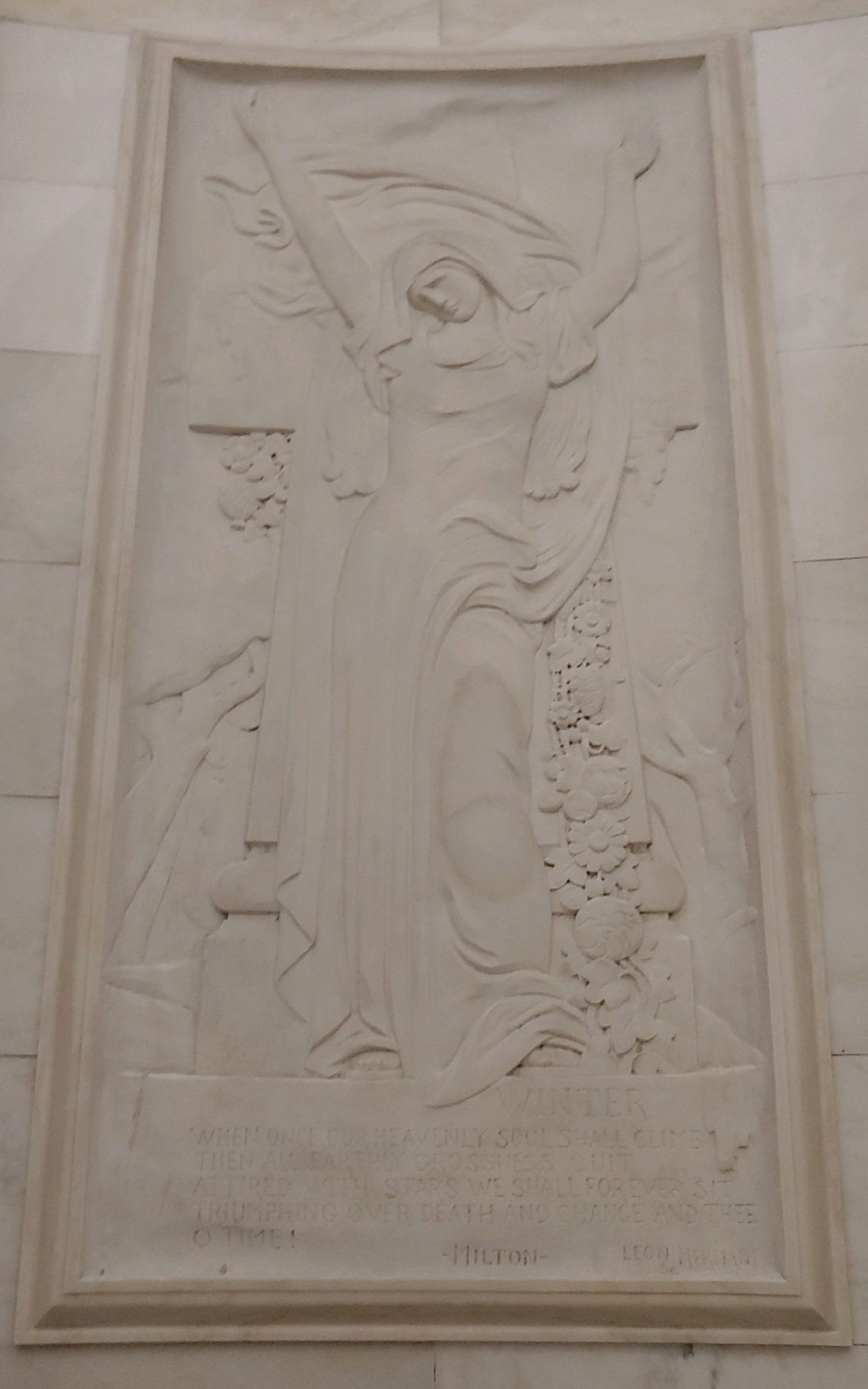
One afternoon recently I was wandering the halls of the Community Mausoleum at Rosehill Cemetery in Chicago.  Although I have been there literally hundreds of times, every time I'm there I see something I hadn't seen or paid attention to before.  In the 1929 Fourth Addition to the mausoleum, where the halls come together is an area covered by a glass dome.  In addition, on the walls there are four very large sculptures representing the four seasons:


Winter

Autumn

Summer

Spring

I stopped and for the first time took a really close look at just how beautiful they are.  Only one of the four, "Winter" is signed:


It is signed "Leon Hermant Sc"

Everyone has heard of noted sculptor Leonard Volk, who is buried at Rosehill.  I even told his story in my blog several years ago:


But Leon Hermant?  Never heard of him.  So I decided he would make a good subject for this blog.  It was easy to find information about his many sculptures, but finding biographical material about him, including where he was buried, turned out to be very difficult.  I am not the only person who has had trouble "digging up" information on Leon Hermant.  This is from a "call with your problems and we'll help you" column from the Chicago Tribune of  05 July 1980 called the "Action Line":


The people at the Action Line were only able to provide a very sketchy biography of Hermant, but this was years before the information explosion caused by the Internet.  So I decided to some "deep digging" and try to find out as much as I could about Rosehill's "forgotten" sculptor, Leon Hermant.

Let's start out with a photo:

Leon Hermant


Isn't this photo wonderful?  Doesn't he look just how you would expect a French sculptor to look?  The only thing he is missing is a beret, but the hat jauntily perched on his head will suffice.

Leon Hermant was born Leon-Theodor Hermant on April 5, 1867 in Marson, France to Eugene Ernest Leonard Hermant (????-1891) and Marie Cedulie Aurelie Prinet (????-1891)  Little else is know about his family, other than the fact that he married Palmyre-Angele Machet on February 2, 1891 when he was twenty-three years old.  The marriage took place in Saint Memmie which is in the Marne region of north-eastern France.  

Palmyre-Angele Machet was born November 6, 1873 in Saint Memmie.  She was the daughter of Sulpice Machet (1843-1899) and Marie Severine Adrienne Remiet (1848-1900).  After her marriage to Hermant, she seemed to fade into obscurity. 

"Leon Hermann" first came to the United States on August 1, 1903, aboard the SS La Couraine, which sailed from Le Havre, France to New York.  Leon listed his occupation as "Artist."  He paid for his own passage, and was bringing more than $50.00 into the country with him.  Interestingly, he also brought a wife "Maria," who was thirty-two years old.  His goal was to be a part of the Louisiana Purchase Exposition, also known as the St. Louis World's Fair which was held from April 30-December 1, 1904.  He must have been successful because he was mentioned in an article in the St. Louis Republic newspaper from January 22, 1904 about the Club Francaise banquet.  The Club Francaise was made up of artists, sculptors and writers who were in St. Louis for the exposition.  

Leon Hermant was also connected with the "Diner Francaise." a bi-weekly dinner for French notables who came to the World's Fair.  

On July 14, 1904, "French Day" at the Fair, Leon Hermant's sculpture of an allegorical representation of the French Republic was unveiled.  The newspapers raved about Hermant's creation.  Unfortunately I have not been able to find a photo of the statue.

In addition to the public adulation, Leon Hermant met someone at the Fair who would be a big part of his life for the next 23 years: Carl Beil (1857-1927).  Beil was also a sculptor, and had been born in Germany.  After he immigrated to the US, Beil served as Superintendent of Sculpture at the Chicago World's Columbian Exposition and later at Fairs in Buffalo and the one Hermant was a part of in St. Louis.  Beil and Hermant hit it off immediately and after the Fair was over, formed their partnership in 1905 which would last until Biel's death in 1927.  Of their partnership, Beil was said to be the businessman, and Hermant the artist.  

The United States was growing by leaps and bounds in this era, and both public and private concerns wanted to add sculptures to their buildings, parks and yes, even cemeteries.  In 1912 the $2,000,000 Adolphus Hotel opened in Dallas, Texas.  It was billed as "the most beautiful building west of Venice."


The beauty of the Adolphus was enhanced by Leon Hermant's sculptures of "Night" and "Morning" on the outside of the fifteenth floor:


On September 9, 1913 Rosehill Cemetery in Chicago proudly announced that Leon Hermant would be contributing his talent to their new community mausoleum:


 Here are Hermant's magnificent sculptures on the outside of the Rosehill Mausoleum:


The 1914 Chicago City Directory showed Leon Hermant living at 4601 S. Calumet Avenue in Chicago.  A house built in 2019 occupies that spot today.  The Directory also noted his work address as "Beil & Hermant, 19 East Pearson in Chicago."  A Loyola University high-rise occupies that spot today.

The Sioux Falls (SD) Argus Leader newspaper reported on July 03, 1918:


The architect for the cathedral was Emmanuel Masqueray, the French architect who previously has designed the Cathedral in St. Paul, Minnesota and served as the chief designer for the building of the Louisiana Purchase Exposition in St. Louis.  Masqueray and Hermant most likely met at the St. Louis Exposition and it was natural for Masqueray to ask his fellow countryman to provide sculptures to decorate the new cathedral.  St. Joseph's Cathedral in Sioux Falls has of course been extensively renovated since it was built in 1918 and it is almost impossible to pick out what still remains from Hermant's original work but I am guessing that these might have have been done by him:


The first time that Leon Hermant participated in the US Census was in 1920.  "Leon Homant" was living with dentist Raymond Prettyman and his wife Louise at 2567 72nd Place in Chicago as a "Roomer."  A house built in 2010 occupies that spot today.  Hermant told the census taker that he was forty-seven years old (he was fifty-three), that he was born in France, that he immigrated the the US in 1905 (it was 1903), and that he had submitted papers to become an American citizen.  He said he could both read and write, and that his mother tongue was French.  He also said he was "Single."  No sign of either Palmyre-Angele or the "Maria" who came with him to the US in 1903.     

It appears that Leon Hermant was a man of many talents.  A May 16, 1922 article about him in the Chicago Tribune calls him a "Parisian Sculptor-Architect" and reported that he had written a play:


In 1924, Hermant was hired to create sculptures for the Delaware Bridge Joint Commission for a new bridge to connect Camden, New Jersey with Philadelphia.  He created four identical bronze statues that once stood on flagpoles at the toll plazas on either end of the Delaware River Bridge, now known as the Benjamin Franklin Bridge. They were installed in 1926 when the bridge opened. According to the sculptor Leon Hermant, they celebrated man’s triumph over nature, referring to the fact that when the bridge opened, it was the longest suspension bridge in the world.

When the roadway was widened after World War II, the flagpoles were removed and the statues banished to storage, where they remained for more than 50 years. The DRPA restored the statues and returned them to public display on July 1, 2001 at the celebration of the Benjamin Franklin Bridge’s 75th anniversary. They are now on view in the lobby of One Port Center, the DRPA’s Camden headquarters:

Winged Victory statues by Leon Hermant on display in the Lobby of One Port Center


In late 1924 it was announced that Hermant had been commissioned to do the work he is most remembered for today - the statue of Louis Pasteur.  The statue was commissioned by the Alliance Francaise and was to be installed in one of the parks or along one of the boulevards in Chicago.  The completed statue was originally installed in Grant Park, but in 1946 it was moved to the grounds of Cook County Hospital in Chicago.  Here is a photo of the unveiling in 1928 in Grant Park:


Here's the statue as it stands today, outside the (Old) Cook County Hospital:


"One doesn't ask of
One who suffers: What
Is your country and
What is your religion?
One merely says, you
Suffer, this is enough
For me.  You belong to
Me and I shall help you."
                Louis Pasteur
 
On May 10, 1927 it was announced that among others, Leon Hermant has been awarded the Cross of the Legion of Honor from the French government.  Hermant received the award as recognition for his body of work, but most of all for his work in creating the Louis Pasteur memorial. 

But Leon Hermant was not just collecting awards in 1927.  He was also awarded the contract to design the statue of George Washington which was to be placed atop the dome of the courthouse in Washington, Pennsylvania.  The following article describes part of the process Hermant went through to design one of his masterpieces.  From the Monongahela (PA) Daily Republican of  June 3, 1927:


And here's the finished product:


In 1928 Leon Hermant was commissioned to sculpt three panels of carved figures to be placed above the ninth floor windows of the new Medinah Athletic Club in Chicago:

  
The panels were designed by George Unger in collaboration with architect Walter W. Ahlschlager but Hermant was chosen to do the actual sculpting.  Here is one of the three panels today:


In addition to his work at the Medinah Athletic Club, Leon Hermant was hired in 1928 to create a sculpture called "To the Heroes of Illinois" which stands at the Memphis (TN) National Cemetery overlooking the graves of  soldiers from Illinois who fought and died for the Union in the Civil War.  The Illinois Monument was dedicated on Memorial Day, 1929.  It consists of a pink and black granite base and sarcophagus, surmounted by a bronze figure of a deceased soldier lying atop a bier. 


On November 3, 1929 the management of Rosehill Cemetery announced that they would be building the fourth addition to their community mausoleum.  In Units 1-3, sales of both the family rooms and the crypts and niches had been brisk.  In fact most of the family rooms in each unit had been sold before the construction of that phase had been completed.

Rosehill had been so pleased with Hermant's work on the outside of the mausoleum that they now asked him to come inside and produce the Four Seasons wall panels mentioned at the beginning of this article.     

Hermant's reputation was such that his contribution to Unit 4 was mentioned in Rosehill's advertisements:


Let's take another look at Hermant's work:


SPRING
Hail bounteous May, that dost inspire
Mirth, and youth and warm desire
Hill and dale dost boast thy blessing
This we salute thee with our early song
and welcome and wishe thee long.
                                          Milton.


SUMMER
But thy eternal summer shall not fade,
........................................                    
So long as men can breathe, or eyes can see,
So long lives this, and this gives life to thee.
                                             Shakespeare


AUTUMN
There is no death! The stars go down
To rise upon some other shore.
And bright in heaven's jeweled crown
They shine for evermore.
..........For all the universe is life...
There are no dead."
                                                   Maeterlink


WINTER
When once our heavenly souls shall climb
Then all earthly grossness quit.
Attired with stars we shall forever sit
Triumphing over death and change and thee
O time!
                                                 -Milton-
Leon Hermant
                                                                                                                     Sc

Here are the sculptures in place:


Another 1929 work of Hermant was in Evanston - the Shakespeare Garden at Northwestern University: 


The 1929 work that Leon Hermant is most famous for, is the work that he did for the Gold Star Mothers to create a memorial to be part of the Illinois Centennial Building in Springfield:


Gold Star Mothers are mothers whose children (male or female) died in defense of the United States. The name of the memorial refers to the Gold Star Mothers Club, formed in the aftermath of World War I. A mother whose child had died in honorable military service while serving during the time of war was permitted to hang in her window a service flag with a gold star emblazoned on it.

Here is the finished product, dedicated December 11, 1930:


As he had ten years previously, Leon Hermant again participated in the US Census.  This time it was for 1930.   He was now living at 619 North Michigan Avenue in Chicago.  A modern high-rise occupies that spot today.  He said he was fifty seven years old (he was 63).  He said that he paid $160.00 per month rent, but he did not live alone.  He had a "Partner," fifty six year old Marius Roussel.  Both men said they were "Single."  Leon Hermant said this time that he immigrated to the US in 1902 (it was 1903), and that he was now a naturalized citizen.  Both men reported their occupation as "Artist" and the industry as "Sculptor."  They did not report owning a radio.  As with wives Palmyre-Angele and "Maria," partner Marius Roussel has faded into obscurity.     

In 1930 Leon Hermant created another unusual sculpture.  He was commissioned to carve a sculpture of a polar bear for the White Chapel Memorial Park in Troy, Michigan.  It guards the graves of  seventy members of the 339th Infantry and 330th Engineers. These were members of Michigan’s Polar Bear Division who made the supreme sacrifice in the far off frozen tundra of northern Russia during World War I. The famed memorial, was carved from a solid block of white Georgia marble. The sculpture was dedicated on Memorial Day, May 30, 1930.  It sits outside White Chapel's community mausoleum:


In 1932 Leon Hermant was commissioned by the Illinois Chapters of Daughters of the American Revolution to create a statue of General George Rogers Clark to be erected in Metropolis, Illinois at the former site of Fort Massac.  Clark was honored for exploring and conquering vast stretches of land North and West of the Ohio River.  The statue stands facing the Ohio River.  Here is the statue when dedicated in 1932:


And here is the statue today:


In 1934 the Indiana Historical Library was built in Indianapolis.  As part of the construction, Leon Hermant was commissioned to create ten sculpted panels in stone, each five feet by eight feet representing Indiana citizens.  They are:  Explorer, Soldier, Pioneer, Farmer, Lawmaker, Miner, Builder, Manufacturer, Educator, and Aspiring Citizen.  I could not find photos of all the panels, but here is a sample:


I have not pictured or even mentioned, all of the sculptures done by Leon Hermant during his career.  He was a prolific sculptor and as his reputation grew, so did the requests for his work.  We will probably never know all of Hermant's work - in addition to his many public monuments he also did sculptures for people to enjoy in their homes.  Wikipedia lists eight public monuments and twelve architectural sculptures created by Hermant;  Artnet lists auction results for five of his non-public works auctioned since 2000. Prabook lists twenty public works attributed to Hermant.  The French Sculpture Census lists fifty-six works of Hermant.  As I said, we will probably never know all of the works sculpted by Leon Hermant.

As shown above, even during the Great Depression Hermant continued to receive commissions for his work.  But, as busy as he was, his age began to catch up with Leon Hermant.  On February 7, 1936 when he was 68 years old (the newspaper said he was 62), the Philadelphia (PA) Inquirer reported the following:


The sad news announcing the death of Leon Hermant was reported in the Chicago Tribune on December 14, 1936:


According to his obituary, he was living at 22 East Ontario Street in Chicago above the L'Aigion Restaurant.  A parking garage occupies that space today.  Here is his Death Certificate:


The Certificate said he died "About December 12."  When his body was discovered it was thought he had been dead for about three days.  Unfortunately most of the spaces on the Death Certificate are filled with "Unknown," but it does say that he died of heart disease.  The Death Certificate lists his age as "about 65"; the newspaper obituary said he was 70; he was actually 69 years old when he died.  

Now the story takes an unexpected turn.  This is from the Montreal (Canada) Gazette from 15 Dec 1936:


Where did all his money go???  Yes, 1936 was in the middle of the Great Depression, but Hermant had worked steadily since he arrived in the US in 1903 - even during the Depression.  He was not married, and had no children, so his money wasn't going to them.  I doubt that the rent was high on an apartment over a restaurant - but all his money was gone.

I saw in the Illinois Death Record that he was interred at Acacia Park Cemetery in Chicago.  I contacted Acacia Park and they told me they had no record of a "Leon Hermant."  I suggested that he may have been cremated at Acacia Park but interred someplace else.  They told me that even if he had just been cremated there, they would have a record, but they did not.

However, after an extensive search they were able to give me the following information:

First, the original paperwork from the county listed him as LEON HERMONT.  

The person or persons in charge of him listed are: The French Council, 909 N. Michigan Ave, Chicago, IL.  

Date of Death - 12/12/1936,  Cremated - 12/16/1936 at 1:00 p.m.

Funeral Home: Shute (Chicago)

Place of Death: 22 E. Ontario Street, Chicago, IL  

Age at time of Death: 65

Friend: Dr. M.M. Reslett, 58 E. Washington Street, Chicago, IL

Dr. Reslett is listed as a friend.  He took the ashes home for a short time and then he also signed an agreement with Acacia Park to have Leon Hermant's ashes "Strewn under the Pines".  

Long story short....Mr. Hermant was scattered under pine trees at Acacia Park Cemetery in Chicago.  Which pine trees?  Unfortunately the records do not say.

So parts of the story of the famous French-American sculptor Leon Hermant will have to remain a mystery.  For example, What happened to his first wife Palmyre-Angele Machet?  His second wife "Maria?"  His "Partner" Marius Roussel?  Why did he die broke and alone?  What happened to all his money?  
  
We may never know the answers to these questions.  We do know, however that Hermant was a gifted sculptor and he left us many examples of his talent to remember him by - especially at the Rosehill Mausoleum.  Lastly, here is a portrait painted of Leon Hermant late in life by noted artist Oskar Gross:


Leon Hermant, noted Chicago sculptor - may he rest in peace "under the pines."


Special thanks to the researcher who was able to "dig up" the details about the disposition of Leon Hermant's remains.