Friday, March 22, 2013

ACROSS THE MILES - William Benezet Bogert

In the old days people either stayed in the same general area where they were born, or they moved half way around the world looking for a better life.  These days it is much more common for people to move around.  Years ago, families bought large cemetery plots figuring that the family would all be buried together.  A perfect example is one of my relatives who bought ten graves in Rosehill Cemetery in 1938.  Four of the graves have been used, but, other than me, there is nobody left in Chicago.  The six remaining graves will probably never be used.  One of the attendants at Rosehill told me that a few years ago Rosehill went searching for heirs to repurchase and resell unused graves, but the task turned out to be almost impossible.

This week I will tell the story of a family, some of whom are buried here in Lake Forest, Illinois, and others in the same immediate family who are buried in Cismont, Virginia.

I have mentioned before that I often search ebay for items pertaining to Evanston, Illinois.  The other night I came upon an unusual item:


The listing said:

Antique Photo - William Benezet Bogert.  One of 77 photos from an album of members of the Class of 1882 of Brown University in Providence, Rhode Island.  I believe the photos were taken in 1878 when the class entered Brown.

William Benezet Bogert, Ph.B., Commission merchant, firm of Wright, Bogert & Co., Chicago, Ill.  Member of Chicago Board of Trade; Committee on Arbitration 1891-1892; Committee of Appeals 1893-1894; Board of Directors 1897-99; Chairman Executive Committee 1898-99.  Address:  1818 Sheridan Road, Evanston, Illinois.

Unfortunately where 1818 Sheridan Road stood is now a vacant lot that is part of Northwestern University:

1818-1820 Sheridan Road, Evanston, Illinois
 
I thought there would probably be an interesting story here and I was right.

William Benezet Bogert was born October 2, 1860 in Providence, Rhode Island.  He was one of four sons born to Theodore Parker Bogert (1830-1885) and his wife Sarah Bull Wilken (1833-1906).  His brothers are Francis Nelson (b. 1855), James (b. 1859) and Theodore Peacock (b. 1862).  William Bogert was a direct descendant of Captain William Jackson who fought in the Revolutionary War in Col. Clinton's New Windsor Regiment.

As we found out from the ebay listing William Bogert graduated from Brown University in 1882 with a Bachelor in Philosophy degree.  According to his obituary, after he graduated from Brown he was in the cotton manufacturing business for three years in Taftville, Connecticut.  In 1885 he relocated to Chicago as a member of the firm of Carington, Patten & Co.  On June 29, 1887, twenty-six year old William Benezet Bogert married twenty-five year old Ella Loomis in Evanston:


They were married at St. Mark's Episcopal Church in Evanston by the rector, The Rev. Richard Haymans.


and by 1890 they were living in their home at 1818 Sheridan Road.

William and Ella had three children:  William Benezet Bogert, Jr. (1888-1930), Theodore Loomis Bogert (1889-1968) and Frances Hoyt Bogert (1892-1985).

Ella Loomis Bogert died on Christmas Day, 1909 in Evanston.


She died from exhaustion caused by empyemia.  Empyema may have a number of causes but is most frequently a complication of pneumonia.

From the Chicago Daily Tribune of December 26, 1909:

BOGERT - Ella Loomis Bogert, wife of William Benezet Bogert, at Evanston, Dec. 25.  Illinois.  Funeral from her late residence, 1818 Sheridan road, Evanston, Tuesday, Dec. 28 at 1:30 p.m.  Interment private.
 
The family decided to buy a cemetery plot in the Lake Forest Cemetery overlooking Lake Michigan and buried Ella there:


Photo: Rommy Lopat

A little more than five years after the death of Ella Bogert, fifty-three year old William Bogert married forty-seven year old Caroline Wood of Louisville, Kentucky on January 7, 1914.  This was Miss Wood's first marriage.

William Bogert retired from his firm Bogert, Maltby & Co. in 1916.  He decided to go back east and he bought a farm on Keswick Road in Abermarle County, Virginia where he lived with his wife and son Theodore, a tobacco broker and daughter Frances, active in relief work during and after World War I.  William Bogert spent his retirement as a breeder of pure-bred Hereford cattle and half-bred hunters, some of which were Madison Square Garden winners.

On February 21, 1930 William Benezet Bogert, Jr died.  He alone of his immediate family still lived in the Midwest.  Since the family had purchased a large plot at Lake Forest Cemetery when Ella died in 1909, it was natural that William Jr. would want to be buried there as well, and he was.

 Photo: Rommy Lopat
Here is the order William Jr's wife put in for his military headstone:


And here is the finished product:

Photo: Rommy Lopat

After the death of William Benezet Bogert, Jr., there were no longer any members of the immediate family living in the Chicago area - they had all reloacted to Virginia.

The next person in the immediate family to die was William Benezet Bogert, Sr's second wife Caroline Wood Bogert, who died February 9, 1947 at the age of  80.  So what to do now? There were still unused graves in the Lake Forest Cemetery in Illinois where his first wife and son are buried, but Caroline had no connection to Illinois - she had been raised in Louisville, Kentucky.  Even though there was a large cemetery plot in Illinois it made no sense to bring Caroline back to Chicago for burial.  William Bogert, Sr. bought another large cemetery plot - this one in the picturesque and historic Grace Episcopal Church Cemetery in Cismont, Virginia. It was here that Caroline Wood Bogert was laid to rest:

Photo: Dylan and Ciana

Here is the plot that William Bogert, Sr. bought in Virginia:

Photo: Dylan and Ciana

The next family member to die was William Bogert, Sr.  He died in the afternoon of  February 21, 1948 at "Ben-Coolyn Farm", his home in Virginia.  He was 87.  His death merited notices both in the New York Times:


and the Chicago Daily Tribune:


Even though the family now owned two large cemetery plots - one in Lake Forest, Illinois and the other in Cismont, Virginia, I am sure they never seriously considered bringing William back to Illinois.  He was buried next to Caroline in the plot in Virginia: 

Photo:  Dylan and Ciana

William and Caroline Bogert were joined by his son Theodore in 1968:

Photo: Dylan and Ciana

Photo: Dylan and Ciana
and his daughter Francis in 1985:

Photo: Dylan and Ciana

So there you have it - a family whose burials are separated by almost 800 miles.  The Bogert family owns a large cemetery plot in Lake Forest, Illinois and at Grace Church, Cismont, Virginia.  It is interesting to note that the Grace Church Cemetery rules are that the ownership of any grave reverts to the church if unused for fifty years.  Secular cemeteries might want to add that to their charters as well.  

May William Benezet Bogert, the Illinois Bogerts, and the Virginia Bogerts, rest in peace.


Friday, March 15, 2013

SHE FOUGHT ROSEHILL CEMETERY AND WON - Mary Hopkinson

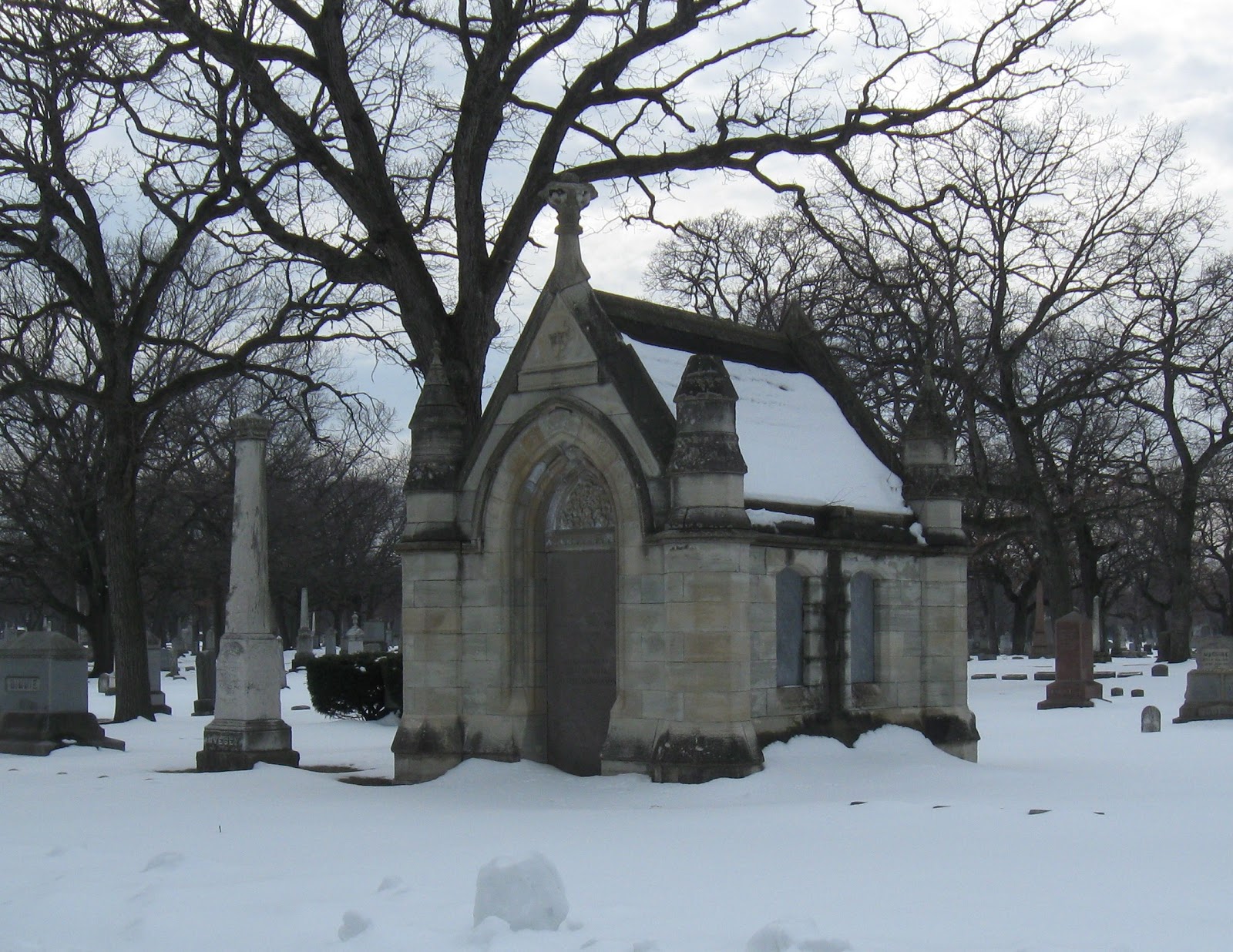
As I have mentioned in previous entries, Rosehill Cemetery in Chicago is a beautiful place.  No matter the season, you can walk the curving roads and see magnificent works of funerary art, many over 100 years old.  If you wandered through Section D, one of the oldest sections of the cemetery, you would come across a beautiful old family mausoleum of yellow stone,


resembling in may ways the entrance of Rosehill itself. 


You would never guess from looking on this peaceful spot just how controversial this family mausoleum was when it was built, and how hard the Rosehill Cemetery Company fought to keep it from being completed.  This is the story which the Chicago Tribune called "Widow Hopkinson Defeats a Cemetery Company."

Charles Hopkinson was born c1826 in Lancashire, England.  On May 10, 1849 when he was twenty-three he came to the United States and settled in Wisconsin.  It was there that he met Mary Hughes, also from England, and they were married on November 4, 1857, in La Salle County, Illinois. 

Charles Hopkinson was a real estate agent.  Before the Great Chicago Fire of 1871, his office was at 128 W. Washington, after the fire, his offices were at 119 Dearborn.  The Hopkinson home was at 451 W. Washington.  By 1876, Hopkinson had made his fortune and retired to enjoy his home and family which consisted of Charles, Mary and their daughter Lillia (b. c1861 in Wisconsin).   

Charles and Mary had heard good things about the "new" Rosehill Cemetery (dedicated July, 1859) and had probably attended funerals there themselves.  To ensure that they would get a choice spot, Charles decided to purchase a lot ahead of need, so on September 5, 1863 Charles purchased Lots 135 and 136 in Section D.   The deed Charles received from Rosehill contained standard language to the effect that no above ground vault or monument could be erected without the prior approval of the Rosehill Cemetery Company. 

Charles Hopkinson died on January 7, 1883.  He was 57 years old.  Shortly after his funeral, his widow Mary appeared at the downtown Chicago office of Rosehill for the purpose of presenting her plans for a family mausoleum for approval.  The secretary referred her to Van H. Higgins as the appropriate officer.  He was, at that time, treasurer and owner of a majority of stock of the company.  After several interviews a time was agreed upon to go to the cemetery.  Higgins, one or two members of the board,  and a landscape gardener for the cemetery, a Mr. Cleveland, met Mrs. Hopkinson at the cemetery.  It was understood and agreed that the plans would be submitted to Mr. Cleveland and that his decision would be final and conclusive.  An examination was made, and Cleveland decided that the erection of a vault on the premises as proposed was unobjectionable.  Then Van H. Higgins, in the presence of several witnesses, told Mrs. Hopkinson that the matter was ended, and Mrs. Hopkinson immediately made arrangements to have construction of the mausoleum started.  The mausoleum itself was said to cost $5,000.00.  After construction had begun, Rosehill ordered it stopped immediately.  Rosehill now objected to the construction of the mausoleum not because of its design, but because of its location.  According to Rosehill, the lot on which Mrs. Hopkinson was proposing to construct the mausoleum was "almost directly opposite, and in sight of the gate (of the cemetery), and that (it) would obstruct the view from said entrance, and disfigure the grounds of said Cemetery." 

Now I am not an attorney, but a quick look at the map of Rosehill will show that it is a stretch to say that the Hopkinson plot was in sight of the gate, and in no way is directly opposite the gate. 


I suppose in 1883 you might have been able to make an argument that the mausoleum could be seen from the front gate, but all these years later, with mature landscaping and scores of monuments in the sightline, it does not stand out at all.

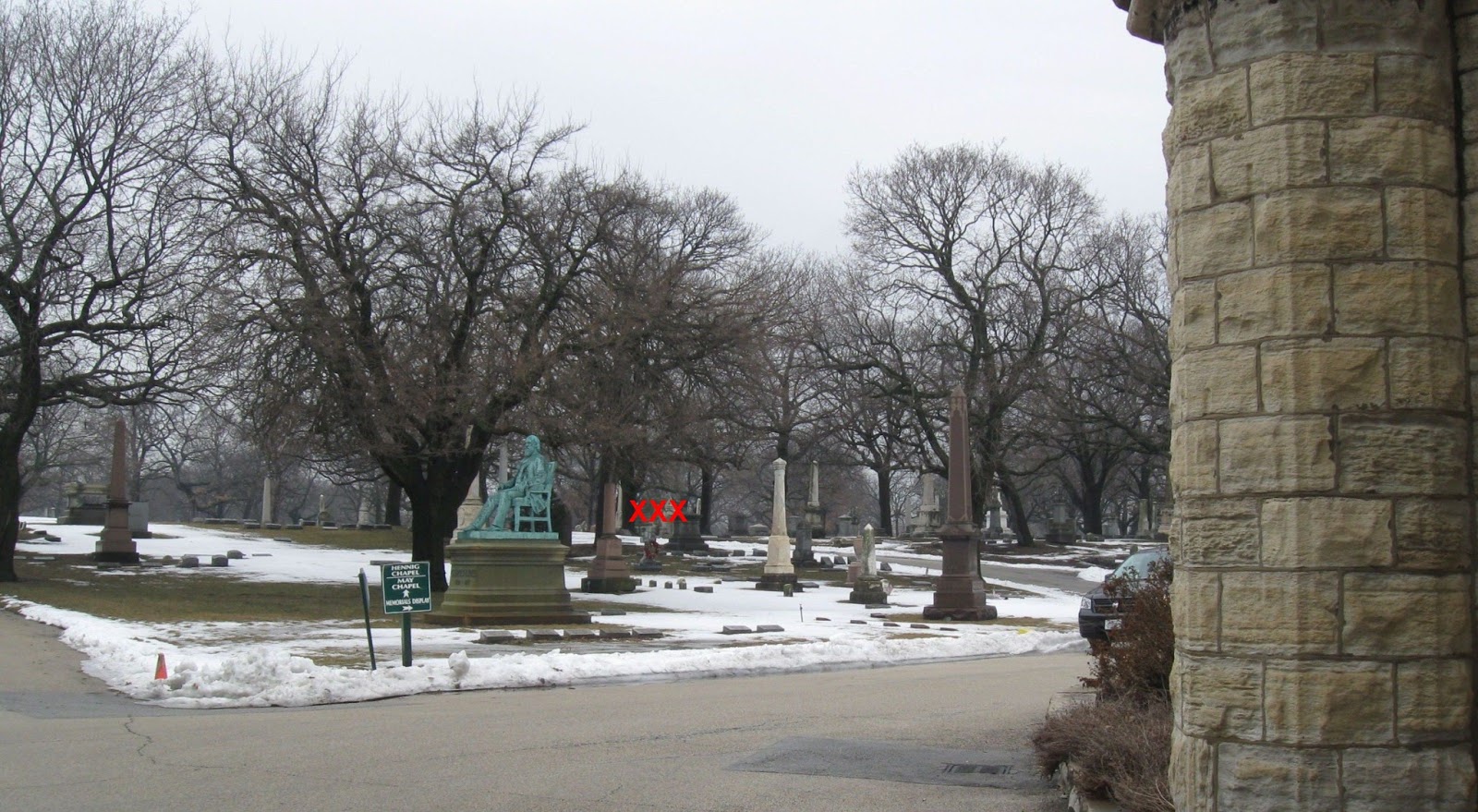
Here is a current view, standing at the Rosehill gate and looking toward the Hopkinson mausoleum:


If you look in the middle of the photo there are three red Xs that mark the Hopkinson mausoleum.  You can barely see it - and this is in winter, with all the leaves off the trees.  In the summer I'm sure you can't see the mausoleum at all.

According to Mrs. Hopkinson's suit, the cemetery's decision was arbitrary, and that there were, in fact, six other vaults near her lot, two of which were owned by Directors of the Rosehill Cemetery Company, and all six, in Mrs. Hopkinson's opinion, were inferior to hers.

Since construction of the mausoleum had been stopped, and in fact, Mrs. Hopkinson herself was barred from the cemetery, she felt her only recourse was in the Courts.  On May 31, 1883, Mrs. Hopkinson's attorney filed suit to force Rosehill to allow the construction of the mausoleum to be completed.  The case was decided in favor of Mrs. Hopkinson.  Rosehill appealed, and the Appellate Court ruled in favor of Mrs. Hopkinson.  Finally Rosehill appealed to the Illinois Supreme Court, who, through a decision rendered by Justice Alfred Craig (no relation) upheld the ruling in favor of Mrs. Hopkinson. 

Here is the article from the Chicago Daily Tribune of May 6, 1884:

GRAVEYARD LAW
Widow Hopkinson Defeats a Cemetery Company

Judge Shepard yesterday decided the case of Mary Hopkinson, executrix of the estate of Charles Hopkinson, deceased, against the Rosehill Cemetery Company.  This was a bill to restrain the company from interfering with her in creating a handsome mausoleum to the memory of her late husband.  The latter died in January, 1883, leaving $2,500 to be devoted to erecting a family vault on his lot in Rosehill, and to this the widow added an equal amount.  He bought the lot in 1863, subject to the restrictions and provisions of the company's charter and all rules and regulations printed on the back of the deed to him.  One of these regulations provided that no vault should be built above ground without the consent of the Company; another that if any lot-owner should erect any structure on any lot which should be decided by a majority of the trustees to be offensive, or improper, or inconsistent with the surrounding lots they should have a right to remove it.

The Judge said the last edition of the rules and regulations was dated Dec, 20, 1880, and it was to be presumed that they were the ones now in force.  they contained, however, a provision requiring that the plan of the mausoleum should be submitted to the trustees, but omitted to forbid, in the case of a failure to submit the plans, the erection of the structure.  Mrs. Hopkinson had been given to understand that her plans were satisfactory, but the committee appointed to examine them reported to the trustees against them after she had commenced work.  It was a question whether a corporation of such ample powers should be allowed to exercise such an arbitrary discrimination in a case of this kind.  No other application had ever been refused, and it appeared the trustees had acted arbitrarily and exercised an unjust discrimination.  A decree, would, therefore, be rendered in Mrs. Hopkinson's favor granting her the injunction asked.

The mausoleum was completed, and Mr. Hopkinson was interred in 1885.


Mary Hopkinson joined her husband in the mausoleum in February of 1904.

     
But that was not the end of the story.  From the Chicago Daily Tribune of  March 7, 1905:

FIGHT OVER $100,000 ESTATE
Relatives of Mrs. Mary Hopkinson Make Charges Against Mrs. Lilla Johnson.

The will of Mrs. Mary Hopkinson, disposing of an estate of $100,000 was attacked in a petition filed yesterday by eight claimants.  Those who signed the petition are Leslie Highes, John Hughes, Elizabeth Smith, Etta Cann, Thomas Hughes, Jane Swering, Sophia June, and Laura Evans, none of whom was mentioned in the will.

Mrs. Lilla Johnson, they say, was with Mrs. Hopkinson a great deal of the time, and a strong influence over her.

Several days after the execution of the will, it is alleged, Mrs. Johnson took the paper from Mrs. Hopkinson, and although Mrs. Hopkinson begged for its return that she might destroy it, and offered a reward for its recovery, she was refused.

The will mentioned Hannah Nims and Ann Jenkins for small amounts, and gave $1,000 to Charles Hess, leaving the remainder of the estate to Mrs. Johnson, in a codicil.

What the article does not mention, of course, is that Lilla Johnson was the daughter of Mary Hopkinson.

Interred in the Hopkinson mausoleum, along with Charles and Mary Hopkinson are two of Mary's siblings, R.E. Hughes and Sarah J. Hughes.  R(ichard) E. Hughes died September 3, 1864 at the age of twenty-one.  He served in the 88th Illinois Regiment.

Sarah J. Hughes, Mary's sister died August 22, 1900.

Also in the mausoleum are Charles and Mary's grandson Charles A. Johnson, Sr. (1892-1965) and his wife Gladys Anita Atkinson Johnson (1902-????).

Lastly, the Hopkinson mausoleum is said to be haunted.  The story is, that because of all the rigamarole over his mausoleum, that Charles Hopkinson, every year on the anniversary of his death, (January 7th) makes his displeasure known by a low moaning and the rattling of chains.  I have never been to the Hopkinson mausoleum on January 7th, but all the times I have been there, Charles, and all the rest of the family, are resting comfortably (and quietly).

This is a story of a woman who had the will (and the money) to fight a major corporation to see that her husband's final wishes were carried out.  I am glad she prevailed.

May Mary Hughes Hopkinson, her husband Charles, and those interred with them, rest in peace. 

Friday, March 8, 2013

THE OTHER FRANKS SON - Jack M. Franks

One year ago in this blog I told the story of  the parents of Nathan F. Leopold, Jr., one-half of the infamous Loeb and Leopold murder team who set out to commit the perfect crime and murdered fourteen-year-old Bobby Franks.  If you are not familiar with the story of Richard Loeb and Nathan F. Leopold, Jr., a very good synopsis can be found in Wikipedia:

I pointed out in the blog entry about the Leopold family that when a heinous crime is committed there are more people who suffer than the victim alone.  The families of the perpetrators suffer untold agonies to be sure, but they pale in comparison to the suffering done by the victim's family. This week we will explore the story of Jack M. Franks, the older brother of murder victim Bobby Franks.

Jack Morris Franks was born May 9, 1908 in Chicago, Illinois to fifty-three year old Jacob Franks, and his thirty-one year old wife Flora nee Griesheimer.


Jacob Franks was born February 17, 1855 in London England to Joseph Franks and Hannah (nee Hart).  Two-year-old Jacob immigrated with his family to the United States in 1857.  In the 1900 Census, Jacob Franks is living in Chicago with his sister Rosina Rubin and her family, and Jacob lists his occupation as "Capitalist".


Flora Grieshimer was born August 15, 1876 in Chicago to Morris (Moritz) Grieshimer and Bertha (nee Dernham).  Later on, the family Americanized their surname to "Gresham".


On February 17, 1906, Jacob Franks' fifty-first birthday, he incorrectly stated his age as forty-seven when he married twenty-eight year old Flora Grieshimer.  They were married by Rabbi Joseph Stolz of Temple Isaiah in Chicago.


When Jacob and Flora Franks had a son in May of  1908 they did not name him after his father directly.  Instead of calling him Jacob Franks, Jr., they decided on the more American sounding "Jack".  Jack Morris Franks was born May 9, 1908 in Chicago, Illinois.


Mr. and Mrs. Franks already had a daughter Josephine Helene Franks, born November 30, 1906.  The ill-fated Robert Emanuel "Bobby" Franks was not born until September 19, 1909.

Jacob Franks was a businessman.  In the 1910 Census he listed his occupation as "Manufacturer of Watches," and he was at that time the president of the Rockford Watch Company in Rockford, Illinois.  The Rockford Watch Company went out of business in 1915, but in the 1920 Census, Jacob Franks still listed his occupation as "Owner Watch Company".

Jack Franks had just celebrated his sixteenth birthday when his brother Bobby was kidnapped on May 21, 1924.


Jack Franks - 1924

We don't know what went through Jack's mind when Bobby did not come home from school as usual but if the Franks family was like most families, the older siblings were expected to look after their younger brothers and sisters.  We can imagine that many times Jack was told "Look out for your brother."  As the hours ticked by on that fateful Wednesday Jack must have wondered just what had happened to Bobby.  According to accounts at the time Jack had even suggested that Bobby may be at the Loeb's house playing tennis, but when someone checked, Bobby was not there.  Both Jack and his sister Josephine had no idea where their little brother was.

Most accounts state that when Loeb and Leopold called the Franks home around 10:30 the night of the 21st, Flora Franks was alone, or (more likely) alone except for a housekeeper.  Jack was not at home when the call came in - he was probably out searching the neighborhood for his lost brother.


We can be sure that Jack was present the next morning when the ransom demand letter came in, and he was probably present later that same day when the call came in from his uncle Edwin Gresham that Bobby's body had been found.


Bobby Franks' funeral was held on Sunday, May 25, 1924 from the Franks home at 5052 S. Ellis Avenue.


5052 S. Ellis Avenue, Chicago

Here is the account from the Chicago Daily Tribune of May 26, 1924:

SIMPLE FUNERAL SERVICE IS HELD FOR FRANKS BOY

“I will lift up mine eyes to the hills” - But her mother heart lay buried behind the marble slab with its words of gold: “1909 - Robert Franks - 1924.”

For yesterday afternoon while police were following every clew that might lead to the capture of the kidnappers who murdered the young son of the millionaire Jacob Franks, a simple funeral service was held at the home at 5052 Ellis avenue.  Then, guarded by six motorcycle police, the body was taken to the Franks mausoleum at Rosehill cemetery.


His Schoolmates Attend.

Only relatives, a few close friends, and twenty of Robert's schoolmates from the Harvard private school were admitted at the house, where grief is mingled with horror and fear - for the life of the daughter Josephine has also been threatened.

The hushed groups here and there did not talk of the tragedy, but their eyes were all fixed on the lodestone of their thoughts, the little white coffin in the library. There before the fireplace where he used to dream, it stood covered with a blanket of crimson rosebuds. The mantel was hidden with crescents of lilies of the  valley and orchids, circles of roses and mignonettes and bouquets of peonies.  Sheaves of lilies and baskets of old fashioned garden flowers banked  the walls.


The service was conducted by Elwood A. Emory, first reader, and Maybelle B. Armstrong, second reader, of the Fifth Church of Christ, Scientist.  The twenty-third Psalm was read and other passages of Scripture, and the Lord‘s Prayer with spiritual interpretation from (Mary Baker Eddy's) Science and Health. Glenn Drake, soloist from the same church sang "Shepherd,  Show  Me  How  to Go”, and “O, Gentle Presence.”


Mother Sits Dazed.

Mrs. Franks, who had been frantic with anxiety since her son’s disappearance last Wednesday, sat in subdued quiet throughout the reading of the words meant for comfort.  She had told her son good-bye alone in the room with him three hours before - and she made no effort  to look again in the flower covered casket.

But as she passed a group of schoolboys clustered on the stairway she paused and ran her hands hungrily over their faces.  Some with the round features of childhood, others slim in adolescence - and four days ago her son had been with them!


Eight of them served as pallbearers:  Maurice Gresham, John Coleman, Justin Cohen, Robert Ascher, Louis New, William Schuyler, Sidney Eppenstein, and Max Welheimer.  As they carried the casket slowly out to the hearse, Mr. and Mrs. Franks and 17 year old daughter Josephine, left by a side entrance to escape the photographers and crowd who had gathered at the front.  They were escorted by one of the guards stationed at the home as a result of threats made since the murder of the boy.  A dozen policemen were in front of the house to regulate the crowd of two or three hundred, who had gathered to see the procession, and the departure was made with quiet dignity.


Flower Strewn Path.

Twenty-five cars carried the friends to the cemetery.  A velvet carpet was laid from the road to the mausoleum, and flowers were strewn on each side.  The crowd separated quietly to make way for the casket - still covered with flowers - and stood with bared heads while it was placed inside.


Mr. Emory again read from the Scriptures, "I lift up mine eyes to the hills", and offered prayers.  Mrs. Franks, assisted by Josephine and her brother, stood for a long time at the door, looking down at the coffin where her boy lay.  Then they put aside the blanket of crimson buds, and placed the slab: 1909 - Robert Franks - 1924.

She trembled, turned away, and went back to the car, where she gave way to her grief in pitiful little moans and sobs.  Her daughter, a pretty dark-eyed girl, tried to comfort her, and so did her husband, though he, too, was on the verge of breaking down.


Slowly the procession turned back to town.


As shown in this photo from the funeral, the Jacob Franks family mausoleum had already been built when Bobby was killed in 1924, although nobody had been interred there yet.  Bobby was the first "occupant".

You may wonder why a couple who had been married in Temple Isaiah had Christian Science Readers conduct their son's funeral. Sometime between 1906 and 1924 the Franks family converted from Judaism to Christian Science.  In the 1910s and 1920s many wealthy society women converted to Christian Science and took their families with them.  Apart from the theological tenets of Christian Science, it was a very appealing faith for women to follow.  Christian Science was a religion founded by a woman (Mary Baker Eddy) and one of the few "mainline" religions that not only allowed female clergy, it encouraged women to follow the call.  In the 1930 Census, Flora Franks listed her occupation as "Christian Science Practitioner."  


But life goes on, even after a tragedy such as this.  It was not enough that Jack Franks had to deal with his brother's murder and funeral, he also had to endure the indignity of the sensational trial of Bobby's killers:  Richard Loeb and Nathan Leopold, Jr.  The trial took place in July, August and September of 1924.  Jack went to court every day, along with other members of his family.  He had to sit just a few feet away from Loeb and Leopold, knowing that they had killed his brother while trying to commit "The Perfect Crime".  He had to witness the emotionally heart-wrenching testimony of both his father and his mother.  He had to listen as the autopsy report of Bobby was read into the court record, with its unemotional description of Bobby's wounds and the fact that Bobby's face and genitals had been darkened and disfigured by the acid put on them by Loeb and Leopold.  Like the other members of the Franks family, Jack had no closure after Bobby's funeral.  All his emotional wounds lay open and exposed day after day and week after week.  Every day the newspapers were filled with lurid photos and stories about the perversions of Loeb and Leopold.  It was impossible to escape.  It is a miracle that none of the Franks family lost their minds, although Flora did suffer from spells of melancholy - but who could blame her.

In researching this story I read the transcript of the trial of Richard Loeb and Nathan Leopold, Jr. for kidnapping and murder.  It is a sordid tale.  If you want to read the trial transcript, you can find it at:  


http://darrow.law.umn.edu/trials.php?

On September 10, 1924 to a packed courthouse that included Jack Franks and his family, Judge John R. Caverly pronounced the sentence on Richard Loeb and Nathan Leopold, Jr.:  The term of their natural lives (for murder) and 99 years (for kidnapping).  Jacob Franks reported at the time that the Franks family had never wanted to see Loeb and Leopold executed for their crime.


In September of 1924 the Franks family moved out of their beautiful home on S. Ellis avenue and into the Drake Hotel on Lake Shore Drive.


Maybe there were just too many reminders of Bobby in the Ellis avenue home.

In the autumn of 1927 to try to put some normalcy back into their lives, Jack and his father took a vacation together to Banff, Alberta, Canada. Jack wrote of the trip in his book Echoes, published by The Lakeside Press, Chicago, 1929.     


It was a limited edition on 1000 copies, each one autographed by Jack M. Franks.  


The first part of the book is entitled "The Echo of a Journey with Jacob Franks" and "Which I dedicate to and write about my beloved father." 


Here is a photo of Jacob in Banff that Jack included in the book:


The second part of the book is original poetry composed by Jack.  He laces his poetry with quotes from "Science and Health with Key to the Scriptures" by Mary Baker Eddy, and from the Christian Science hymnal, and even manages to take a swipe at the practice of medicine.  It seems that Jack had become a willing participant in the Faith of his mother.


If readers expected a tell-all book from Jack, they came away sorely disappointed.  The first part is an ode to his father and the second part is filled with random thoughts and musings.  There is one poem, however called "And Tender Thoughts Flowed On" which Jack wrote "after scrutinizing a tinted picture of my brother:"


Reviews of Echoes were lukewarm.

Jacob Franks died on April 19, 1928 of heart disease.  His death certificate erroneously listed his year of birth as 1857.


He was interred in the Franks family mausoleum in Rosehill Cemetery above the crypt of his son Bobby.


As I mentioned above, the 1930 Census listed Flora Franks' occupation as "Christian Science Practitioner."  Jack listed his occupation as "Freelance Writer."  They paid $750.00 per month for their suite at the Drake Hotel.

On July 21, 1930, Jack accompanied his mother and his sister Josephine (by then Mrs. Richard Glaser) to the laying of a cornerstone for a $100,000 memorial to Bobby Franks, a boys' clubhouse at 3413 W. Thirteenth Place in Chicago.  The funds were left in the will of Jacob Franks to fund a memorial giving "pleasure, help and encouragement to boys as he (Bobby) gave sympathy, consideration and encouragement to his playmates."  Mrs. Franks placed a trowelful of mortar on the cornerstone as it was lowered into place.  The press reported that Jack spoke in place of his mother and he was quoted as saying:  "(Bobby's) death left an aching void in our hearts.  It may help to appease that pain to realize that hundreds of boys will be happy here in this structure built in his memory."  It is interesting to note that the boys clubhouse dedicated to Bobby Franks sits in the heart of the old Jewish neighborhood of Lawndale, off of Douglas Boulevard, and the Tribune noted that the Franks family enlisted the aid of The Young Men's Jewish Charities to help them decide on a suitable memorial. The building is still standing today, and is still a youth center, although it is now dedicated to the Polk Brothers, another Jewish philanthropic family of Chicagoland.        

3413 W. 13th Place, Chicago

The Chicago Daily Tribune of October 7, 1930 announced a happy occasion for the Franks family:


The Franks family and the Florsheim family moved in the same social circles, and Milton and Gertrude Florsheim also lived in the Drake Hotel, so Jack had probably met their Arkansas cousin several times through the years.  There is no record of the marriage in Illinois, so they probably married in Arkansas.

In April of 1933, Flora Franks married widowed Chicago attorney Albert S. Louer.    


The newspapers reported that "Mr. & Mrs. Louer would be staying in her apartments in the Drake Hotel."

Flora's first marriage (to Jacob Franks) was performed by Rabbi Joseph Stolz of Temple Isaiah in Chicago.  For her second marriage (to Albert S. Louer) she chose Dr. Preston Bradley of The Peoples Church in Chicago.  Bradley preached a form of liberal religious humanism that would fit well with Flora's unitarian and Christian Science beliefs.  As far as I could ascertain, Albert Louer remained a practicing Jew all his life.

In 1935, on the eleventh anniversary of the slayings, Jack Franks was asked if he had any opinion as to where or whether Loeb and Leopold should be freed.  He said "I have no feelings of animosity.  It has been hard for the families.  How my family feels about it, I don't know.  We never discuss it.  As far as I am concerned, I just want them to stay out of my life.  They're in another world from me, and I'm not interested in them, that's all."

On June 15, 1937, Flora Grieshimer Franks Louer died of breast cancer at the age of 60.  


Her obituary from the Chicago Tribune is short and to the point:


MRS. ALBERT S. LOUER

Chicago, June 16 (AP). - Mrs. Flora Gresham Louer, mother of Bobby Franks, who was killed in 1924 by Richard Loeb and Nathan Leopold, died last night in her apartment at the Drake Hotel at the age of 60. She had been ill a year.  Her first husband, Jacob Franks, father of Bobby, died several years after the boy's murder.  They had two other children, Jack Franks and Mrs. Josephine Glasser (sic).  Mrs. Franks and Albert S. Louer, retired attorney, were married four years ago.

Flora was laid to rest in the Jacob Franks mausoleum at Rosehill:


The Chicago Daily Tribune from July 12, 1938 brought the surprising news of the sudden death of Jack M. Franks:


BOBBY FRANKS' BROTHER FOUND DEAD IN HOTEL

Jack M. Franks, brother of Bobby Franks who was murdered by Leopold and Loeb, was found dead of a heart attack yesterday in his room at the DeWitt hotel, 244 East Pearson Street.  He was 35 (sic)years old.  His sister, Mrs. Josephine Glaser of New York City, was notified and is on her way here to make funeral arrangements.  He formerly attended the University of Chicago, where he was active in fraternity affairs and a member of the staff of the Daily Maroon, student newspaper.  At the time of his death he was a partner in the firm of Franks & Cooke, real estate dealers at 319 South Clark Street.


Jack died of chronic myocarditis, complicated by epilepsy.  His death certificate states that he had been divorced from his wife Ida. 


He was also interred in the Jacob Franks mausoleum, although across from his parents and Bobby:


There is a postscript to the story from the Chicago Daily Tribune of June 29, 1945:


Josephine Franks Glaser Lederer died October 20, 2007, just short of her 101st birthday.

Bobby Franks was the direct victim of Richard Loeb and Nathan Leopold, Jr., but the other members  of the Franks family were their indirect victims.   Jacob Franks was seventy-three when he died, but Flora was only sixty.  I think it's safe to say that the stress of dealing with the murder of a child probably took some years off their lives - especially Flora.  Jack Franks died of heart trouble when he was only thirty years old.  From the time Jack was sixteen he had to deal with the stress of losing his little brother in a violent and public way.  I am sure that not a day went by where he did not think about Bobby, and I am also sure that every time he met someone new or was in a new situation that the subject came up as well. 

Richard Loeb and Nathan Leopold, Jr. may have killed Bobby Franks directly, but the list of their victims is much longer than that.  When asked, Jack said with his characteristic understatement, "It has been hard for the families."  Bobby Franks' life was taken quickly, but the rest of the Franks family died a little bit every day.

May Jack Morris Franks, and all the Franks family rest in peace.

Friday, March 1, 2013

THE AUNT I NEVER KNEW - Ida Elizabeth "Betty" Craig

Through the years I heard my Dad talking about his sister Betty, who had died at a young age as a result of an accident.  As with most family stories you hear when young, it went in one ear and out the other.  It was not until after my Dad's death and I started getting interested in the family history that I found out the whole story of my Aunt Betty.

Readers of the Lacon, Illinois Home Journal of January 29, 1925 saw the following story:


DEATH VISITS WM. CRAIG HOME
  Betty Craig Dies Tuesday Morning From Injury Caused by Fall  


Tragedy of death and the attendant grief and anguish has cast its gloom into the lives of Mr. and Mrs. William Craig and family and their numerous friends through the loss of their daughter Betty, aged five years.
  
Her death was due to an accident incurred on Wednesday evening, January 21, when she sustained a fall caused by her being brushed by a dog on the sidewalk near her home.  Delmas Pettett, noting her fall, picked her up and carried her into her home.
  
She had apparently suffered only slight injury and no serious development appeared until Friday morning.  Dr. A.W. Bradford was called at that time to attend her.  There seemed to be no cause for alarm and later in the day she recovered almost completely from her mishap.  Within twenty-four hours a critical change had occurred and on Monday, Dr. Cutter, specialist from Peoria, was called.  Accompanied by her mother and aunt, Mrs. Peter Craig, the little girl was taken to Peoria and an operation was performed at the St. Francis hospital at five o’clock p.m. by which it was hoped that a clot on the brain would be removed, relieving her condition.  This operation failed in its desired result and death occurred at eight o’clock Tuesday morning, January 27, 1925.  
  
Ida Elizabeth Craig was born in Lacon, May 1, 1919, and was the youngest child of Mr. and Mrs. William Craig.  On her was lavished the affection of her older brothers and sisters as well as her parents and her sudden removal from the family circle brings intense sorrow.  Only those who have suffered similar loss can realize the extent of their suffering.
  
The sympathy of the entire community goes out to the stricken family and a profusion of flowers surrounding the waxen figure of her who had been joy and sunshine in the home evidenced participation in their sorrow.
  
The family circle which has been broken by the visitation of Death are the parents, Mr. and Mrs. William Craig, brothers and sisters Raphael, Cecil, Donald, Delilah, Marie and Edward.
  
The funeral was held this morning at the Catholic church.  Friends acting as pall bearers were, William Schwartz, Joe Thiedohr, Paul Wenk Jr., and Morris Dunn.
  
Relatives from a distance attending the funeral were Raphael Craig - Chicago, Mr. and Mrs. John Speigel and daughters Cleo and Helen - Davenport, Iowa, Mr. and Mrs. Earl Gapen and son Leo - La Salle, Ill., and Frank Stinger - Magnolia.
  
In the instance of death of this beloved child is emphasized the force of the oft repeated expression, “God moves in a mysterious way, his wonders to perform.”  The stricken family are comforted by their faith in the Omnipotent Father who has taken home a loved one to await their coming.


Betty with her parents, Bill and Ida Craig

Betty is buried along with the other Craigs in the Immaculate Conception Catholic Cemetery in Lacon, Illinois.  Although this blog is called Under Every Tombstone, I can't show you Aunt Betty's tombstone because she doesn't have one.  According to my Aunt Marie who remembered Betty's funeral, Betty is buried by the side of the road next to her parents.

According to Lea Merdian Knoerle, who went to the Lacon High School with my Dad, they postponed the senior class play because it was supposed to be held during the time of Betty's wake and funeral. Here's a photo that Lea gave me from the play:


Lea Merdian Knoerle far left; John C. "Pat" Craig far right

So that's the story of my Aunt Betty Craig, who I never knew but hope to meet someday in a better place.

May Ida Elizabeth "Betty" Craig Rest in Peace.