Friday, October 25, 2013

THE MAN WHO HAD A CHAPEL NAMED FOR HIM - Horatio Nelson May

Anyone who is familiar with Rosehill Cemetery in Chicago has seen the May Chapel.  It is right near the main lake in the center of the cemetery - nestled into a hillside:


Amazing how the color of the stone changes depending on the light.

If you were lucky enough to get a look inside, you could see the following plaque over the door at the back of the room leading to the receiving vault:


A. D. 1899
This Chapel
is
Erected in Memory
of
HORATIO N. MAY
Who Died
September 30, 1898
at Nauheim
Germany

Horatio Nelson May

So, who was Horatio N. May and why is a chapel named for him in Rosehill Cemetery?  Let's find out what we can "dig up" about Horatio May and his wife Anna.

Horatio Nelson May was born in Canada in 1839 to Horatio Nelson May MD (1801-1848), the distinguished physician from St. Armand, Canada, and his wife Sarah, nee Humphreys (1806-1863).  Young Horatio joined his siblings Mary L. (b. 1833), Calvin D. (b. 1835), and Emily E. (b. 1837).  The Mays were direct descendants of Col. Ezra May, a commander of the 2nd MA Regiment in the Revolutionary War.

Horatio's father died in 1848, and the 1850 Census shows the 11 year-old Horatio living with his uncle Ezra May and Aunt Lovisa in Belvidere, Illinois where Ezra listed his occupation as "Merchant."  Horatio first came to Chicago in 1856, and was one of the early settlers who took an active interest in the city's growth and development.  

Soon after his arrival in Chicago he joined the Volunteer Fire Department.  In January of 1860 May was elected the 1st Lieutenant of Fire Company No. 2.  and served until the volunteers were replaced by a paid fire department.

The 1860 Census shows 21 year-old Horatio May living in Chicago's 2nd Ward at the home of Calvin Fitch, Physician, where May listed his occupation as "Clerk".  

In the early days of his business career, May was engaged in the Commission business with John C. Neely, and made his start in a small store on River Street.  Later he became identified with McKindley and Ingraham, grocers.  The Chicago Daily Tribune of March 11, 1864 carried a Notice that Horatio N. May had been admitted as a Partner to McKindley, Ingraham and Company, wholesale grocers.

On August 7, 1882 Horatio Nelson May married Miss Anna Lush Wilson in Chicago:


Anna Lush Wilson was born on November 20, 1849 in Chicago to the well-known Chicago pioneer and newspaper editor John Lush Wilson (1812-1888) and Mary, nee Whipple (1823-1868).  Anna had six sisters: Laura (1845-1876), Caroline Gilbert (1848-1912), Alice (1855-1863), Mary Blackstone (1857-1927), Gertrude Quintard (1859-1943), and Frances H. (1863-1950) and one brother Richard L. Wilson (1851-1937) 

On December 1, 1886, Horatio N. May joined C.B. Farwell, Joseph Stockton, and Andrew E. Leicht in being appointed Lincoln Park Commissioners.

Lincoln Park Commissioner Horatio N. May

From the very beginning of their marriage, Anna Wilson May used her social position and her money for the betterment of Chicago.  Mrs. May was also quite the innovative thinker and planner.  She lived north of the river on Astor Street and all of her shopping was done south of the river in the central retail district.  The bridges crossing the river were ugly and crowded and Anna had an idea that there was a better way to traverse the dividing waterway by building a boulevard that would travel under the river bed.  As early as November of 1890, Mrs. May was speaking out for a tunnel from Ohio street to Monroe street, effectively linking the North Side to the Loop, tunneling under the Chicago River.  

Chicago Mayor DeWitt Cregier had proposed building an expansive bridge at a wide point in the river connecting Michigan Avenue with the north side at a cost of $5,000,000.  Anna believed the bridge idea was old school and proposed constructing a 50-foot-wide, 3,200-foot-long, slowly-receding, road and pedestrian boulevard tunnel just east of today's Rush Street, that would burrow under the river and rise again on Michigan Avenue at Randolph Street.  She hired noted architect Joseph Silsbee to work with her on the plan which included Corinthian-capped columns supports, white glazed tile walls and electric lighting, all coming in at a much less costly $1,500,000.  Not only did Mrs. May want the tunnel, she proposed it be done in time for the World's Columbian Exposition in 1892 - and she had a name:  "The Columbian Tunnel." Mrs. May also suggested that the tunnel be financed with a bond issue, which bonds would, she said, immediately be snapped up by her and her friends.  Unfortunately Mrs. May's great tunnel project never got off (or under) the ground.

The municipal election of April 1891 brought a new mayor to Chicago, Hempstead Washburne, and with him, a new city Controller:  Horatio N. May.

Chicago City Controller, Horatio N. May

At the time of May's appointment, the Chicago Daily Tribune said:  "...It is only necessary to say that Mr. May, named for the Controller, is a member of the firm of Corbin, May & Co., wholesale tea merchants.  He is a director of one of the national banks and proprietor of the Commercial Hotel Building.  In later years, Mayor Washburne was quoted as saying, "(May) took control of the Controller's Office when the City was in financial straits, and systemized the office and carried the government through in first-class shape.  The City's finances were in good shape at the close of my administration, and this was due to Mr. May's careful and able management."    

While City Controller, May also retained his position on the Lincoln Park Board.  The Tribune said: "In the growth of Lincoln Park (May's) hand was to be plainly seen.  He wanted to make it the most beautiful park in the world.  When the park was in its infancy he was always planning for improvements.  He spent a great deal of time in the park, and was instrumental in the development of the beach drive which has become such a striking feature of the park."  Although Horatio May lost his Controller's job when Mayor Washburne was voted out of office in 1893 (in those days, Chicago mayors were only elected for two-year terms), he retained his Lincoln Park Commissioner position until his death.

Horatio N. May died on October 1, 1898 in Bad Nauheim, Germany. He had a bad case of  "La Grippe" (what we would now call the flu) in the Spring of 1898.  As the year continued he was unable to shake off the illness, so on July 28, 1898 he left Chicago for Bad Nauheim, Germany. Bad Nauheim  is a world-famous resort, noted for its salt springs, which are used to treat heart and nerve diseases.  A Nauheim or "effervescent" bath, named after Bad Nauheim, is a type of spa bath through which carbon dioxide is bubbled.  In September May was said to be doing better, and Mrs. May had written to relatives that her husband was doing so well that they would probably soon be returning to Chicago.  Then on October 1, May's business partner Calvin Corbin received a terse cable from Mrs. May reporting her husband's death and that funeral arrangements would be cabled later.  Mrs. May asked Corbin to inform May's two sisters in Canada of his passing.

Here is the official notice of Horatio May's death outside the United States:


Here's Horatio N. May's obituary from the New York Times of October 2, 1898:


After May's death, Anna Wilson May immediately made arrangements to return to Chicago with her husband's body.  The funeral was held October 17, 1898:


Readers of this blog will be interested to see that David B. Forgan was one of May's honorary pallbearers, as was Abraham Lincoln's son, Robert Todd Lincoln. 


After her husband's death and funeral, Anna Wilson May wanted to leave a perpetual memorial to her husband that was more than an elaborate tombstone.  Because of the great love both she and her husband had for Chicago she wanted to leave a memorial that could be used and enjoyed by Chicagoans for years to come.  But what to do?

Mrs. May was already familiar with the life and works of noted architect Joseph Lyman Silsbee (1848-1913),


and in fact, the May's had hired Silsbee to design their home at 147 (now 1443 N.) Astor Street.

Horatio and Anna May Home, 1443 N. Astor Street, Chicago

After consultation with Silsbee, Anna May decided on a memorial chapel to honor her husband in Rosehill Cemetery that would be designed by Silsbee.  This is from the Chicago Daily Tribune of June 14, 1899:


Construction of the chapel had been scheduled for the summer of 1899, but there were delays, and the Chicago Daily Tribune carried an article on September 17th that the cornerstone would be laid the next day:


The Tribune, in an article titled "Costly Tombs of the Rich" from August 19, 1900 gave the final specifics of the May Chapel:

"A memorial chapel and mausoleum dedicated to the memory of the late Horatio N. May was recently erected in Rosehill Cemetery, Chicago, at a cost of $30,000.00.  It is built of light-colored granite, and in general dimensions is 35 x 70 feet.  There is a carriage porch extending the full width of the front, so that entrance and exit may be had in stormy weather without discomfort.  Immediately inside the entrance are robing rooms, with stairrooms on either side.  The nave contains all the seats except those formed by the gallery.  At the rear is the opening to the receiving vault.  The roof is of oak, with hammer-beam trusses and curved brackets.  The floor is of mosaic, and the walls are of fine terra cotta material." 


Most people who have been to Rosehill Cemetery are familiar with the outside of the May Chapel, but few people have ever been inside it. The chapel is kept locked as a rule, and the cemetery uses the Hennig Chapel in the mausoleum for services these days as opposed to the May Chapel.  When my aunt died in 2004, we had to specifically ask for the May Chapel for her service.  I didn't even think to take pictures at that time; however, now I am going to take you inside the Horatio N. May Memorial Chapel now so you can see its beauty for yourself:


Photo by Doug McGoldrick Photography

Photo by Doug McGoldrick Photography

Photo by Doug McGoldrick Photography

Photo by Doug McGoldrick Photography


Photo by Doug McGoldrick Photography

Photo by Doug McGoldrick Photography


Mosaic tile on ceiling of carriage porch

In the back of the chapel is the Receiving Vault for Rosehill.  In the old days, bodies were stored here when the ground was too frozen to dig graves, or when a family mausoleum was being built but had not been completed in time to receive the remains.  It was also used to house bodies when the Rosehill Community Mausoleum was being built, so that people who had purchased space in the yet-to-be-completed mausoleum would not have to go through reinterment.


Photo by Lenka Reznicek

Photo by Lenka Reznicek


Anna Wilson May died on March 20, 1907 of cancer in Chicago.

Anna Wilson May


Here is her obituary from the Chicago Daily Tribune:


She is buried next to her husband, and the chapel she built as a memorial to her husband at Rosehill Cemetery.

Several people have indicated that the May Chapel was also a mausoleum, and that Horatio and Anna May were interred there.  That is incorrect.  Horatio and Anna May are interred under a simple concrete slab to the right of the carriage porch as you face the front door:

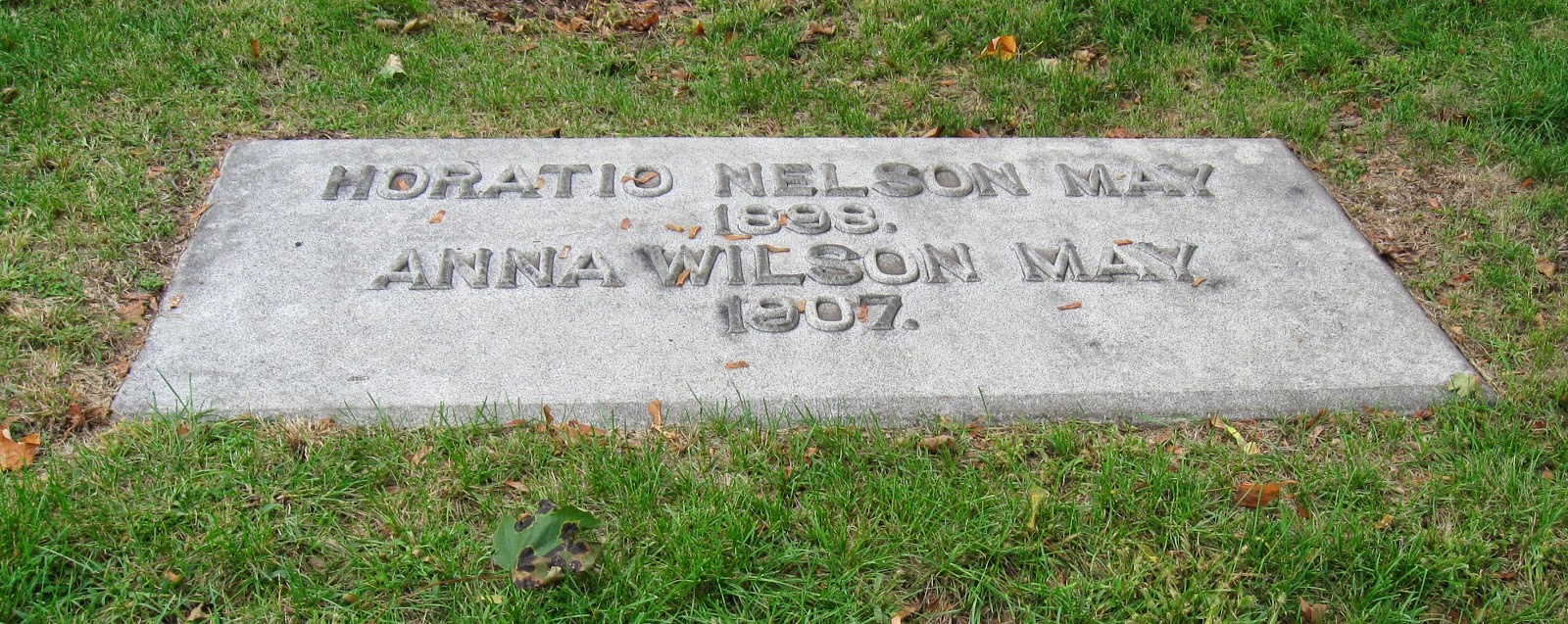


So, now you know the story of the chapel Anna Wilson May built as a memorial to her late husband, Horatio Nelson May - and you have been able to see the inside of this Silsbee-created jewel for yourself. What a wonderful memorial to Mrs. May's husband, and what a wonderful gift to us to still be enjoying over 100 years later.

Photo by Karen Gordon


Photo by Tim Nafziger


Horatio Nelson May and Anna Wilson May - may they rest in peace.


Acknowledgements:  It is almost impossible to find photos of the inside of the May Chapel.  In my research I was very lucky to come upon the work of Doug McGoldrick, of Doug McGoldrick Photography in Chicago. Doug was hired to photograph a wedding in the May Chapel in October of 2007.  He very graciously allowed me to use his fantastic photos for this article. Please check out his website:  www.dougphoto.com 

Also a thank you to Karen Gordon for graciously allowing me to use her wonderful photograph of the May Chapel in the snow.  Check out her website for some other fantastic photos:  www.kalenagphotography.com 

And another thank you to Tim Nafziger, who graciously allowed me to use his dramatic photo of the May Chapel at sunset.  Check out his website:   www.timnafziger.com

And yet another thank you - to Lenka Reznicek, who graciously allowed me to use her photos of the Rosehill Receiving Vault.

Any photos not taken by Doug, Karen, Tim, or Lenka are from the author's collection.

Friday, October 18, 2013

HE BROUGHT YIDDISH THEATRE TO CHICAGO - Ellis F. Glickman

On a recent Sunday trip to Jewish Waldheim Cemetery, I had a page of Find a Grave photo requests.  One of these requests took me to Gate 9 - Anshe Maariv.  While looking for the grave I was supposed to photograph, I saw an interesting gravestone:


The gravestone for Ellis and Ray Glickman was carved to look as if it had a stage curtain over it, and in the middle, the masks of tragedy and comedy that have symbolized the theatre for centuries.  I figured there would be an interesting theatre-related story under this stone and I was right.

Ellis Glickman is the man credited with bringing Yiddish Theatre to Chicago.  But let's start back at the beginning, as we tell our tale of the theatre.


Ellis Glickman was born Elias Glickman in April of 1870 in Zsitomir  Russia.  His father's name was Fischl Glickman.  I could not find out his mother's name, but I did find that he had a brother, Phillip (1859-????).

Ellis began his career on the stage with Jacob Adler in London in 1887. After some disappointments, he decided to come to America, which he did in 1888. In the United States he made his debut in Troy, New York, in Goldfaden's comedy, "Kuni-Lemels". He then went on tour in Yiddish plays, and in 1890 was well received in Chicago.


Because of his warm reception, he realized that there was a great need for Yiddish theatre in Chicago that was being largely ignored. He decided to fill that void, and early in the 1890s he relocated to Chicago for the express purpose of establishing Yiddish theatre here. He became a naturalized U.S. citizen on December 8, 1893 in Chicago.


The first Yiddish stock company he organized here was established in Metropolitan Hall at Jefferson and O'Brien streets in 1894. 

On New Years Eve 1895 Ellis Glickman married Miss Ray Lipsitz (1875-1935) in Chicago.


Glickman's hunch was correct - there was a market for Yiddish theatre in Chicago.  Within two years he had outgrown the Metropolitan Hall, and he moved to the larger Lyceum Theater.


The 1900 Census shows the Glickman family living at 329 14th Street in Chicago.  There is 30 year-old Ellis who lists his profession as "Performer", wife Ray, son Mortimer (born December, 1898), Ellis' brother Phillip (who lists his occupation as "Nothing"), and Ray's mother Bluma Lipshitz.  Chicago changed its address numbering system in 1909.  329 14th Street (old) converts to 932 West 14th Street (new).  A parking lot now sits at 932 W. 14th Street.    


One of the ways Ellis Glickman made theatre classics appealing to his Yiddish audience was to change the play to make it more "Jewish". For example, here's an excerpt from the Chicago Daily Tribune's February 28, 1903 review of Glickman's adaptation of "Uncle Tom's Cabin":


JEWISH ACTORS PRESENT "UNCLE TOM'S CABIN" IN YIDDISH TO A GHETTO AUDIENCE AT GLICKMAN'S THEATER.

MEMBERS of one persecuted race portrayed the wrongs of another last night when "Uncle Tom's Cabin" was presented in Yiddish at Glickman's Jewish theater, 56 Suth Desplaines street. While the audience hissed, an exiled Russian Jew, Ellis F. Glickman, as a burnt cork Uncle Tom bent beneath the lash of Simon Legree and pleaded for deliverance.


Eliza and Harris, appearing more like new arrivals at Castle Garden than southern slaves, told their sufferings in a mixture of German, Arabic, and English; Aunt Ophelia made her "how shiftless" quite as effective in its strange rendering, and when Uncle Tom took little Eva upon his knee to tell her of the angels in heaven it was from the Talmud that he read.


It was, in short, an Uncle Tom of the Ghetto—a curious mélange of character interpretations, all breathing the atmosphere of the west side Babel. Jacob Frank as Marks was a typical "shyster" lawyer of the police court, Mrs. St. Clair presented the startling apparition of a Levantine beauty in hoopskirts, while little Eva was a pretty child of an oriental cast of features with golden curls and wearing a starched frock.


It was odd to see the Israelitish countenance shining through the burnt cork of the negro or adorned with the rakish mustache of the revolver firing, whip cracking slave owner—odd to find the wide verandas of the southern mansion filled with types of Chicago's foreign population, and stranger still to hear the plantation songs sung to Hebrew melodies.


Mr. Glickman made a better Uncle Tom than is seen in many an American company in tent or theater. He was well made up as a venerable, solemn, kind hearted family slave, and he adapted the sonorous Yiddish lines to the character in an admirable manner. In the slave auction, the bondage under Legree, and the death of Little Eva, Mr. Glickman's acting was distinguished by a taste too often lacking in the companies where the play is not such a stranger.

Even Shakespeare was not "sacred" to Glickman.  Here's an article from the Tribune on February 16, 1903 where it talks about Glickman "re-writing" Hamlet:


Capitalizing on the success he had in Chicago, Glickman took his Yiddish stock company on the road in 1903, touring the United States to great acclaim.  He had the misfortune to be in San Francisco in April, 1906 during the great earthquake and fire and lost everything he had there in the conflagration.  


Glickman returned to Chicago and in August of 1907 the Tribune noted that Glickman had opened a completely renovated International Theater:


While operating the International Theater, Glickman tried a well-publicized experiment, using nine girl ushers in place of the customary males.  Unfortunately, this experiment failed miserably when he asked one what she would do to aid the patrons in case of fire in the theatre and she replied "I'd run like hell."  

The December 30, 1903 Iroquois Theater fire in Chicago caused the city to dramatically tighten its fire regulations for theatres.  This caused the doom of the International Theatre as reported by the Chicago Daily Tribune on April 20, 1909:


THEATER ADMITS VIOLATING LAWS
International "Caught With Goods" Having Three Sets of Movable Scenery; Is Allowed None.
New York Pull Alleged.
"Big Tim" Sullivan Said to Have Helped Local Managers Take Chance In Violation of Ordinances.

With the memorial roll of 600 men, women, and children who died in the Iroquis fire still before Chicagoans, the management of the International theatre, 401 Wabash avenue has "taken a chance" by deliberately using movable scenery in defiance of the city ordinance that provides that, as a Class 4 theater, it is subject to immediate closure by the police if other than stationary scenery is used.

Following discovery of the unlawful practices, and a warning to mend their ways, the managers presented the show within three hours at night with movable scenery.  Chief of Police Shippy, before this last violation occurred, had stated that he would confer with Fire Chief Horan this morning, and that the theater might lose its license.

Admit They Are Violators.

A reporter for the Tribune caught the theater people "with the goods" yesterday afternoon and secured an admission of guilt.  Fred W. Busey, representative of the show, did the admitting after the reporter and Building Inspector E.F. Kelling had counted three sets of movable scenery stacked on the stage.  he also admitted that under date of April 10 he received a communication addressed to himself, and Ellis Glickman, manager of the theater, stating that the place would be closed if other than stationary scenery was used.

Lastly, he admitted being a good friend of "Big Tim" Sullivan of New York, whose arm was rumored to have reached to Chicago to help out himself and "Al" Woods.

Denies "Pull" From New York

That "Big Tim" figured in the violation of the ordinance, without let or hindrance was denied by Busey.  He maintained humbly that the ordinance and the written orders of the building and fire department heads were disregarded simply in the hope that the disregarders would not be caught.  What the fireman on duty at the theater was doing instead of reporting the use of movable scenery Busey failed to explain.  He simply followed the usual course of violators of the theater ordinance by promising to be good when caught.

The reporter gave his information about the International to Building Commissioner Campbell, who promptly said that if the law was being violated he did not know how it came about.

"I will have it looked up and give you a full report on it tomorrow," said the commissioner.  Fire Marshall Horan and I gave strict orders to respect the ordinance.

The reporter requested the assignment of Inspector Kelling to accompany him on a tour of investigation at once and the commissioner agreed to the proposition.  First, however, Inspector Kelling displayed the files.

Letter to Theater Managers.

One letter, under date of April 8, addressed to the managers, contained instructions regarding the theater, in certain specific details which apparently were complied with.  Another under date of April 10 was as follows:  
"Ellis Glickman and Fred W. Busey, Managers International theater:

"You are hereby notified as managers of the International theater, Wabash avenue and Hubbard court, that a license has been granted to operate said theater as a Class 4 theater restricted to stationary scenery only.  If movable scenery is used the house will be ordered closed.
"Murdock Campbell
Building Commissioner.

"James Horan
Fire Marshall"

Under the same date, the following letter was sent to the Chief of Police:

"George M. Shippy:
"Dear sir - Please allow International Theater, Wabash avenue and Hubbard court, to open as a Class 4 house only.  If movable scenery is used, close the theater."

The letter was signed by Commissioner Campbell and Marshall Horan.

Hard to Find Managers.

When the theater was visited there was difficulty in finding responsible persons to talk about the scenery.  A man was discerned walking off the stage rather hurriedly.

"There goes Mr. Busey, said one of the stage hands."

"Well, he'll have to walk chalk," observed Inspector Kelling, starting for him.  

"Didn't you get the orders of the department saying you couldn't use movable scenery and telling you that if you did we would close the house?" asked the inspector.

"Well, we're not using all of it now," replied Mr. Busey.

"But why have you been violating the law at all by using moving scenery?" asked the reporter.

"We just took a chance", admitted Mr. Busey.

"I won't be down here tonight, but I will tomorrow night and if I find movable scenery being used, I will close you up," asserted Mr. Kelling. "I'm going to make a report to the Building Commissioner tomorrow, anyhow.  It will rest with him as to what action to take respecting past violations."

Chief Shippy was wroth when he heard of the discovery of the afternoon.

"I shall see Fire Chief Horan the first thing in the morning and go into this matter," he said.  "I had the place visited to see if there was anything immoral going on, but I had no reports about the scenery.

"I intend to have men watch this theater, but it may be that the violations that have occurred already will warrant taking away the license of the place.  The use of movable scenery should have been reported long ago, and I will try to find out why it wasn't done."        

Even though Glickman tried to use his considerable clout, he was unable to get the International reopened.   He decided he had had enough of Chicago, and the 1910 Census shows the Glickman family living in New York, at 246 38th Street.


246 W. 38th Street, New York City

Ellis listed his occupation as "Theater Manager" and the family had another addition:  another son, Frederick, who was born in 1904.

New York was not able to hold on to Glickman, and The Economist of May 18, 1912 carried the following item:

White and Tabor have negotiated a ten year lease west of the river as follows:  To Ellis F. Glickman, the Bijou Theatre property at the southwest corner of Halsted street and Jackson boulevard, at an aggregate rental of $130,000.00.  The lease will remodel the theater at a cost of $15,000.00 and (Glickman) plans to make it the foremost Jewish playhouse in the west.

It was during this period in New York that Ellis Glickman decided to try his hand at the new medium of motion pictures.  He signed up as an actor to work on an occasional basis with Thanhouser in 1914 and 1915. His first appearance was in "Repentance". The New York Dramatic Mirror, May 27, 1914, told of his debut with Thanhouser:

Charles J. Hite, president of the Thanhouser Film Corporation, has made it possible for Ellis F. Glickman, the Jewish character actor, to be seen in silent drama.  There has just been produced at the New Rochelle studio a four-reel picture by Mr. Glickman, called "The Last Concert."  Mr. Glickman has played more than 800 character parts on the speaking stage, being at one time leading man for Bertha Kalich.  The Last Concert is Mr. Glickman's second appearance in the silent drama, his previous story being "Repentance."  Minnie Berlin plays opposite Mr. Glickman, being supportive in a cast headed by Nolan Gane, Thanhouser's juvenile.

The Last Concert was not released until nearly a year later, on May 3, 1915.

In addition to the newly-renovated Bijou, another theater was opened at 12th street and Blue Island avenue as "Glickman's Palace Theatre".


The 1920 Census had the Glickman family living at 3234 Douglas Boulevard, in the heart of the Jewish neighborhood of that era:


3234 Douglas Boulevard, Chicago

Ellis lists himself as a "Theater Manager".  His wife Ray and son Fred are with him - Mortimer must have moved out on his own.  However Ray's mother Bluma has rejoined the Glickmans.

Ellis Glickman was managing three Yiddish theaters in Chicago in the 1920s.  As the 1920s came to a close, Glickman was mostly managing the theatres, and occasionally still producing shows.  However, he was still writing plays as well.  On May 16, 1929 he copyrighted a story called "A Regular Woman" - a drama in 3 acts.  The copyright entry notes that it is "an unpublished work."


In the late 1920s, Ellis and Ray Glickman moved again - this time to an apartment at 939 W. Windsor Avenue in Chicago:


939 W. Windsor Avenue, Chicago

The 1930 Census has the Glickmans still at 939 W. Windsor.  It listed 58 year old Ellis, a "Theatre Performer", his wife Ray, eight year-old grandson Bert, and a live-in maid.  It also reported that the Glickmans owned the building on Windsor, and assigned it a value of $30,000.00 - and they did own a radio..

Ellis F. Glickman died in Columbus Hospital on October 3, 1931 of  heart disease.  he was "about 62 years old."


He was buried at Gate 9 - Anshe Maariv Cemetery, part of Jewish Waldheim Cemetery in Forest Park, Illinois, Row 32, Lot 2.  Here's his obituary from the Chicago Daily Tribune of October 4, 1931:


His beloved Ray followed him on February 13, 1935.  Here's her obituary:


Ray Glickman

She is buried next to her husband.

It is said "Choose a job you love, and you'll never have to work a day in your life".  I think we can safely say that Ellis F. Glickman never worked a day in his life.


Ellis F. Glickman

May he rest in peace.

Friday, October 11, 2013

HE CHANGED THE COURSE OF U.S. HISTORY - Jack Ruby

Westlawn Jewish Cemetery in Norridge, Illinois is a beautiful, peaceful place.  Anyone visiting Westlawn would certainly notice the quiet, occasionally broken by the chanting of mourners at graveside services. Were you to walk among the flat gravestones in the Violet section of Westlawn, you would never guess that someone buried there literally, and some say single-handedly, changed the course of U.S. history. Who is it that is the most famous, or infamous, permanent resident of Westlawn Cemetery?


Jack Ruby - the man who killed Lee Harvey Oswald, the assassin of President John F. Kennedy, on live television.


The defining moment for my generation was the assassination of President John F. Kennedy.  Ask anyone who was alive back then where they were when they heard the news and they will be able to tell you - in minute detail.  Being part Irish, my family LOVED President Kennedy and so we were riveted to our (black and white) television to watch the coverage of the aftermath of the assassination and the funeral of the president. We were watching on Sunday, November 24, 1963 as JFK's assassin, Lee Harvey Oswald was being transferred from the Dallas police station to the county lockup.  And we watched live as Oswald was himself assassinated by Jack Ruby.  Just who was Jack Ruby? Let's see what we can "dig up" about Westlawn Cemetery's most infamous resident.

Jacob Leon Rubenstein was born March 25, 1911 in Chicago to Joseph Rubenstein (1871–1958) and Fannie Turek Rutkowski (1875-1944), both Polish-born, Orthodox Jews.  The 1920 Census has the Rubenstein family living at 1232 S. Morgan Street in the midst of the Jewish immigrant enclave in Chicago. Unfortunately, 1232 S. Morgan is now a vacant lot.  Jacob joined his siblings Hyman (1901-1970), Anna (1903-1985), Marion/Mary (1906-1995), Eva (1909-1992), Sam (1912-????), Eael/Isadore (1915-2006) and Ida/Eileen (1917-2000).  The Rubenstein family had come to the US in 1903.  Joseph Rubenstein was a carpenter, and the language spoken at home was Yiddish.  

On June 6, 1922 when Jack was 11 years old, he had his first brush with the law when he was arrested for truancy.  By his own admission he spent more time at the racetrack than he did in school.   Young Rubenstein sold horse-racing tip sheets and various other novelties, then acted as business agent for a local refuse collectors union that later became part of the International Brotherhood of Teamsters.

The 1930 Census shows some upheaval in the Rubenstein family. Jack's father Joseph, and his brother Samuel moved out to 1355 Peoria Street.  Joseph indicated his marital status as "Divorced". Unfortunately, 1355 Peoria Street no longer exists, either.  Jack was living with the rest of the family at 739 S. Kostner, where Hyman, his oldest brother was listed as the Head of Household.  On the 1930 Census, 19 year old Jack was listed as not having an occupation. Hyman was listed as a securities salesman, and Marion was listed as a mimeographer for a bond house.  Jack's mother Fannie listed her marital status as "Married".  As with so many properties in the old Jewish neighborhood, 739 S. Kostner is a vacant lot as well.

Jack Rubenstein's first mention in the Chicago Daily Tribune came on July 2, 1933:


Jack's address in 1933 was 1222 N. Sawyer Avenue in Chicago.  A factory now stands at 1222 N. Sawyer.  Interesting that Jack added four years to his age to make him 26 when he was really only 22, and that, as the article said, he had from 300 to 500 peddlers selling the coupons!

Rubenstein and Leon R. Cooke, an attorney, organized the Waste Material Handlers Federal Labor Union in 1937.  Cooke was shot to death two years later.


There must have been a reconciliation in the Rubenstein family, because the 1940 Census shows the whole family living back together at 624 Independence Boulevard.

624 Independence Boulevard, Chicago

29 year old Jack listed his occupation as Secretary of a Union.

In fact, early in 1940, Jack, who was then known as "Sparky" Rubenstein lost his union position after Paul Dorfman, a close friend of Jimmy Hoffa, took over the union.   He received the nickname "Sparky" from his boxing nickname "Sparkling Ruby."

Although Jack's older brother Hyman enlisted in the Service in World War II, Jack did not enter until he was drafted in 1943.  He served in the Army Air Forces, working as an aircraft mechanic at bases in the U.S. until 1946.  He had an honorable record and was promoted to Private First Class.


Upon discharge, on February 21, 1946, the almost 35 year old Jack Rubenstein returned to Chicago.

When Jack returned to Chicago he found work selling small cedar chests for a company owned by his brother, Earl. In 1947 Jack moved to Dallas where he managed the Singapore night-club for his sister, Eva Grant.  It was in Dallas where Jack and his brothers shortened their surnames from Rubenstein to Ruby. The stated reason for changing the family name was that he and his brothers had opened up a mail order business and feared that some customers would refuse to do business with Jews.


Jack Ruby with his sister Eva Grant

In October, 1947, Jack Ruby was arrested by the Bureau of Narcotics. Steve Guthrie, the sheriff of Dallas, later claimed that Ruby had been sent by criminals in Chicago to manage illegal gambling activities in the city. However, Jack Ruby was eventually released without charge.

Jack Ruby remained in Dallas and after borrowing money from a friend he purchased the Silver Spur Club. He also acquired the Bob Wills Ranch House, a western-style nightclub.  These clubs were not successful and in 1954 he became a part-owner of the Vegas Club.  His attempts to establish another nightclub, the Sovereign Club, also ended in failure.


Ruby now opened the Carousel Club. He employed a master of ceremonies, a small band and four strippers.


In August 1959 Jack Ruby was invited to visit Cuba by the Dallas nightclub owner, Lewis McWillie.  At that time McWillie was supervising gambling activities at Havana's Tropicana Hotel.  Later, McWillie was involved in the campaign to have Fidel Castro overthrown after he had taken power from Fulgencio Batista.

Ruby's workers were members of the American Guild of Variety Artists (AGVA).  Ruby had a record of not paying his workers on time and for dismissing them for unreasonable reasons.  This behaviour resulted in several disputes with the AGVA.  In June 1963 Jack Ruby visited New Orleans where he obtained the services of a stripper known as Jada. After three months she was also dismissed and this caused further union problems.  It is claimed that as a result of his problems with the AGVA Ruby made contact with associates of Mafia leaders, Carlos Marcello and Santos Trafficante, during the summer of 1963.

The Warren Commission that investigated the assassination of President Kennedy, attempted to reconstruct Ruby's movements from November 21 through November 24, 1963.  The Commission reported that he was attending to his duties as the proprietor of the Carousel Club in downtown Dallas and the Vegas Club in the city's Oaklawn district from the afternoon of November 21 to the early hours of November 22.

According to the Warren Commission, Ruby was in the second-floor advertising offices of the Dallas Morning News, five blocks away from the Texas School Book Depository, to place weekly advertisements for his nightclubs when he learned of the assassination of Kennedy around 12:45 pm.  Ruby then placed telephone calls to his assistant at the Carousel Club and to his sister.  The Commission stated that an employee of the Dallas Morning News estimated that Ruby left the newspaper's offices at 1:30 pm.

White House correspondent Seth Kantor — who was a passenger in the motorcade — told the Warren Commission that he went to Parkland Hospital about an hour after President Kennedy was shot (1:30 pm). (It was at Parkland Hospital that Kennedy received medical care after the shooting.) Kantor said that as he was entering the hospital, he felt a tug on his coat.  He turned around to see Jack Ruby who called him by his first name and shook his hand.  Kantor said that he had become acquainted with Ruby while he was a reporter for the Dallas Times Herald newspaper.  According to Kantor, Ruby asked him if he thought that it would be a good idea for him to close his nightclubs for the next three nights because of the tragedy and Kantor responded that he thought that doing so would be a good idea.  According to the Warren Commission, Ruby arrived back at the Carousel Club shortly before 1:45 pm to notify employees that the club would be closed that evening.

Ruby was seen in the halls of the Dallas Police Headquarters on several occasions after the arrest of Lee Harvey Oswald on November 22, 1963; and newsreel footage from WFAA-TV (Dallas) and NBC shows Ruby impersonating a newspaper reporter during a press conference at Dallas Police Headquarters on the night of the assassination.  District Attorney Henry Wade briefed reporters at the press conference telling them that Lee Oswald was a member of the anti-Castro Free Cuba Committee.  Ruby was one of several people there who spoke up to correct Wade, saying: "Henry, that's the Fair Play for Cuba Committee," a pro-Castro organization.  Some speculate that Ruby may have hoped to kill Oswald that night at the police station press conference.  Ruby told the FBI, a month after his arrest for killing Oswald, that he had his loaded snub-nosed Colt Cobra .38 revolver in his right-hand pocket during the press conference.

Two days later on Sunday, November 24, after driving into town and sending a money order to one of his employees, Ruby walked to the nearby police headquarters and made his way to the basement.  At 11:21 am CST — while authorities were preparing to transfer Oswald by private car from the police basement to the nearby county jail — Ruby stepped out from a crowd of reporters and fired his .38 revolver into Oswald's abdomen, fatally wounding him.  The shooting was broadcast live nationally, and millions of television viewers witnessed it. There is some evidence that Ruby's actions were on a whim, as he left his favorite dog, Sheba, in the car before shooting Oswald.

When Ruby was arrested immediately after the shooting, he told several witnesses that he helped the city of Dallas "redeem" itself in the eyes of the public, and that Oswald's death would spare "…Mrs. Kennedy the discomfiture of coming back to trial."  At the time of the shooting Ruby said he was taking phenmetrazine, a central nervous system stimulant.


After Ruby's arrest, he asked Dallas attorney Tom Howard to represent him.  Later, Ruby replaced attorney Tom Howard with prominent San Francisco defense attorney Melvin Belli who agreed to represent Ruby pro bono.

Jack Ruby with Melvin Belli

 Some observers thought that the case could have been disposed of as a "murder without malice" charge (roughly equivalent to manslaughter), with a maximum prison sentence of five years.  Belli attempted to prove that Ruby was legally insane and had a history of mental illness in his family (the latter being true, as his mother had been committed to a mental hospital years before).  On March 14, 1964, Ruby was convicted of murder with malice, for which he received a death sentence.

Following Ruby's March 1964 conviction for murder with malice, Ruby's lawyers, led by Sam Houston Clinton, appealed to the Texas Court of Criminal Appeals, the highest criminal court in Texas. Ruby's lawyers argued that he could not have received a fair trial in Dallas because of the excessive publicity surrounding the case.

Eventually, the appellate court agreed with Ruby's lawyers for a new trial, and on October 5, 1966, ruled that his motion for a change of venue before the original trial court should have been granted.  Ruby's conviction and death sentence were overturned. Arrangements were underway for a new trial to be held in February 1967 in Wichita Falls, Texas, when on December 9, 1966, Ruby was admitted to Parkland Hospital in Dallas, suffering from pneumonia.  A day later, doctors realized he had cancer in his liver, lungs, and brain.  Three weeks later, he died.

Jack's body was claimed by his family and they had him brought back to Chicago to be buried in the family plot at Westlawn.


Much has been written about who Jack Ruby was, and why he killed Lee Harvey Oswald.  Conspiracy theorists have been happy to add Ruby to the mix, suggesting he was a pawn of the Chicago mob, Fidel Castro, the CIA, the Communists, etc., etc.  When questioned about the possibility of Ruby's killing Oswald at the request of someone else, Dallas reporter Tony Zoppi, who knew Ruby well, claims that one "would have to be crazy" to entrust Ruby with anything as important as a high-level plot to kill Kennedy since he "couldn't keep a secret for five minutes… Jack was one of the most talkative guys you would ever meet. He'd be the worst fellow in the world to be part of a conspiracy, because he just plain talked too much."  He and others describe Ruby as the sort who enjoyed being at "the center of attention", trying to make friends with people and being more of a nuisance.


According to an unnamed Associated Press source, Ruby made a final statement from his hospital bed on December 19 that he alone had been responsible for the murder of Lee Harvey Oswald.  "There is nothing to hide… There was no one else," Ruby said.

We will probably never know the whole story behind the assassination of President John F. Kennedy. Because people are reluctant to leave a mystery unsolved, some will continue to put forth possible scenarios, books will be written, and probably more movies will be made.  We do know that under the grass of Westlawn Cemetery lies the body of one of the major players - whether he acted alone or as the instrument of another, little Jacob Rubenstein from the west side of Chicago changed the course of history forever.

May he rest in peace.

Friday, October 4, 2013

THIS ONE WILL BREAK YOUR HEART - Joseph Sabatka, Jr.

Anyone who is a frequent reader of this blog know that I am very soft-hearted, especially when it comes to children and dogs.  So you can imagine how I felt when I was surfing the net recently and came upon the following ceramic grave photo:


Since this was on a grave at Bohemian National Cemetery in Chicago I thought I'd take a drive over there and see it for myself.  And here it is, hidden all the way back in Section 5, Lot 58:


This is obviously the grave of young Josef Sabatka, along with his father Joseph and his mother Emma. According to the office at Bohemian National there are other members of the Sabatka family buried in the plot, but they are not named on the tombstone.

The part of the stone about young Josef says the following:

Zde odpociva nas syn
JOSEF SABATKA
Zem 26 Cervence 1913
V stari 5 roku a 2 mes
Spi sladce milacku nasi

With a little help from Google Translate, here it is in English:

Here rests our son
JOSEPH SABATKA
Died 26 July 1913
At an age of 5 years and 2 months
Sleep tight our darling.


So, what can we find out about the Sabatka family, and young Joseph? Let's take a look.

Joseph Sabatka was born in Chicago on May 29, 1908 to Joseph Sabatka (1878-1951) and Emma, nee Valvoda (1883-1964).  Joseph the elder, was born in Bohemia.  His family came to the U.S. in 1882 when he was four years old.  Emma was born in Illinois, but both of her parents were born in Bohemia. 

Joseph and Emma married in Chicago on February 8, 1902.  They were blessed with four children:  Herman (1903-1953), Emma (1906-???), Joseph (1908-1913), and Eveline (1913-????).  

The 1910 Census shows the Sabatka family living at 1037 W. 20th Place in Chicago.  There is currently a garage at 1037 W. 20th Place:

1037 W. 20th Place, Chicago

Joseph listed his profession as "Proprietor of a Saloon".  In addition to Joseph and Emma, there were their children Emma, Herman and Joseph, and in-laws Anna Vaca, Joseph Valvoda, Anna Vaca and William Vaca.

Young Joseph died on July 26, 1913 of peritonitis due to a ruptured appendix - the very same thing that would take the life of silent film star Rudolph Valentino thirteen years later.


Joseph was just shy of five years and two months old.  His family purchased a plot at Bohemian National Cemetery on Pulaski Road in Chicago, and he was buried there three days later on July 29, 1913.

It's not known who produced the beautiful tombstone of a boy and his dog, but it is a work of art.  As I have mentioned in previous articles, the broken column signifies a life cut short.  We also don't know how long Joseph's dog lived after his death, but as we saw with Valentino and his dog Kabar, it is not unusual for a dog to die from a broken heart after losing their master.  We all know of stories even today, of dogs who will not leave their master's casket at the funeral home, or their grave in the cemetery.  For Joseph's dog to be featured so prominently on his tombstone, he must have been a big part of Joseph's life.  The sculpture of the dog is worn with age, but he still stands watch over the grave of his young master 100 years later.


What became of the rest of the Sabatka family?  Little Joseph's father, Joseph Sabatka, Sr. died in  1951.  Both of his sisters, Emma/Emily (Rudolph Pape) and Eveline/Evelyn (Norman Larsen) went on to marry and have families of their own.

Herman Sabatka also married (Marie Sebesta).  He went on to have a long and successful career with the Cicero, Illinois Police Department before failing health forced him to retire early.  He died in Los Angeles, California in 1953.

Apparently Little Joseph's mother Emma Sabatka liked to play the horses.  Her's a little mention from the Chicago Daily Tribune of November 25, 1934:


Emma/Emilie Valvoda Sabatka died in 1964.  Here's her obituary from the Chicago Daily Tribune of December 5, 1964:


So that's the story of a tombstone that features a boy and his dog, that, through the artistry of a unknown sculptor, still steals our hearts over 100 years after it was placed on the little boy's grave.

May Josef Sabatka and his four-legged pal rest in peace.