Friday, January 16, 2015

SHE MADE THE VIKINGS COME ALIVE - Ottilie Adalina Liljencrantz

Last week I told you the story of Gustave Adolph Mathias Liljencrantz, a noted civil engineer who started his career in Sweden and then emigrated to Chicago.  I mentioned when writing about Gustave that he had a famous daughter who I would be writing about this week, and so here is the story of Ottilie Adalina Liljencrantz.
 
Ottilie Adalina Liljencrantz was born January 19, 1876 in Chicago to Gustave Adolph Mathias Liljencrantz (1842-1927) and Adalina Charlotte, nee Hall (1845-1915).  Ottilie was their only child. When she was born, the family was living at 69 (now 529 W.) Grant Place in Chicago:

529 W. Grant Place, Chicago

The 1880 US Census shows the family still living at the Grant Place address.  Gustave listed his occupation as "US Surveyor."  Adaline's mother Harriet Hall was also living with the Liljencrantz family.  She listed her occupation as "Help of Home," and four year old "Ollie" was listed as being "At Home."

The 1890 US Census for Chicago is lost, but the City Directory of the time shows the Liljencrantz family living at 3808 Johnson Court (now 3808 S. Vincennes, Chicago).  The site was formerly occupied by part of the Ida B. Wells Homes; now it is a vacant lot.

The first time the name Ottilie Liljencrantz appeared in the newspaper was on April 25, 1894 when the Chicago Daily Tribune reported on a marionette show she staged in her home:


This was followed up on January 20, 1895 by a Tribune story reporting that Ottilie Liljencrantz was staging her own play "In Fairyland" at the Carleton Club as a benefit for the Home for Destitute Crippled Children in Chicago:
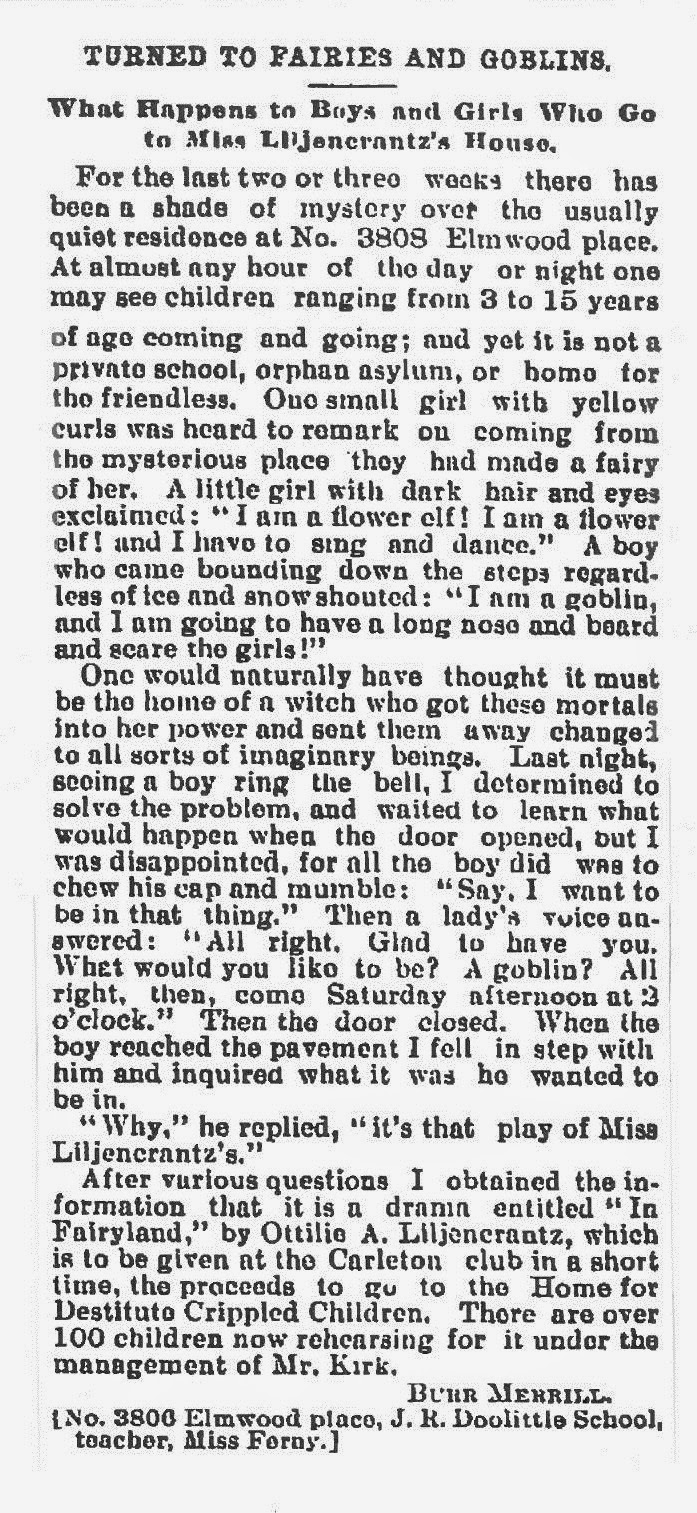

The 1900 US Census shows the family living in the same place, although it is now referred to as 3808 Elmwood Place.  Fifty-seven year old Gustave lists his occupation as "Assistant US Engineer." The other members of the family are fifty-five year old Adaline,  twenty-two year old Ottilie, and Adaline's mother, eighty-two year old Harriet Hall.  No occupation is listed for Ottilie.

We don't know specifically when Ottilie Liljencrantz started to write stories, but we do know that her first novel, The Thrall of Leif the Lucky: a Story of Viking Days was published by the A.C. McClurg & Co., Chicago in March of 1902 when Ottilie was only twenty-six years old.


The publishing of her first novel got a writeup in the Chicago Daily Tribune of March 11, 1902:
 

Reviews of the book were mixed.  Here is one from the Chicago Tribune literary critic from March 15, 1902:


In their Christmas advertisements for 1902, Ottilie's publishers A.C. McClurg & Company called The Thrall of Leif the Lucky "The most beautiful book of fiction for the year."

McClurg must have been satisfied with the book's performance, because in May of 1903 they published Ottilie's second novel, The Ward of King Canute: a Romance of the Danish Conquest. Here's an ad from the Tribune on May 2, 1903 that lists some of the critics' comments:


For her third novel, Ottilie Liljencrantz decided to change publishers. Her book The Vinland Champions was published in November of 1904 by D. Appleton & Company, New York.


In all, Ottilie Liljencrantz published five novels (one posthumously), all historical fiction about the days of the Vikings:


Every year saw the novels of Ottilie Liljencrantz grow in popularity.  By mid-1905, A.C. McClurg & Co. was reporting that The Ward of King Canute had just gone its second edition, and The Thrall of Leif the Lucky was in its eighth edition!

With the increased popularity of her books, came increased fame for Ottilie Liljencrantz.  On November 24, 1905, the New York Times reported that Miss Liljencrantz was one of the authors invited to the upcoming dinner at Delmonico's given by George Harvey to celebrate the seventieth birthday of Mark Twain.

In February of 1906, Ottilie's new publisher Harpers announced the release of her next novel, Randvar the Songsmith: A Tale of Norumbega:


As with her other books, the reviews were mixed, but by now she had built up quite a following, so sales of Randvar were brisk.

The 1910 US Census hinted at problems in the Liljencrantz household. First of all, the family has moved.  Their new address is 627 E. Groveland Park in Chicago:


627 East Groveland Park, Chicago

Sixty-eight year old Gustave Liljencrantz lists his occupation as "Civil Engineer."  For some reason Ottilie's mother Adaline is not listed as living in the household.  Thirty-four year old Ottilie is listed, as well as Adaline's mother, ninety-two year old Harriet Hall.  Also listed are twenty-two year old Violet Meyer, a nurse, and sixteen year old Bessie Pienski, a live-in servant.

The nurse must have been there to take care of Ottilie, because she passed away on October 7, 1910.  Readers of the Chicago Daily Tribune of  October 8, 1910 saw the following:


Here is Ottilie Liljencrantz' death certificate:

She died at the Streeter Hospital, 2646 Calumet Avenue in Chicago:


The cause of death was uterine cancer complicated by cancer of the liver.  The newspaper article about her death mentioned an operation two weeks previously; the death certificate said she had been hospitalized for eighteen days.   The death certificate said she was to be buried at Oakwoods Cemetery but we know that she is interred in the mausoleum at Rosehill Cemetery:


Ottilie Liljencrantz's popularity continued after she was gone.  On November 6, 1911, one year after her death, the A.C. McClurg publishing company brought out a volume of Ottilie's short stories which they titled A Viking's Love: and Other Tales of the North:

   
In November of 1928, Metro-Goldwyn-Mayer studios released 'The Viking' an all Technicolor production based on The Thrall of Leif the Lucky starring Donald Crisp and Pauline Starke.  Here is the New York Times' review of 'The Viking:


The Internet has given new life to the literary works of Ottilie Liljencrantz. Virtually all of her works are available to read online, and a whole new generation of readers are being captivated by her tales of Viking days through Kindle or Goodreads or Project Gutenberg.  

Here is just one of the 5-star reviews for The Ward of King Canute:

Awesome!  This is a great work of fiction. Liljencrantz's writing evokes a bygone era and really illustrates the life of Canute and his army during the Danish conquest. This book is filled with many colorful characters, but King Canute, Elfgiva of Northampton, and Randalin really stand out.

It is wonderful that through the miracle of the Internet, Ottilie Liljencrantz lives on, more than one hundred years after her untimely death.


Ottilie Adalina Liljencrantz - she made the Vikings come alive.  May she rest in peace.

Friday, January 9, 2015

RENOWNED CIVIL ENGINEER FROM STOCKHOLM TO CHICAGO - Gustave Adolph Mathias Liljencrantz

Unit One was the first section of the Rosehill mausoleum to be built.  It was completed in April of 1916.  If you were to enter through the main entrance doors, after you passed a section of private family rooms, you would find a white stone staircase on your right.  This staircase leads to the upper level of Unit One.  It is a large open room lined with private family rooms except for the east wall, which is made up of niches for cremated remains.  There are niches with white marble faces along each side, and the middle is comprised of forty two niches with glass fronts:


If you were to look to the left as you face the wall of niches, you would encounter the final resting place for three members of the Liljencrantz family:  Gustave, Ottilie, and Adaline.
 
  
This week we will take a look at the life of Gustave Liljencrantz, a renowned civil engineer, and next week we will look at the life of his daughter Ottilie, a noted author who died a the age of thirty-four.

Gustave Adolph Mathias Liljencrantz was born April 11, 1842 in the province of Upland, Sweden.  His parents were Baron Johan Carl Liljencrantz (d. 1862), a Custom House inspector, and Henriette, nee von Schoultz.

Young Gustave first attended the New Collegiate School, and after that the Royal Technological Institute, both of Stockholm.  He graduated as a civil engineer in June, 1866.  Later on he became a gentleman of the chambers at the Swedish Royal Court.  Men who held this position were in the business of asking for favours on behalf of clients, and passing messages to the monarch or lord heading the court.  These "gentlemen" comprised a mixture of nobles hoping to rise in their career, and those—often of humble origin—whose specialized abilities the monarch wanted to use or reward.

Gustave Liljencrantz was assistant engineer at the construction of the Dalsland Canal in Sweden from 1866-1869.  The Dalsland Canal, still in use today, is said to be one of the world's most beautiful.  In 1869 Gustave left Sweden, settling in Milwaukee, Wisconsin.  In Milwaukee he took a position as a draftsman in the U.S. Engineer Office until 1870 when he joined the Chicago, Minneapolis & St. Paul Railroad, also as a draftsman.

In 1871 he moved again - this time to Chicago where he returned to the US Engineer Office, quickly rising through the ranks as his talents became apparent.

On April 27, 1875, Gustave married Miss Adaline Charlotte Hall (1845-1915), a native of North Pownal, Vermont.

On January 19, 1876 they were blessed with a daughter who they named Ottilie Adaline Liljencrantz (1876-1910), the subject of next week's article.

The 1880 US Census finds the family living at 69 (now 529 W.) Grant Place in Chicago:


529 W. Grant Place, Chicago

Gustave listed his occupation as "US Surveyor."  Adaline's mother Harriet Hall was also living with the Liljencrantz family.  She listed her occupation as "Help of Home."

Being an engineer, Gustave also liked to tinker with gadgets in his spare time.  On September 18, 1883 he received his first US Patent #285048, for a "Fruit Jar Opener:"


Not being satisfied with that, he received another US Patent #286836 on October 16, 1883 for a different fruit jar opener:


As a US Engineer, Gustave Liljencrantz spent a good portion of his time creating maps for the government.  Here's one he produced in 1880 of the Chicago Harbor:


Gustave Liljencrantz was listed in the 1889 edition of the US Register of Civil, Military and Naval Service as an Assistant Engineer at an annual salary of $175.00.

Gustave received another patent on September 2, 1890, #435701 for a "Folding Stair-Chair":


The 1890 US Census for Chicago is lost, but the City Directory of the time shows the Liljencrantz family living at 3808 Johnson Court (now 3808 S. Vincennes, Chicago).  The site was formerly occupied by part of the Ida B. Wells Homes; now it is a vacant lot.

On May 18, 1896, Gustave Liljencrantz became a naturalized US citizen.

The 1900 US Census shows the family living in the same place, although it is now referred to as 3808 Elmwood Place.  Fifty-seven year old Gustav lists his occupation as "Assistant US Engineer."  Living with him are fifty-five year old Adaline,  twenty-two year old Ottilie, and Adaline's mother, eighty-two year old Harriet Hall.

Changes are apparent in the 1910 US Census.  First of all, the family has moved.  Their new address is 627 E. Groveland Park in Chicago:


627 E. Groveland Park, Chicago

Sixty-eight year old Gustave lists his occupation as "Civil Engineer."  For some reason Adaline is not listed as living in the household.  Thirty-four year old Ottilie is listed, as well as Adaline's mother, ninety-two year old Harriet Hall.  Also listed are twenty-two year old Violet Meyer, a nurse, and sixteen year old Bessie Pienski, a live-in servant.

The nurse must have been there to take care of Ottilie, because she passed away on October 7, 1910 after complications from an operation.  As mentioned above, Ottilie Liljencrantz was a renowned author, and her story will be told in this blog next week.

On June 5, 1912 Gustave Liljencrantz published a book of his own:  Rapid Cost Estimation for Piers and Breakwaters.  While not as popular as his daughter's books, his book did receive rave reviews in the engineering community.

Adaline Hall Liljencrantz' mother Harriet Parker Hall, died on February 27, 1912 at the age of ninety-three.

Being past the usual retirement age of sixty-five, Gustave did not give up his love of tinkering.  On March 10, 1914 he received US Patent #1089713 for a toy gun that he designed:


and in June, 1915 he received a US Patent #1143210 for a game called "Running for President:"


Gustave Liljecrantz retired in the spring of 1916 when he turned seventy-four.  He had buried his loving wife and his devoted daughter.  He was old and he was tired.  On August 10, 1916 he applied for a US passport.  He had a ticket to sail on the  Frederick VIII, leaving New York on September 6, 1916 for Sweden.  Here is his passport photo:


Gustave Adolph Mathias Liljencrantz c 1916

He said in his application he planned to stay in Sweden visiting relatives for "possibly one year."  He ended up staying there for the rest of his life - eleven years.

Readers of the Chicago Daily Tribune of November 6, 1927 saw the following article on page 12:


After his body was cremated, he joined his beloved Adaline and Otillie in the Rosehill mausoleum:
 

The death records for Ottilie Liljencrantz and Adaline Liljencrantz indicate their interment at Graceland Cemetery in Chicago.  In those days Graceland did have a crematory - perhaps they were cremated at Graceland and may have originally been interred there, but after seeing the magnificent Rosehill Mausoleum, the decision was made for all three to be interred at Rosehill.

  
Gustave Adolph Mathias Liljencrantz, a civil engineer from Sweden who used his talents to make Chicago a better place - may he rest in peace.

Friday, January 2, 2015

THE SAD TALE OF Dr. Abraham J. Weissman

You may remember the story I posted back on January 10, 2014 about the girl buried under the broken tombstone, little Dora Rosa Sachs who died in May of 1905:

http://undereverytombstone.blogspot.com/2014/01/all-that-left-is-broken-tombstone-dora.html

At the end of that article I made the following comment:

PS - The physician who signed her death certificate Dr. Abraham Weissman turned out to be quite a scoundrel, but we'll save his story for another week.

This is the week that I will tell the story of Dr. Abraham J. Weissman and you can decide for yourself if he was a scoundrel.

Readers of the Chicago Daily Tribune of September 28, 1911 saw the following item:

DOCTOR AND WIFE HE DESERTS WHILE ILL

Under photos identified as "Mrs. A.J. Weissman" and "Dr. A.J. Weissman" was this:

Dr. A.J. Weissman of 1106 S. Ashland avenue, drove up to his house in an automobile while his wife was sick in a hospital, packed $15,000 in the machine and skipped.  His wife says he also took her gems and other valuables.  

1106 S. Ashland is now occupied by part of the University of Illinois at Chicago Campus. 

This was followed by a Page One item in a later edition the same day:

SKIPS WITH $15,000 IN AUTO; WIFE LEFT
With Spouse in Hospital Dr. A.J. Weissman Packs Money in Car; Takes Her Gems.
Mortgages His Property

Dr. A.J. Weissman, a physician well known in the Jewish section of the west side, drove his automobile up to his residence at 1106 South Ashland boulevard Monday morning.  With considerable deliberation he packed into the machine about $15,000 in cash, all his wife's jewelery, all the family silverware, his medicine case, his private papers, and every other portable item of value he could find about the house.''

Then he got into the car himself, and jerked the speed "into the high." The police learned about this yesterday morning.  They searched for the physician all day.  At the end of their day's labor they hadn't found a trace to the doctor's whereabouts - not even the smell of his gasoline smoke. 

Leaves a Wife, Ill.

The police, however, did find some of the things that the doctor left behind him.  Among them was his wife, who is seriously ill at the Presbyterian hospital.  Two other relicts (sic) are his children, Morris, aged 14, and Louis, aged 9.

The fourth is Mrs. Jennie Cohen, Dr. Weissman's sister-in-law.  She wanted to know what had become of the $4,000 she had given the doctor on Friday to use in buying a mortgage.  Other items that the doctor failed to carry away were some parcels of real estate which he owns in various parts of Chicago.

It is a mistake, however, to conclude that he had overlooked them entirely.  The police found that before Dr. Weissman took his departure he had plastered these properties with mortgages.  The proceeds were part of the "junk" that he packed into his car.

At the Presbyterian hospital, where she has been for eight days, Mrs. Weissman was able to shed a little light on the motive that had inspired the doctor in taking such mysterious leave. 

"Not Sick, but Stubborn."

"I have been sick with a chronic complaint for more than a year," she said.  "Last Saturday my husband paid me a visit.  No sooner had the nurse got out of earshot than he started in to upbraid me for being sick all the time.  he said that I was a bad wife, because I was sick so much.

Interfered with his business.

"I said that I couldn't help being sick, but he replied that I was just stubborn.  Anyway, he asserted he was tired of it.  It was too bad, he insisted, that I hampered him so.  If it wasn't for me, he said, he might be a rich man.  He wound up by saying that he was going to get a divorce.

"The law, he assured me, would justify him in trying to get rid of a wife who was a dead weight on his hands.  It was a great injustice, he said, to compel a man to slave all his life paying hospital bills when, if he were given a little chance, he would be able to save his money and pile up a fortune so that when he died he could endow hospitals and colleges, just like Rockefeller does. 

Says He Took Her Jewels.

"I told him that I guessed his argument was all right.  I said he could go right ahead and get his divorce.  All I asked, I said, was that he would grant me $10 a week alimony and the custody of my two sons.  If I had that, I said,  I'd quit being a dead weight on him.

"He said he would think it over and went away.  I haven't heard from him since.  I guess he thought the $10 a week I wanted was too much.  He figured it out that to go the way he did would be cheaper.

"I got out of the hospital on Tuesday and went home.  I found the place stripped.  My husband had taken everything he could carry off, even little things off the mantelpiece.  My jewelry was gone.  It was worth $1,000. So was all our silver.  The was $50 in bills on the sideboard.  He took that.

"We have two tenants upstairs, A. I. Jacobson and Max Salk.  When I asked them if they had seen Dr. Weissman they said that Monday morning he had called on them and asked them to pay the rent to his brother, Samuel, who lives at 824 West North avenue, until they heard from him again."

Mrs. Weissman was asked if there was another woman in the case.  She said she didn't know. 

May Have Gone to Europe.

"I know of only two girls that the doctor admired," said she.  "One is Pearl Nudelman.  She is 19 years of age and resides at 3440 Cottage Grove avenue.  The other is a Miss Nathanson of 213 East Eighteenth street.  I don't believe they cared anything for him."

Inquiries at the two addresses showed that both girls are in Chicago. They said they hadn't seen Dr. Weissman in a year.

The police are working on the theory that Dr. Weissman may have gone to Europe.  Detectives Deasy and Bywater had a talk with Mrs. Cohen in the afternoon.  She said that Weissman often talked about going back to the "old country" as soon as he was rich enough.

Wow!  Quite a story about the good (?) doctor and his wife.  Before we find out how the issues of 1911 were resolved, and before we look into the mysterious events surrounding the death of Dr. Weissman in 1938, let's see what we can find out about him:

Abraham Joseph Weissman was born November 3, 1871.  On his 1924 passport application he said that he was born in Russia and that his father's name was "Shimel" (Simon).  His mother's name was Lizzie, nee Tenenbaum.  Weissman said he emigrated from Russia about 1890 and immediately moved to Chicago.  He became a naturalized citizen on March 16, 1899.  We also know that he had a brother Samuel, but that's about all we know of his immediate family.

About 1901 Abraham Weissman married Fannie Shore in St. Joseph, Michigan.  She had been married previously to a Mr. Rosenberg and had a son Maurice Rosenberg in 1898.  Sometime after that, Mr. Rosenberg passed away and Fannie was available to marry Dr. Weissman.

Abraham and Fannie Weissman had a son of their own, Benjamin Louis Weissman (1902-1982) on August 31, 1902 in Chicago.

But all was not blissful with the newlyweds.  Late in 1902 Abraham and Fannie Weissman were divorced.  That didn't work out either, because they were remarried on February 10, 1903.  Still unhappy, Fannie again sued for divorce in January of 1904.  She dropped the suit, however before the divorce was final and Abraham and Fannie Weissman were reconciled - at least temporarily.

By the 1910 US Census the Weissman family (and Maurice Rosenberg) were living at 1012 S. Ashland Avenue in Chicago. Abraham lists his occupation as General Practice Physician.  The Weissman family is doing well enough to have a live-in servant: 19 year old Trissa Kaiser.

By the time of the 1911 article, the Weissmans had moved one block south, to 1106 S. Ashland Avenue in Chicago.  Both addresses on S. Ashland are now part of the UIC Campus.

The Weissman family saga was continued in the next day's Chicago Tribune (September 29, 1911):

DR. WEISSMAN OFF TO RUSSIA?
Brothers say He has Gone to Alma Mater in Warsaw.
Case to the Grand Jury.
Sister-in-law Accuses Physician if Stealing $4,000 From Her.

Dr. A. J. Weissman, who skipped in an auto with $15,000 and other valuables from his house at 1106 South Ashland boulevard Monday, is on his way to Russia.  This was the statement last night of a brother, Samuel Weissman, 824 West North avenue, who says that before leaving Dr. Weissman conferred upon him the power of attorney.

"My brother," he said, "left Chicago because the nagging of his wife was ruining his disposition.  He has gone back to the medical college in Warsaw from which he graduated twenty years ago."

Goes Before Grand Jury.

Mrs. Jennie Cohen, a sister-in-law of the missing doctor, says she does not believe this statement.  "Dr. Weissman," she said. "is,hiding in Chicago.  I will find him and have him indicted by the grand jury for larceny as bailee.  He stole $4,000 from me."

Mrs. Cohen, her husband, and her attorney, I.B. Pearlman, appeared before the grand jury during the day and testified regarding Mrs. Cohen's charge that she placed $4,000 in Dr. Weissman's hands for him to invest in a mortgage.

It is understood that the grand jury voted a true bill, which will be returned in court this morning. 

Fight Over the Property.

The property at 1106 S. Ashland boulevard is valued at $21,000.  On this is a mortgage of $8,500.  The balance of this estate will be demanded by Mrs. A.J. Weissman.  An attachement will be placed on the estate by Mrs. Cohen.

Per the Chicago Daily Tribune of October 8, 1911, Dr. Weissman had been found:

FUGITIVE DOCTOR IN CELL
A.J. Weissman, Accused of Embezzlement, Caught in Iowa.
Identified by Relative.
Chicagoan Traced Through Letter His Brother Wrote Him.

In the arrest of "J. Chapman" in Davenport, Ia early yesterday, the police have Dr. A.J. Weissman, alleged embezzler, who left his home 1026 South Ashland boulevard last week with family property, while his wife lay ill in the Presbyterian hospital. 

After recognition by Harris Cohen, 1037 West Twelfth street, his brother-in-law, Dr. Weissman admitted his identity.

Extradition papers are being prepared and Inspector Nicholas Hunt probably will send a policeman to Davenport today to bring the doctor back.  Cohen went to Davenport with detectives at the demand of his wife, who charges that Dr. Weissman embezzled $4,000 she gave him to invest in mortgages.

Trace Through Letter.

Dr. Weissman was believed to have gone to Europe.  Suspicion that he had eloped with a Chicago girl was disproved when the girl was found at her home.

Detective Lavin, who was watching the home of the doctor's brother, Jesse Weissman, owner of a pool hall at 324 West North avenue, saw Jesse Weissman mail a letter.  Lavin waited until a mail collector called. The letter was addressed to J. Chapman, care of J.G. Levinson, 426 Maple street, Des Moines, Ia.  From that address "Chapman" was traced to Davenport. 

Divorce Suit is Pending.

Dr. Weissman is a graduate of Rush Medical college and had a large practice.  He was married to Mrs. Weissman in St. Joseph, Mich., ten years ago.  She was a widow.

The doctor and his wife have frequent quarrels in which, it is said, he upbraided her for her delicate health.  She was in the Presbyterian hospital suffering from a nervous breakdown, when he departed.  She has filed suit for divorce.  The warrant on which Dr. Weissman was arrested was sworn to by Mrs. Cohen.

The Chicago Daily Tribune printed a follow up article on October 14, 1911 reporting that Mrs. Weissman was granted temporary alimony of $25.00 per week and $200.00 solicitors' fees pending the final divorce decree.  

So that was it?  Did they live happily but separately ever after?  Not quite.  The divorce decree was granted, because they had to apply for yet another marriage license when they re-re-married on September 25, 1913!  He was forty-one years old; she was thirty-eight.  They should have known better.  It was obviously a case of can't live together/can't live apart.

They were still together at the time of the 1920 US Census.  They were still living at 1106 S. Ashland Boulevard in Chicago.  Abraham Weissman still reported his occupation as "Physician."  They reported that they owned the building they lived in, but it was mortgaged.  Still living with them were sons Maurice Rosenberg, who was 22, and Louis Weissman, who was 16.

Sometime during the early 1920s Abraham and Fannie divorced again - this time for good.  And although Fannie Weissman stayed single for the rest of her life, Abraham Weissman did not.  About 1925 he married a woman named Matilda called Tillie (1895-????), whose last name is not known.  When they married, Abraham Weissman was 54, and Tillie was 30.  Dr. Weissman and Tillie had a son, David, who was born in 1927.

The 1930 US Census shows the reconstituted Weissman family (Abraham, Tillie and David) living at 1145 Independence Boulevard in Chicago:

1145 S. Independence Boulevard, Chicago

They were renting their apartment for $77.00 per month.  Abraham Weissman reported that he was a physician and shaved a couple of years off of his age, admitting to 57 (he was 59).  Tille was 35 and David was 3. They also still employed a live-in servant, forty year old Sadie Lind.

Dr. Abraham Weissman managed to keep his name out of the newspapers for the remainder of his life.

And that brings us up to Thursday, October 27, 1938 when someone found a body floating in the waters of Lake Michigan at the foot of Webster Avenue.

Lake Michigan at the foot of Webster Avenue, Chicago

The first Death Certificate was filled out by an Officer Roy Dunkleberger of the Chicago Police Department who reported that the body of an "Unidentified White Man" about 60 years old was found floating in Lake Michigan at the foot of Webster Avenue.  The Cause of Death was reported as "Asphyxiation by Drowning."


On October 31, 1938, Louis B. Weissman went to the Cook County Morgue and identified "Unknown White Man" as his father, Dr. Abraham J. Weissman:


Louis reported tha the last time he had seen his father alive was on October 21, 1938.  He said his father was living at 3941 Pine Grove in Chicago and that (no surprise here) he was divorced from Tillie.

3941 N. Pine Grove, Chcago

Once his son had positively identified the remains, a regular Death Certificate could be filed for Dr. Abraham J. Weissman:


Dr. Weissman was buried November 1, 1938 at Jewish Waldheim Cemetery in Park Forest, Illinois - at Gate 48 (Drohitchen).  There was no obituary or death notice in the Tribune.


They told me in the office that no one else is buried in that plot, and that is the case:


We will never know what caused seventy one year old Dr. Abraham J. Weissman's body to end up in Lake Michigan on that October day in 1938.  Since he could not seem to be able to live with anyone while he was alive, it is probably appropriate that he rests alone in the plot at Waldheim.

Was he a scoundrel?  I'll let you decide that for yourself.

Dr. Abraham J. Weissman - may he rest in peace.