I have mentioned in previous articles for this blog that I check eBay on a regular basis for items about Evanston. You never know what people have in their basements or attics but you do know that eventually most of it will end up on eBay.
Recently someone on eBay was selling several bound volumes of City of Evanston Improvement Bonds:

 |
| Note that this bond is signed in the lower left corner by William Collin Levere, the subject of another article on this blog. |
These were bonds issued by the City of Evanston to raise the money for infrastructure projects like roads, street lighting, sewers, etc. The volumes on eBay were from the late 1800s and early 1900s and were signed by Evanston mayors Thomas Bates, James Patten and John Barker. But one of the bonds was signed by F.W. Gerould as Mayor Pro-Tem on August 21, 1902:


That would have been during the term of Mayor James A. Patten, Evanston's legendary "Wheat King." Apparently the Evanston Historical Society decided that they didn't need these volumes any more in their collection and sold them to a Chicago rare book dealer.


That would have been during the term of Mayor James A. Patten, Evanston's legendary "Wheat King." Apparently the Evanston Historical Society decided that they didn't need these volumes any more in their collection and sold them to a Chicago rare book dealer.
I know a lot about Evanston history but I had never come across the name F.W. Gerould before. So I thought I would do some research and see if he would be an interesting subject for this blog - and he was.
F.W. Gerould was born Francis Wheelock Gerould on January 13, 1854 in East Smithfield, Pennsylvania to Marcus Botsford Gerould (1818-1895) and Mary E., nee Bingham (1860-1901). Marcus Gerould was originally a merchant by trade but in middle age he tried his hand at being a cattle broker. Marcus and Mary were blessed with three children: Leslie Bingham Gerould (1846-1924), Francis Wheelock Gerould (1854-1918) and Marcus James Gerould (1861-1889).
In 1856 the Gerould family moved to Ogle, Illinois. The 1860 US Census finds the Gerould family still living in Ogle. Marcus Gerould reported his occupation as "Clerk." The family consisted of Marcus and Mary, 12-year-old Leslie and 6-year-old Francis. The family reported that they owned real estate worth $800.00, and personalty worth $50.00.
The 1870 US Census finds that the Gerould family has moved to Rockford, Illinois where Marcus reported his occupation as "Cattle Broker." Leslie Gerould had moved out on his own, so the family now consisted of Marcus and Mary, 17-year-old Francis and 9-year-old Marcus. Mary's 65-year-old mother Electa Bingham was living with them, and they also had a "Domestic Servant" 19-year-old Lottie Lundbery. Francis told the census taker that his occupation was "Clerk in a Shoe Store."
During this period Gerould spent five years with the "Rockford Rifles" of the Illinois National Guard. By the time of his discharge, he had worked his way up to Second Lieutenant.
In 1878, 24 year old Francis (now called "Frank") moved to Chicago and accepted a position with A.(lbert) G.(oodwill) Spalding & Bros., the noted sporting goods company. He would spend his entire career with Spalding - a total of 40 years.
I was not able to locate F. W. Gerould on the 1880 U.S. Census.
On September 1, 1881 Frank Gerould married Mary Sophia Avery (1860-1901) in Chicago.
Mary Sophia Avery was born in February of 1860 in Belvidere, Illinois to William Dickey Avery (1835-1916), and Fannie Elizabeth, nee Hale (1837-1895). W. D. Avery was in the advertising business.
Both Frank Gerould and Mary Avery came from distinguished families who could trace their lineage back to men who fought in America's War for Independence.
Frank and Mary Gerould were blessed with five children: Helen Louise Gerould (1890-1979), Frank Avery Gerould (1893-1968), Alice Adele Gerould (1895-1896), Walter Blakeslee Gerould (1898-1967), and Leslie B. Gerould (1901-????).
After they were first married, Frank and Mary Gerould lived at 15 Lane Place (now 2020 N. Orleans Street) in Chicago:
 |
| 2020 N. Orleans Street, Chicago |
In the Chicago directories of this era, Frank Gerould described himself as a "Manager for A. G. Spalding & Bros."
From his earliest years, Frank Gerould was an avid cyclist and in 1890 was elected President of the Lincoln Cycling Club in Chicago.
In the midst of success and prosperity, grief entered the Gerould house as well. Little Alice Adele Gerould died on June 8, 1896, less than one year old. The Gerould family bought a beautiful family plot along the road in Section 112 of Rosehill Cemetery, in the shade of a beautiful old tree, and that is where they buried little Alice.

1896 also brought new beginnings for the Geroulds. With a growing family, the Gerould family left Chicago and purchased a home at 1200 Judson in Evanston:
 |
| 1200 Judson, Evanston |
Frank Gerould was now settling down. He had a beautiful home and a beautiful family. He decided it was time to give something back to his community, so in 1899 after First Ward Alderman Daniel A. Mudge announced that he would not be running for reelection, Gerould announced that he would be a candidate to fill the vacant seat. As it turned out, Gerould ran unopposed and so in the election held April 18, 1899, he was elected with 358 votes.
The 1900 US Census finds the Gerould family in their home at 1200 Judson. The family consisted of 46-year-old Frank, 40-year-old Mary, 10-year-old Helen, 6-year-old Frank, and 1-year-old Walter. In addition, Frank's mother Mary was living with them, as was Frank's brother Leslie B. Gerould. Rounding off the census listing were their two servants, 21-year-old Ida Olson, and 23-year-old Anna Bier.
Others looked at Frank Gerould and saw a man of growing influence in the community, as well as the business world. In 1900 Gerould was asked to join the Board of Directors of the State National Bank of Evanston, a position he would hold for the rest of his life.
Tragedy was to fall on the Gerould household when Mary Avery Gerould died on March 12, 1901 from heart disease. Here is her death notice from the Chicago Daily Tribune of March 14, 1901:

The Evanston Index from Saturday, March 16, 1901 had a nice obituary for Mrs Gerould:
MRS. F. W. GEROULD
Mrs. Mary Avery Gerould, wife of F. W. Gerould, 1200 Judson avenue, passed away early Tuesday morning after a very short illness of heart disease. Mrs. Gerould had been out of health for several months, but not until last Sunday evening was she seriously ill. She had recently visited her old home in Belvidere, returning from there less than two weeks before the death occurred.
Mrs. Gerould was born in Belvidere 41 years ago. Her parents were Mr. and Mrs. William Avery and her father is living in Evanston at the home of his son, Sidney Avery, 1430 Benson avenue. Mrs. Gerould was educated at the public schools and high school of Belvidere and was married to Frank W. Gerould in 1881. They made their home in Chicago until five years ago, when they removed to Evanston. Mr. Gerould was elected to the city council two years ago and will close a successful term next month.
While living in Chicago, Mrs. Gerould was a member of the Fulton Avenue Presbyterian church, and since coming to Evanston has been connected with the First Presbyterian church. She was a member of the Evanston Woman's club and of the University guild. Surviving her besides her husband, brother and father, are three children - Helen, Frank and Walter - and a sister, Mrs. George Blakesley of Kansas City.
The funeral services were held Thursday at 2 o'clock at the family residence. Rev. J. H. Boyd of the First Presbyterian church officiated, and music was furnished by the church choir. The pallbearers were J. H. Andrews, O. T. Eastman, H. R. Ross, Dwight Jackson, T. P. Stanwood, A. B. Jones, A. E. Dunn, E. F. Pierce. Interment took place at Rose Hill.
The following resolutions were adopted by the Evanston city council at a special meeting held Wednesday evening, and a committee consisting of Alderman Underwood, Barker and Curran were elected to represent the council at the funeral.
"Whereas, A member of this council, who is known to the people of Evanston for his wise and untiring devotion to their interests, and who enjoys the cordial friendship and loyalty of all who have been associated with him in public office, has suddenly been called to experience an irretrievable loss.
"And Whereas, Though we appreciate that no words of ours can in any degree alleviate his sorrow, we still desire to make known to our bereaved associate the deep and abiding sympathy we feel for him in his affliction. Now therefore be it
"Resolved, That this council in its own behalf and in behalf of the several officers and employes of the city of Evanston, hereby extend to Frank W. Gerould, alderman of the First ward of this city, the earnest and sincere assurance that his grief and bereavement are to them a cause of personal and heartfelt sorrow, and be it further
"Resolved, that an engrossed copy of this resolution, with the signatures of the mayor and city clerk, be delivered to our friend and colleague."
Mary Gerould was buried in the family plot at Rosehill Cemetery in Chicago, joining little Alice Adele, who died five years previously.

In those days, Evanston has two alderman for each ward, and each was elected for a two year term. Alderman Frank Gerould ran for reelection unopposed, and in the election held April 16, 1901 he was reelected, this time with 347 votes.
As I mentioned at the start of this article, I came across City of Evanston Improvement Bonds from 1902 which were signed by F. W. Gerould as Mayor Pro Tem.
First, let's look at exactly what a "Mayor Pro Tem" is. The Section of the Evanston City Code entitled "Mayor Pro Tem," provides:
If a temporary absence or disability of the mayor incapacitates him from the performance of his duties but does not create a vacancy in the office, the city council shall elect one of its members to act as mayor pro tem. The mayor pro tem, during this absence or disability, shall perform the duties and possess all the rights and powers of the mayor. No additional salary or compensation shall be paid the mayor pro tem for acting as mayor pro tem; and
The Evanston City Council Rules further define the role of a Mayor Pro Tem: "'Mayor pro tem' is a member of the City Council, who is elected by the Council to perform the duties and possesses all the rights and powers of the Mayor if a temporary absence or disability of the Mayor prevents the performance of Mayoral duties, but does not create a vacancy in the office."
When the Evanston City Council met at their regular meeting on July 1, 1902, Alderman Gerould moved that when the Council adjourns Tuesday evening July 8 it adjourn not to meet in regular session until Tuesday evening, September 9, 1902. The motion passed unanimously.
When the Council met again on July 8, 1902, Mayor Patten asked the Council to elect a Mayor pro-tem. After a spring and early summer of frantic trading of wheat futures, Patten had planned to take a vacation to Colorado to relax. Patten knew that there would be financial matters that had to be addressed in his absence, so it made sense to have Alderman Gerould elected Mayor pro tem, since in addition to being alderman, Gerould was the Chairman of the Finance Committee of the Evanston City Council. Today, when a mayor pro tem is needed, the sitting alderman with the most seniority is elected. In 1902, any sitting alderman could be elected.
The minutes of the Council meeting from July 8, 1902, reported that Alderman Frederick Arnd nominated Alderman Gerould to be mayor pro tem, in Mayor Patten's absence. The nomination was seconded by Alderman Frank R. Seelye and carried. Voting aye, were Alderman Frederick Arnd (1st), Clarendon B. Eyer (2nd), James P. Grier (2nd), Frank R. Seelye (3rd), John T. Barker (3rd), James Lill (4th), Peter Schimberg (4th), Charles M. Schindler (5th), John C. Schuett (5th), George L. Wallace (6th), John W. Branch (6th), John M. Curran (7th) and Frank B. Dyche (7th). No alderman voted nay. Of course, since this directly affected him, Alderman Gerould did not vote.
At that same City Council meeting of July 8, 1902, Alderman Gerould, for the Finance Committee, presented and moved the adoption of the following resolution:
"WHEREAS, This Council will adjourn at this meeting not to meet again in regular session until Tuesday, September 9, 1902;
THEREFORE, BE IT RESOLVED, that the Mayor or Mayor pro tem, and City Comptroller be, and they are hereby authorized to draw and issue warrants for all pay-rolls and bills for the various departments, together with bonds and warrants for the contractors' partial estimates on public improvements, for the months of July, and August, 1902, that may be presented, duly approved and certified by the proper officers and chairmen of the respective committees and Chairman of the Auditing Committee, and to report back to the Council at the first meeting to be held in September next." The Resolution passed unanimously.
So, Alderman F.W. Gerould, as Mayor pro tem in Mayor Patten's absence, had the approval to execute the Public Improvement Bonds I mentioned at the start of this article.
The Evanston Index newspaper from December 20, 1902 carried the following headline:
MAYOR PATTEN NOT TO RUN
Will Not Stand for Re-Election Next Spring.
What did this mean for Frank Gerould? Having had a taste of Evanston political life, he decided to set his sights higher. The Chicago Daily Tribune from December 23, 1902 contained the following story:
WANTS TO BE EVANSTON MAYOR
Two Avowed Candidates, George Gouch and Ald. Gerould,
and Others Mentioned as Possibilities
With two avowed candidates for the office of mayor and several possibilities, Evanston's mayoralty campaign will be lively. Following Mayor (James A.) Patten's statement that he would not be a candidate Ald. Gerould announced his candidacy. Gouch was Mayor Patten's opponent in the last election. O. H. Mann, Evanston's first mayor, and L. L. Smith of South Evanston are mentioned as possibilities.
The election was to be held April 21, 1903, so Alderman Gerould had plenty of time to put his campaign together.
The Evanston Index, in its edition of January 31, 1903 seemed to know who they thought would be a good mayor:
FRANK W. GEROULD, WHO IS PROMINENTLY MENTIONED FOR MAYOR.
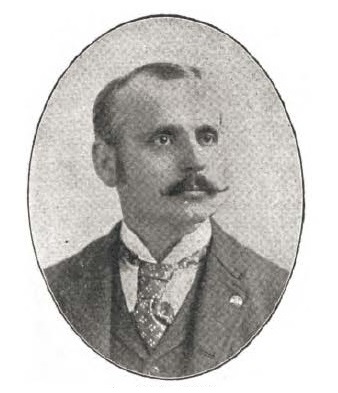
Among the men toward whom the citizens are turning when the mayoralty question comes up these days is Alderman Frank W. Gerould of the First ward. He has been one of the strong men of the council since his advent into that body several years ago, and his record during the last two years as chairman of the finance committee has been altogether creditable to him and of decided benefit to the municipality. No measure can go through the council but it is subjected to the test of his keen mind. Evanston has always been noted among American cities for the able men whose services its common council is able to command, but it is the general consensus of opinion that our city has never had the services of a man which were given more freely or unselfishly bestowed than those of the subject of this sketch. In his hands the best interests of the city will be safe, and the city will have an executive of whom it may be proud.
But then as now, politics is never dull. On March 3, 1903, out of the blue, Third Ward alderman John T. Barker, announced that he, too, would be a candidate for mayor in the upcoming election. Barker said that he would present himself as a candidate to the Republican city convention to be held on March 7th. Barker said that he currently had the endorsement of nine of the thirteen Republican aldermen. Mayor Patten said that he would remain neutral, because he had been a close friend of both Barker and Gerould for many years.
The Chicago Inter-Ocean newspaper told the result in their Sunday March 8, 1903 edition:
BARKER IS NAMED FOR MAYOR
Nominated by Evanston Republicans in Convention.
Alderman John T. Barker was nominated for mayor of Evanston yesterday to succeed Mayor James A. Patten. Alderman Frank Gerould, Barker's only competitor in the primaries on Friday, did not allow his name to be presented to the convention, and his thirteen delegates voted for Barker.
After organizing the convention by making George P. Merrick chairman, F. S. Seelye nominated Alderman Barker and George P. Englehard of the Gerould forces seconded the nomination. After securing the nomination, Mr. Barker made a speech thanking the delegates and promising if elected to uphold Republican principles.
What happened? Why did Frank Gerould withdraw his name at the last minute? Did he sense that he could not win against the Barker forces, so it would be better to withdraw before the vote? Unfortunately for us, history does not record why Gerould made this momentous decision.
Gerould was convinced instead to stand for reelection to his current post as alderman of the First Ward. He had an opponent this time - steamfitter George H. Laing, but in the election of April 21, 1903, Gerould was re-elected with 274 votes for him, and just 22 votes for Laing.
In the 1905 Evanston civic elections, Frank Gerould was easily re-elected. His opponent this time was the Socialist candidate George Michaelini, who owned a fruit store in Evanston. The final vote tally was Gerould 162, Michaelini 24.
Gerould told friends through the years that he ultimately wanted to run again for Mayor of Evanston. The 1907 civic election seemed to be the right time. Mayor John Barker announced that he would not seek reelection. The only other man in the race was the marginally popular Evanston chief of police Col. Albert S. Frost. Gerould announced his candidacy in late 1906. He was so sure of victory this time, that he announced that he would not be running for reelection as Alderman of the First Ward. It was all or nothing for Gerould in 1907.
The Chicago Daily Tribune said on January 19, 1907 that Gerould "is looked upon by many as the logical successor to Mayor Barker, and is the chief opponent of Col. Frost."
Victory seemed assured for Frank Gerould this time. The Chicago Inter-Ocean newspaper quoted Gerould on January 31, 1907 as saying, "I am confident of election."
But victory eluded Frank Gerould yet again. The following appeared in the Evanston Index newspaper from March 16, 1907:
WHY MR. GEROULD RESIGNED
Evanston, March 15, 1907
To the Citizens of Evanston:
I feel it is only fair to make a statement regarding the withdrawal of my name from nomination as a candidate for the office of mayor.
I feel it is only fair to make a statement regarding the withdrawal of my name from nomination as a candidate for the office of mayor.
I regret exceedingly that changes in business responsibilities and duties arising after my petitions were circulated compelled me to take such action, but in justice to the citizens of Evanston, to myself, and to my business. I could not decide otherwise. I would not undertake any responsibility that I might be obliged to neglect, and it would have been impossible for me to have performed the duties of mayor, in the event of my election - of which I was absolutely confident - and also to carry the new responsibilities in my business.
I appreciate very much the good words spoken by my friends, and the hundreds of endorsements of my candidacy, and the ticket which I had the honor to lead. It has been a pleasure for me to serve as alderman during the past eight years, believing as I do, that every man should help so far as he can, in all public affairs. I had an ambition to round out my little public service by being elected mayor of this beautiful city, but duty to my business compelled me to sacrifice that ambition.
I hope my friends will vote for the candidates for the other city offices who are on the ticket from which I have withdrawn, viz:
Mr. John P. Hahn, for city clerk.
Mr. Frank H. Seelye, for city treasurer.
Mr. George N. Woodley, for city attorney.
Mr. John H. Guilliams, for supervisor.
Mr. Joseph E. Paden has been persuaded to become an independent candidate for mayor. I consider him splendidly qualified by training and experience to fulfill the duties of that office and I shall vote for him and do all I can to help elect him, and would appreciate it if all who intended to vote for me would cast a ballot for him.
Respectfully,
Frank W. Gerould

Why did Frank Gerould withdraw from the mayoral race - again? Like his withdrawal in 1903, we may never know the true reason. However, Gerould must have had a guardian angel looking after him. When he decided to withdraw from the mayoral contest he could not have known the catastrophe that was waiting for him right around the corner. The Chicago Daily Tribune from March 25, 1907 reported the following:
SPALDING & BROS. LOSE IN BIG FIRE
Flames Consume $350,000 Worth of
Sporting Goods
as Athletic Season Is About to Open.
Car Lines Are Blocked.
Thousands of Sunday Strollers Watch the Blaze
From Side-walk and Elevated Station.
Fire
in the store of A. G. Spalding & Bros. yesterday afternoon destroyed goods
said to be worth $350,000, just at the opening of the baseball season. Loss
on the stock was total.
The building, at 147 and 149 Wabash avenue, is practically
in ruins. It was valued at $50,000. It was a five story structure,
erected shortly after the great fire.
Traffic on the Cottage Grove and Indiana avenue lines was
tied up completely during more than two hours. Thousands of patrons of
the lines were delayed. The tie-up of the surface cars resulted in a
heavy increase in the business of the South Side Elevated road.
There was no interruption of traffic on the elevated, but
the trains could not be seen as they plunged through the dense smoke until they
emerged on the north and south, their windows filled with scared looking
passengers.
The cars in State street were blocked for a time, due to a
lead of hose which the fire- men stretched across the tracks at Monroe street. This
obstacle to traffic was remedied quickly by the traction company’s repair gang,
who placed skids over the hose, thereby giving the cars an opportunity to move
without Interfering with the work of the firemen.
A big crowd of spectators viewed the fire from the platform
of the elevated road at Madison street and Wabash avenue.
Blaze Starts in Basement.
The fire started in the basement of the store shortly after
4 o’clock and during the remaining two hours of daylight, while the firemen
battled with the flames, it afforded a spectacle for thousands of people.
The Windsor-Clifton hotel was separated,
from the burning structure by the fireproof Church building, but the guests
there were thrown into panic by the nearness of the blaze. A telephone
girl remained at her post during the panic and called each guest from the
thirty rooms in the threatened portion of the Windsor-Clifton.
For a time, it was feared the dry goods store of Carson.
Pirie, Scott & Co., in close proximity to the burning building, was in
danger, but It became evident after an hour’s work that the fire would be
restricted to the old building, flanked on both sides by stout fire walls, and
fought in the front and rear by tons of water from twenty lines of hose. After
a three hours' fight the fire was under control, it burned for several hours
afterward.
Smoke Drives Firemen Back.
At 4:30 o’clock in the afternoon fire insurance patrol No. 1
and engine company No. 82 raced to the fire in response to a still alarm, that
came from an automatic sprinkling device in the basement of the sporting goods
establishment. Smoke was pouring then from every window of the building.
Patrol No. 1 reached the fire first and Assistant Driver
Pewersdorf was the first man to break into the front door. As soon as the
door was opened there was an explosion that carried Pewersdorf off his feet and
threw him against the door. An artery of one of his wrists was severed
and he suffered considerably from loss of blood. He was taken away in a
police ambulance.
Two minutes after the first two companies arrived an alarm
was sent from the fire box of engine No. 82 and this was followed promptly by a
2-11 and ten minutes later by a 4-11. A special alarm was sent out at 5
o’clock and the streets were filled with smoking, coughing engines, hose
wagons, and scores of rubber coated fire fighters, with Chief Moran in general
charge.
The flames were fiercest in the rear of the basement in the
north corner. Several fire- men advanced close to them, but were driven
back by the smoke and heat. Lines of hose with their nozzles almost on a level
with the street deluged the basement, but could not prevent the flames from
spreading to the upper floors in the rear, by means of the elevator shaft.
Origin of Fire a Mystery.
D. W. Gilien, reporter for the fire Insurance patrol, who
was one of the first to arrive, sent a telephone message to Manager F. W.
Gerould, who was at his home in Evanston. Mr. Gerould arrived a little
after 5 o’clock. He found Assistant Manager C. S. Lincoln already there.
"I was in the store at 12 o clock," said Mr.
Lincoln. " I have no Idea how the fire started."
Mr. Gerould said he could not understand the cause of the
tire. It was suggested that there had been powder in the basement.
"We have not carried any firearms, cartridges, or explosives
in stock for several years," the manager said. "The loss will
be a serious one for the firm, as this is the opening of the outdoor sporting
season, and we had just laid in a large stock of baseball goods, tennis, and
golf supplies. I have engaged temporary headquarters at 84 Wabash
avenue."
A. G. Spalding, who had been in Chicago last week, left on
Saturday for his winter home in Pasadena.
Telephone Girl Shows Pluck.
Miss Elizabeth Jordan was the heroine in the Windsor-Clifton
hotel and to a consider- able extent she averted a panic. She is the
telephone operator in the hotel, and she stuck to her post when the smoke came
pouring in through the open windows, filling the main floor. She called
up each of the thirty rooms in the threatened northeast portion of the
structure and sent this message over the wire;
“You are wanted in the hotel office by a friend."
Some astonished guests assembled a few seconds later. Meanwhile
James Webster, leader of the Roanoke cafe orchestra, who had been asleep in a
corner room, awoke, saw the smoke. and ran through the corridors excitedly
yelling “Fire!"
The basement of De Jonghe's cafe, next to the Windsor
Clifton, was flooded with a foot of water and the rooms were filled with smoke. Most of the rooms had been engaged for dinner parties and it became
necessary to cancel all these engagements. The proprietor estimated the loss by
smoke damage to his fixtures, not to mention the loss of business at over $500.
The Roanoke cafe, under the Windsor-Clifton. was obliged to
suspend business on account of the heavy smoke.
There is no way that Gerould could have taken on the duties of mayor of Evanston when all of his time would be needed to restock for the baseball season and rebuild the damaged building. His decision to withdraw from the race seems in hindsight to have been providential.
Frank Gerould's hard work and loyalty to the Spalding Brothers was rewarded when in 1909 they announced his promotion to Third Vice President. Ultimately he would hold the position of Vice President and Western General Manager of A. G. Spalding and Bros., and of allied corporations., the Spalding Manufacturing Company and A. G. Spalding and Bros. Manufacturing Company.
The 1910 US Census showed Frank Gerould still living at 1200 Judson in Evanston. The family consisted of Frank, daughter Helen, and sons Frank, Walter and Leslie. In addition there was a live-in housekeeper Florence Patrick, and servants Mary Barrett and Margaret Holton. Frank Gerould listed his occupation as "Manufacturer or Sporting Goods."
Tired of living the life of a widower, on June 28, 1911 Frank Gerould married his housekeeper Florence E. Patrick (1857-1931) in Evanston. The groom said his age was 57 - and he was 57; the bride said her age was 48 - she was 53.
The Chicago Inter Ocean newspaper reported the nuptials on June 29, 1911:
Miss Florence E. Patrick and Frank W. Gerould were married yesterday at Mr. Gerould's residence, 1200 Judson avenue, Evanston. It was a very quiet wedding, as there were no guests except the family and no attendants. Mr. and Mrs. Gerould have gone East on their honeymoon.
Frank Gerould was very proud to see his name on the list of Directors when the State Bank opened its new quarters in 1914. Here's the announcement from the Lake Shore News of Friday November 27, 1914:

In 1914, when Frank Gerould turned 60, he officially retired from Spalding, but remained as a trusted advisor. He remained on the Board of the State Bank of Evanston for the rest of his life.
About this time, Frank and Florence Gerould realized that the Gerould homestead at 1200 Judson was too big for them. It was a house for a growing family, and their family was shrinking as Frank's children married and moved out on their own. In 1917 they made the decision to sell the house on Judson, and they rented an apartment at 802 Forest Avenue in Evanston:
They rented their apartment on Forest - this was long before the era of condominiums and as my father used to say, "who would want to buy an apartment?"
Frank Gerould enjoyed his retirement. He stayed active with his memberships in Chicago area clubs: the Union League Club, the Evanston Country Club, the Glen View Country Club, and his life membership in the Chicago Athletic Club. He was an avid golfer, and kept up his cycling as well.
On Saturday June 8, 1918, sixty four-year-old Frank W. Gerould was a happy man. His son Frank Avery Gerould was set to be married that evening to Miss Mary Katherine Taylor of Kenilworth. Young Frank had graduated from Cornell University ('15 AB) and had received has commission as a second lieutenant at Fort Sheridan. He was stationed at that time at Camp Grant, near Rockford, Illinois.
On Saturday morning, Gerould traveled to downtown Chicago to purchase wedding gifts for the happy couple. As he was eating lunch at the Union League Club he was stricken with a paralyzing stroke. We'll take the next part of the story from the Evanston News-Index from Monday June 10, 1918:
Stricken by paralysis almost at the hour of his son's wedding, Frank W. Gerould, for many years president (sic) of A. G. Spalding & Bros. and prominent citizen and former alderman from the First ward, passed away at 1:40 this afternoon at the Union League club in Chicago.
His two sons and his married daughter were at his bedside. Mrs. Gerould remained at the family home, 802 Forest avenue, too ill from the shock of her husband's sudden illness to journey to Chicago. She was notified by telephone the minute he passed away.
Mr. Gerould went to Chicago Saturday to purchase gifts for his son's wedding. The paralytic stroke came while he was eating lunch at the Union League club.
The wedding uniting Lieut. Frank A. Gerould and Miss Katherine Taylor, was performed at the home of the bride's parents in Kenilworth. The principals wished to postpone the event when they received word of Mr.l Gerould's condition, but they were advised by the stricken man's physician to proceed. Lieut. Gerould had only a four days' leave, and the physician informed him that his father would probably remain the same for several days.
Mr. Gerould was with Spalding brothers for forty years.
He was elected alderman to represent the First ward in 1899 and served for eight years.
He was a member of many clubs.
The News-Index from the next day, Tuesday, June 11, 1918 gave the particulars about Frank Gerould's funeral:
Funeral Services for Frank Wheelock Gerould, who died of paralysis at the Union League club in Chicago yesterday afternoon, will be held tomorrow afternoon at 2:30 o'clock at the First Presbyterian Church. The Rev. David Hugh Jones will officiate.
Burial, which will be private, will be at Rosehill cemetery.
Mr. Gerould, at the time of his death, was a director of the State Bank of Evanston, having been on its board for eighteen years. In point of service, he was one of the bank's oldest directors, and was considered one of its most valued men.
He had been an alderman from the First ward of Evanston for eight years, from 1899 to 1908, and was vice president of A. G. Spalding & Brothers.
Active pall bearers for the services tomorrow will be Daniel B. McCarthy, Robert L. Welsh, Douglas H. Tweedie, William B. Kinkel, G. H. Hamacher and Clarence S. Lincoln, all of Spalding Brothers.
Among the honorary pall bearers will be James A. Patten, David R. Forgan, M. C. Armour, Harry P. Pearsons, Joseph E. Paden, Charles L. Bartlett, Judge Martin M. Gridley, John T. Barker, George H. Tomlinson, George Olmsted, Wilfred F. Beardsley, C. H. Cowper, F. B. Dyche, Keith Spalding, W. F. Hynes, John E. Wilder, George P. Merrick, George C. Lazear, Arthur B. Jones, J. Walter Spalding, Julian W. Curtis, H. J. Wallingford, William A. Dyche, F. J. Scheidenhelm, Harrison B. Riley, Frank M. Elliot, W. W. Buchanan, George M. Ludlow, Frank H. Armstrong, Irwin Rew, C. B. Cleveland, Henry Taylor Jr., Frank H. Burt, L. Wilbur Messer, and Frank S. Shaw.
[NOTE: Gerould’s funeral was a “who’s who” of Evanston politics. His honorary pallbearers included the then-Evanston Mayor (Harry P. Pearsons) and five past or future Evanston mayors: (James A. Patten, Joseph E. Paden, Charles H. Bartlett, John T. Barker and William A. Dyche). Also in attendance was Evanston Township High School principal Wilfred Fitch Beardsley. I wish I could have attended.]
Mr. Gerould was stricken with paralysis while he was in Chicago for the purpose of buying gifts for the wedding of his son, Lieut. Frank A. Gerould of Camp Grant, to Miss Mary Katherine Taylor of Kenilworth.
Because it was feared that Mr. Gerould might continue in his serious condition for days, the wedding ceremony was performed as had been planned on Saturday afternoon.
Frank Gerould was buried next to his first wife and daughter in the plot at Rosehill Cemetery.


So now you know the story of the man who was almost the mayor of Evanston - twice. Even though Frank Gerould never achieved the mayor's office, he spent his life in service to the citizens of Evanston, and for that we should be grateful.
May he rest in peace.
And what about those books of bonds on ebay? Well, I bought them, of course. Did you really think I would let relics like these get away?
Special thanks to Mr. Mike Kelly, who graciously provided much of the research for this article.
About this time, Frank and Florence Gerould realized that the Gerould homestead at 1200 Judson was too big for them. It was a house for a growing family, and their family was shrinking as Frank's children married and moved out on their own. In 1917 they made the decision to sell the house on Judson, and they rented an apartment at 802 Forest Avenue in Evanston:
 |
| 802 Forest Avenue, Evanston |
They rented their apartment on Forest - this was long before the era of condominiums and as my father used to say, "who would want to buy an apartment?"
Frank Gerould enjoyed his retirement. He stayed active with his memberships in Chicago area clubs: the Union League Club, the Evanston Country Club, the Glen View Country Club, and his life membership in the Chicago Athletic Club. He was an avid golfer, and kept up his cycling as well.
On Saturday June 8, 1918, sixty four-year-old Frank W. Gerould was a happy man. His son Frank Avery Gerould was set to be married that evening to Miss Mary Katherine Taylor of Kenilworth. Young Frank had graduated from Cornell University ('15 AB) and had received has commission as a second lieutenant at Fort Sheridan. He was stationed at that time at Camp Grant, near Rockford, Illinois.
On Saturday morning, Gerould traveled to downtown Chicago to purchase wedding gifts for the happy couple. As he was eating lunch at the Union League Club he was stricken with a paralyzing stroke. We'll take the next part of the story from the Evanston News-Index from Monday June 10, 1918:
FRANK W. GEROULD, POPULAR CITIZEN,
DIES IN CHICAGO
Prominent Evanston Resident and Former Alderman
Stricken While Selecting Wedding Gifts.
Dies at Union League.
Was Member of City Council for Eight Years - Head of Spalding & Bros.
Stricken by paralysis almost at the hour of his son's wedding, Frank W. Gerould, for many years president (sic) of A. G. Spalding & Bros. and prominent citizen and former alderman from the First ward, passed away at 1:40 this afternoon at the Union League club in Chicago.
Sons at Bedside.
His two sons and his married daughter were at his bedside. Mrs. Gerould remained at the family home, 802 Forest avenue, too ill from the shock of her husband's sudden illness to journey to Chicago. She was notified by telephone the minute he passed away.
Mr. Gerould went to Chicago Saturday to purchase gifts for his son's wedding. The paralytic stroke came while he was eating lunch at the Union League club.
Wedding Was Saturday.
The wedding uniting Lieut. Frank A. Gerould and Miss Katherine Taylor, was performed at the home of the bride's parents in Kenilworth. The principals wished to postpone the event when they received word of Mr.l Gerould's condition, but they were advised by the stricken man's physician to proceed. Lieut. Gerould had only a four days' leave, and the physician informed him that his father would probably remain the same for several days.
Mr. Gerould was with Spalding brothers for forty years.
He was elected alderman to represent the First ward in 1899 and served for eight years.
He was a member of many clubs.
The News-Index from the next day, Tuesday, June 11, 1918 gave the particulars about Frank Gerould's funeral:
WILL HOLD FUNERAL SERVICES TOMORROW
FOR F. W. GEROULD
Funeral Services for Frank Wheelock Gerould, who died of paralysis at the Union League club in Chicago yesterday afternoon, will be held tomorrow afternoon at 2:30 o'clock at the First Presbyterian Church. The Rev. David Hugh Jones will officiate.
Burial, which will be private, will be at Rosehill cemetery.
Director of Bank.
Mr. Gerould, at the time of his death, was a director of the State Bank of Evanston, having been on its board for eighteen years. In point of service, he was one of the bank's oldest directors, and was considered one of its most valued men.
He had been an alderman from the First ward of Evanston for eight years, from 1899 to 1908, and was vice president of A. G. Spalding & Brothers.
Active pall bearers for the services tomorrow will be Daniel B. McCarthy, Robert L. Welsh, Douglas H. Tweedie, William B. Kinkel, G. H. Hamacher and Clarence S. Lincoln, all of Spalding Brothers.
Honorary Pall Bearers.
Among the honorary pall bearers will be James A. Patten, David R. Forgan, M. C. Armour, Harry P. Pearsons, Joseph E. Paden, Charles L. Bartlett, Judge Martin M. Gridley, John T. Barker, George H. Tomlinson, George Olmsted, Wilfred F. Beardsley, C. H. Cowper, F. B. Dyche, Keith Spalding, W. F. Hynes, John E. Wilder, George P. Merrick, George C. Lazear, Arthur B. Jones, J. Walter Spalding, Julian W. Curtis, H. J. Wallingford, William A. Dyche, F. J. Scheidenhelm, Harrison B. Riley, Frank M. Elliot, W. W. Buchanan, George M. Ludlow, Frank H. Armstrong, Irwin Rew, C. B. Cleveland, Henry Taylor Jr., Frank H. Burt, L. Wilbur Messer, and Frank S. Shaw.
[NOTE: Gerould’s funeral was a “who’s who” of Evanston politics. His honorary pallbearers included the then-Evanston Mayor (Harry P. Pearsons) and five past or future Evanston mayors: (James A. Patten, Joseph E. Paden, Charles H. Bartlett, John T. Barker and William A. Dyche). Also in attendance was Evanston Township High School principal Wilfred Fitch Beardsley. I wish I could have attended.]
Mr. Gerould was stricken with paralysis while he was in Chicago for the purpose of buying gifts for the wedding of his son, Lieut. Frank A. Gerould of Camp Grant, to Miss Mary Katherine Taylor of Kenilworth.
Because it was feared that Mr. Gerould might continue in his serious condition for days, the wedding ceremony was performed as had been planned on Saturday afternoon.
Frank Gerould was buried next to his first wife and daughter in the plot at Rosehill Cemetery.


So now you know the story of the man who was almost the mayor of Evanston - twice. Even though Frank Gerould never achieved the mayor's office, he spent his life in service to the citizens of Evanston, and for that we should be grateful.
 |
| Frank Wheelock Gerould |
May he rest in peace.
And what about those books of bonds on ebay? Well, I bought them, of course. Did you really think I would let relics like these get away?
Special thanks to Mr. Mike Kelly, who graciously provided much of the research for this article.