Sunday, December 1, 2019

THE SHOCKING CONCLUSION TO THE STRANGE DISAPPEARANCE OF A NORTHWESTERN UNIVERSITY FRESHMAN - Leighton Mount


Last month I told the strange story of the disappearance of Leighton Mount, a freshman at Northwestern University in Evanston, Illinois.  Leighton was last seen participating in the annual freshman-sophomore fight which raged on the campus in the early hours of September 23, 1921.  

The search for young Mount continued for months as theories abounded as to where he went.  Some said he had been kidnapped, his mother thought he had amnesia, his girlfriend suggested he had committed suicide because she did not return his love.  The Evanston police tirelessly followed up on every lead with no success.  Mount's father hired private detectives but they were unsuccessful as well.   

Northwestern University President Walter Dill Scott dismissed the disappearance as "there's nothing to it," but cancelled future freshman-sophomore rivalries saying that the disappearance of Leighton Mount had "hurt the university."  With that, Leighton Mount disappeared into the mists of time - until the screaming headline from the Chicago Tribune of Tuesday, May 1, 1923: 

LEIGHTON MOUNT FOUND DEAD
Skeleton Was Buried Under Evanston Pier
Police Believe Him Hazing Victim    

Student hazing in Northwestern university added a shock to its annals last night, when the skeleton of Leighton Mount, a youth who disappeared in September, 1921 was found imbedded (sic) in the sand under an old breakwater at the foot of Lake street, Evanston.


Young Mount, a Northwestern freshman, vanished from his classes in the midst of a spirited controversy over the evils of hazing nearly two years ago.

For months it was protested that he voluntarily was absenting himself because of embarrassment arising from the indignities he had suffered at the hands of rival classmen.

Followed Hazing Sensation.

Mount's disappearance followed on the heels of a hazing sensation following the rescue of Arthur P. Persinger, who was bound head downward to a piling in the lake off Calvary cemetery.  It was said at the time that numerous students had been hazed and that Persinger was forgotten in the confusion of class fighting.

Following the trouble, officials of the university issued statements protesting that Persinger had not been bound, and that Mount had not been severely dealt with.

But after two years of search by Mrs. J. L. Mount, mother of the youth, there came last night the final curtain of the college tragedy.

Boy Finds Queer Bone.

Henry Warren, 12 years old was playing late yesterday in the edge of the water at the foot of Lake street.  


Reaching from the old breakwater, he retrieved from the water a queer bone.  This he took home and exhibited to his mother.  Mrs. Ward (sic) notified the police.  Chief Leggett and a squad hurried to the lake.  Wedged between water-worn timber and stones was a skeleton.


There was little to identify it at first.  But in a moment there fell into view a silver belt buckle.  It bore the letters "L. M." 


"'L. M.'" mused one of the policemen, "Why that's Leighton Mount."

Several feet of rope, rotted, but recognizable as similar to that used in the class rush of 1921 to bind captive students was found by one of the policemen near the edge of the hole in which the skeleton lay.

Mother Identifies Remains.

The news spread over Evanston with the celerity of wireless.  In a few moments it had reached the ears of Mrs. Mount.  The shock unnerved her; and it was only after retiring to her couch for a time that she was able to compose herself sufficiently to enter upon the disconsolate task of identifying the remains.  A few bits of cloth were removed from the skeleton.  These and the belt buckle were the sole evidence of identity.  The mother took them in her hands, slowly, questioningly.  Then she burst into open sobbing.

" O, my boy, my boy!" she said softly.  

And then she told Chief Leggett when she had recovered somewhat that there could be no question of the buckle and the bits of cloth belonging to the son for whose return she had been praying for the last two years.

Rumors Stir Evanston.

No sooner had the discovery become public than a host of rumors filled Evanston, particularly the campus of Northwestern university where only last week routine was disrupted by the death of Louis Aubere.  Aubere was killed in an automobile collision, the climax of a hazing battle.

CAUSES DUAL SENSATION

The discovery of the remains of the missing student had the effect of a double sensation in university circles.  At first President Walter Dill Scott said the sad affair was nothing in which the university could act.  Later, however, Dr. Scott's attitude changed and he summoned all members of the junior class.  To these he explained the necessity for doing all in their power to assist the police. 

The juniors, former classmates of Mount, instantly began a search of Evanston for those of their schoolmates who might throw some light on the last activities of young Mount.  Dozens of other students of the university were called upon; and before midnight the whole university was participating in the investigation. 

The police, as well as officials of the coroner's office, wagged their heads suspiciously when the hiding place of Mount's remains was examined closely.  The skeleton was found under the broad surface of the breakwater at about twenty-five feet from its end.  A small round hole in the flooring of the breakwater was the only discoverable ingress by which the body of the student could have been pushed into the water below.  Thus it was walled between piers of stone.  

Suicide Thought Unlikely.

The police and coroner's theory is that Mount's body must have been thrust into its impromptu grave by persons seeking to hide a possible crime or accident; or, if Mount's death was suicide, he must have lowered himself into the lake cavern before taking his own life.  It was not considered tenable that he killed himself.

It was necessary for the police to cut a hole fifteen feet from the breakwater's edge before the skeleton could be removed.  This fact lent color to the theory that Mount's body was lifeless when it was thrust through the hole in the planking.

"There is no doubt about the identity of the remains," said Chief Leggett.  Mrs. Mount has identified a piece of the cloth shown her as a part of the trousers worn by her son on the day he disappeared.  He had dressed himself in old clothes, a coat and trousers that did not match, canvas shoes and a khaki shirt.  He had dressed this way because he intended to take part in the rough and tumble fight between the students on the campus that night.  The rubber sole of one shoe was found near the remains.

Search for Mount's Associates.

Investigation of Mount's student associates began shortly after the identification was accomplished.  A search was started for J. Hallen Mills and Henry Hassell, both of whom had been heard to speak of having seen Mount at about the time of his disappearance.  Young Hassell when found denied he had seen Mount after the class fight.

While some of the police were insistent that Mount had been slain in a student battle, others were of the opinion that he may have taken his own life.  The latter theory caught credence from report of a note said to have been written by Mount shortly before his disappearance to Miss Doris Fuchs [referred to in previous accounts as Doris Fox], a young woman employed as a nurse girl in the home of John D. Galbraith at 326 Dempster street, Evanston.  Mr. Galbraith now lives in Glencoe.

Girl Tells of Note.

"Miss Fuchs told me," said Mr. Galbraith last night, "that Mount had written her a note, in which he told her he proposed to end his life and do it in such a fashion that his body would never be found.  I have not seen Miss Fuchs for a long time.  She left my place soon after that time."

Norman Norse, a sophomore in the university and who lives in a fraternity house, told the police last night that he saw Mount at 3:30 a. m. on the night of his disappearance.

Says He Saw Mount.

"The campus fight was over," he said, "and several of us were on the breakwater talking and laughing over the night's adventures.  It was between 3:30 and 4 o'clock when I saw Mount come down the breakwater.  I could not be mistaken in the person.  He was with us there for a while.  I remember we had some more good natured scuffling while we were there, but I don't recall  anything more about Mount except that I saw him.  We went home.  I didn't see him again.

Early in the evening President Walter Dill Scott of Northwestern university issued a statement in which he said that Mount was not a student regularly enrolled in the university at the time of his disappearance.  Later in the night however, President Scott issued another statement, saying that he found out that Mount had been enrolled, but, owing to his nonpayment of tuition, had temporarily lapsed in the relation of enrolled student.

Diligent Search Failed.

It was recalled last night that President Scott caused a diligent search to be made at the time of Mount's disappearance.  A search was also conducted for the parents by Attorney H. C. Burnham.  No trace could be found subsequent to that at 3:30 on the night of his disappearance. 

J. L. Mount, father of the boy, was on his way to St. Louis on a business trip last night.  He was notified on the train of the discovery.  He wired that he would return immediately, and asked that all possible attention be paid the investigation.

NEAR FATAL CRASH

The breakwater on which Mount's skeleton was found is near the scene of many Northwestern university class scraps, the most recent of which terminated last Thursday night with the death of Louis Aubere, Northwestern freshman, who was in one of two student automobiles when they came together in the course of  a hazing stunt.  The fight Thursday night began within a few yards of the breakwater and continued northward to the Wilmette bridge over the drainage canal, where the fatal crash occurred.  Within the last few days few students have pledged themselves never to participate in another class demonstration.

Several nights before the date of Mount's disappearance, Arthur P. Persinger, a sophomore at the university, was found lashed to a breakwater piling off Calvary cemetery.  He had been kidnapped from his quarters in the Sigma Nu house and taken out top the breakwater by four freshmen, he said who had apparently forgotten him.  He was rescued when he was on the verge of collapse and in danger of drowning.


When parents of Mount reported later that their son had failed to return to his home, rumors became current that he had been seized by sophomores in reprisal for the Persinger incident.

Although this theory was followed exhaustively for several days by university authorities Evanston police and private investigators retained by Mount's parents, no definite clews that the boy had been subjected to violence ever were uncovered.

Police "Called Off"

Four days after Mount's disappearance, President Walter Dill Scott of Northwestern university, Mayor Pearsons of Evanston, and Chief of Police Leggett held a conference at which Chief Leggett was "called off" and the university officials announced the excitement caused by the search was "a tempest in a teapot" inasmuch as information had been uncovered that Mount had used the class  rush as part of a ruse to leave home.  Various reasons, including reports that his mother had refused to sanction his marriage with an Evanston girl, were given for the youth's desire to get away from Evanston.

Following the announcement of this attitude, Mr. and Mrs. Mount both bitterly criticized the university and city authorities for what they characterized as bungling cooperation in their search for their boy.

The situation however, led to a call to the student body to abandon class demonstrations, a request which was heeded for a time but one which apparently has been completely forgotten since the opening of the university last September.

It was amazing that none of the many people searching for Leighton Mount had ever been able to find a trace of him, when he was under their noses all the time.  I still say that Walter Dill Scott was more worried about bad publicity for the university than in the death of one of his students.  As outlined above, Scott first announced that Leighton Mount "had not been regularly enrolled in the university at the time of his disappearance," as if to say that Mount's death or disappearance was justified.  Then later in the night when he had to modify his previous statement and state that Mount had been enrolled, he had to cover his tracks by pointing out that Leighton Mount had not paid some of his tuition fees, again as if to say that whatever happened to Mount was justified because he had not paid all of his NU tuition. 

As a life-long Evanstonian I can say that Northwestern always acted as if they were just a little better than everyone else.  

The Chicago Tribune headline for Wednesday May 02, 1923 gave more of the Mount story:

MOUNT BOY BURIED IN LIME

Kind of hard to do if you are a suicide, correct???

Before I go any further with the Leighton Mount story I want to acknowledge that there is one person in the Mount story who never gave up on him regardless of how she was treated: his Mother, Pearl Leighton Mount.  The Tribune realized this as well because right next to the latest updates on the death of Leighton Mount was the following article from May 02, 1923:

MRS. MOUNT'S FAITH IN SON IS VINDICATED

With the recovery Monday night of the skeleton of Leighton Mount, former Northwestern university student, fished from beneath the Lake street pier, Evanston, Mrs. J. L. Mount, 1145 Judson avenue, Evanston, lost her son, and she sobs.  

But she won back his reputation, and she smiles.  

For the last twenty months Mrs. Mount has been fighting, with inspired stubbornness, for a fair deal for the eighteen year old youth who disappeared from the university campus in a freshman-sophomore class fight in September, 1921.

Ridiculed by Officials.

The mother, surrounded by the confidence of her husband, and her daughter Helen, and the persistent faith of a small circle of friends, has been ridiculed by officials; her story has been doubted; fictitious explanations have gained credence, until, Mrs. Mount declared last night, "I was almost ashamed to face anyone in Evanston."

It was bad enough to fear that God had taken away my boy's life," she continued.  "But then to have gossip, unfounded and malicious, try to take away his soul - I thought at times I could not stand it."

Three days after young Mount's disappearance, university and police officials called off the hunt.  But the fourth night Mrs. Mount kept the porch light burning, against the chances that her boy would return.

Her Vigil Unrelenting.

A week later a story, wind-born, was circulated to the effect that "the Mounts really knew where he was."  But all during that week and the next, and on, Mrs. Mount spent her money hiring private detectives to search.  She has spent her time tracing down every available clew.  She has spent her hopes, listening for a footstep on the stair, rushing to answer the telephone, and meeting the postman half way down the block.   

"And the rain, how it nearly drove me mad," the frailly stanch woman moaned last night.  "I would lie awake at night and listen to it.  And I would pray for Leighton, out in the rain, with no money, very little clothing, and perhaps a loss of memory.  In the cold it was just as bad."

Scoffed at Suicide Theory.

Through the months Mrs. Mount had refused to believe that the only son; fond of his home, devoted to his mother, with no enemies and no worries, had taken his life.  She scoffed at the idea that he had hidden himself  to get out of difficulties, or had dropped from sight because of a hopeless infatuation for a Doris Fuchs.

"Leighton was happy, pathetically happy, the last time his father saw him." the mother recalled as she sat at his desk yesterday.  "His father left for a trip on Sunday.  He put his arm around Leighton's shoulders and said 'Remember, be a good boy.  You are starting out to be a college man,' and Leighton said 'You bet I will, Pop.'" 

Love Insinuations Untrue.

A malicious lie, is the way the gentle mother, with a tiger-like maternalism, characterizes the report that Leighton disappeared voluntarily because of trouble with Doris Fuchs.  

"There is absolutely no truth to that.  Miss Fuchs and I had lunched together several times during last year.  She showed me a short letter, supposedly written by Leighton, saying he would never see her again.  That didn't mean suicide.  It was just the sort of letter any young boy would write a girl he planned not to see again.  Rather emotional perhaps; that was all."

"My son," the woman continued, "was never in love with the girl.  She was an ardent member of the Christian Science faith.  My boy found help in that religion, and she was taking him to church.  That was all."

Calls Scott Unjust.

Another statement to wish Mrs. Mount takes exception was the persistent report, she states, from Walter Dill Scott of Northwestern university that the Mount boy was not a member of the freshman class, had attended no classes, and had not paid his tuition fees.  

"That is a gross injustice to the boy, and to us, I think, his parents.  President Scott stated that Leighton had attended no classes.  But the president neglects to tell that there had been no classes.  Regular classes were to begin on Thursday.  The class fight was Wednesday night.  Not one boy or girl of the entire 2,000 on the campus had attended classes.  Yet he considered those other pupils enough to question them about the class fight.

That Tuition Fee.

Regarding the tuition fee, she recalls that every student is given ten days in which to pay his bill, pending a final adjustment of the number of subjects for which he registers.

"Leighton," she explains, and there is a note of desperately futile pride in her soft voice, "was going to carry more than the usual fifteen hours.  He was trying to take public speaking over in the school of speech. That meant $17.50 more on the bill.  He was waiting for that arrangement to be concluded before he paid the bill."

Resent Cheap Skate Slur.

"And yet," the woman is earnestly sure of her point, "to those who don't understand the ways of the university, Northwestern officials have let it be understood that my boy was a 'cheapskate'; that he was not paying his bills, even that he was in disgrace.  Is that fair?"

As the mother who has alternated between hope and blind alley despair  for the last twenty months yesterday awaited the arrival this morning of her husband, she tried to enunciate her philosophy.  

"I have always said," she smiled a bit wanly, "that if only I'd hear definitely that Leighton was really dead, I'd be happier than worrying every night that he was out of his mind, wandering around, hurt, in need, without me.

Sorrow Just Beginning.

"But," and her eyes clouded, "now that - that I know - well, my sorrow is just beginning.  If only the university had helped the search when Leighton disappeared perhaps, by now, I would have the dull sorrow that twenty months of obedience to God's will brings.  

"For Leighton, I am glad.  He is happy.  He is well.  And he was prepared, morally and mentally, to die.  

"For myself - well, I won't have the ache of listening for a step on the porch and being disappointed.  But neither will there ever be a chance of me hearing that step."


The Leighton Mount story was headline news every day from May 1 to May 20, 1923.  If I were to reproduce everything that was in the newspapers during this three week period, this blog story would be book-length.  Except for the little news that was new each day, most of the stories were a rehash of what had happened up to that time.  Realizing that even their most dedicated readers would not be willing to slog through all that newsprint every day, for a time the Chicago Tribune listed the new developments separately in their latest Leighton Mount coverage.  

Instead of repeating each story verbatim, I will instead give the headline from each day with any new developments the Tribune printed.  
     
May 03, 1923: MOUNT CASE TO GRAND JURY; NU Trustees Ask Full Quiz and Pledge Aid; Talk of Reward of $5,000 for Guilty


May 04, 1923:  HAZING GRILL LASTS TO DAWN; Newest Mount Clew Leads to Convict's Cell; Boys Air Suspicions of Former Mate

May 05, 1923:  POLICE "FIX" HAZING REPORT: Change Record at Request of Varsity Heads; Mayor Pearsons in Named in Quiz

May 06, 1923:  POLICE ABOLISH NU HAZING; Scott Quizzed by Coroner on Mount's Death; Student Makes New Affidavit


May 07, 1923:  CROWE TO GRILL NU FRATS; New Witness Declares He Saw Boy Hazed; Fisherman Tell of Scene on Beach
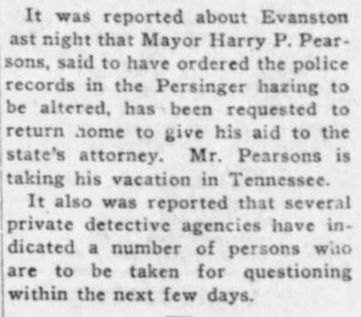


May 08, 1923:  MOUNT LOVE NOTES TO GIRL TO GRAND JURY; Dozens of Students are Summoned


May 09, 1923:  BOYS UPSET MOUNT INQUIRY; Mrs. Mount Tells Jurors of Son's Life; Reveals Love Note to Miss Fuchs

May 10, 1923:  'MOUNT SLAIN' THEORY GAINS; Drop Suicide View as New Clews Unfold; 'Wave Burial' Jolted by 3 Witnesses

May 11, 1923:  MRS. MOUNT BARES N.U. SECRETS; 'Scott Told me He Expelled 16' She Charges; Assails His Stories as "Campus Lies"

May 12, 1923:  BARE EVIDENCE GIVEN BY MILLS IN AKRON CASE; Forgotten Questions Come to Light; Believe Oath Seals Lips of Mount Hazers - Death Brought On Panic Detective Said; Scientists Say Lime Not Used on Mount


In the midst of all these new developments (but no answers) on May 12, 1923 the Chicago Tribune decided to print a story comparing and contrasting Northwestern president Walter Dill Scott's wife (who they refer to only as "Mrs. Walter Dill Scott" - her name was Anna Miller Scott) and Leighton Mount's mother Pearl Leighton Mount.  It's an interesting sidelight to the sordid tale:

MRS. SCOTT AND MRS. MOUNT DIVERGENT TYPES
Mother Calm; Other is Upset at Quiz

By Martha.

Mrs. J. L. Mount, the old-fashioned mother type, meets the world beyond her threshold hesitatingly.  It has so many facets, so many new experiences, that it rather baffles the quiet little woman who lives fullest within the family circle.  But she faced the grand jury investigation confidently, with matter of fact bravery,

She saw only Leighton Mount, the dead son who she must vindicate, as she sat in the jury room.

Mrs. Walter Dill Scott, the highly educated, literary, new woman type, welcomes new contacts with the world about her,  Equipped with an alert mind, a gracious poise and a developed imagination, she challenges new horizons.  But she quailed before the grand jury yesterday.

She saw twenty-three men waiting to interrogate her.  

Study in Contrasts.

These two Evanston women, recently questioned by the grand jury in its investigation into the death of Leighton Mount, who disappeared following a class rush at Northwestern university, present a contrast, sharp but subtle.

A criminal court, a flock of state's attorneys, and a grand jury.  They are not the normal experience of either of the women; the wife of the president of Northwestern university or the mother of the former university freshman.  But the woman who is the less accustomed to the limelight makes the easier adjustments to the calcium in this instance.

Her Great Battle.

Mrs. Mount went through her ordeal in the uncompromisingly Criminal court building, supported by one fundamental idea, a square deal for her only son whose sprawled out skeleton had been found beneath the Lake street pier, Evanston.  She happened to be fighting her battle in a grand jury room.  It might just as well have been a forest of wild animals, a bloody field of battle, a smart drawing room, or a rural front parlor.  

The setting would be an incident.

But to Mrs. Scott, one of Evanston's most prominent club women and writers, trained to make speeches, write books and entertain men and women of distinction, the grand jury room was --- the grand jury room.  There was no sustaining interest that could exclude from her mind, the shadow of those twenty-three men, the ominous background, the bewildering routine of the investigation.       

Now back to the daily headlines:

May 13, 1923:  MOUNT'S CHUM UPSETS QUIZ; 'Confesses' Then Denies Knowing All

May 14, 1923:  FATAL HAZING TO GRAND JURY 

May 15, 1923:  SECRET MOUNT QUIZ IS BARED; Suicide Clews Are Brought Forward

May 16, 1923:  TWO SCOTT BOYS REFUSE TO TELL "FRAT SECRETS"; Do Not Affect the Mount Case, They Say (son and nephew of NU president Walter Dill Scott)


May 17, 1923:  3 NEW TWISTS CAUSE FLURRY IN MOUNT CASE; $10,000 Reward; Scott Parley "Hot Tip" (in which Northwestern University complains that the Mount story has "unnecessarily held the front pages of the newspapers for sixteen days")

May 18, 1923:  JAIL GRID STAR ON GIRL'S STORY ABOUT MOUNT; Says Palmer Told Her He Was Alive

I'm sure Northwestern was very happy that on May 19, 1923 the Mount story was relegated to page 4:

May 19, 1923:  QUIZ BROTHERS OF DORIS FUCHS; Palmer Freed; Alumni Indignant Over Jailing of Star

May 19 also contained this "interesting" article:


On May 20, 1923 the Tribune reported that one of Leighton Mount's classmates decided it was time to implicate Leighton's father, John L. Mount and Leighton's former roommate Roscoe Conkling Fitch:


If it seems like investigators were chasing their tails, they were.  They were no closer to solving the Leighton Mount murder in 1923 than they were in 1921 - but that didn't stop people from continuing to come forward with new "information."

On June 2, 1923 Leighton Mount's former roommate Roscoe Conkling Fitch revealed his latest theory:


Fitch did not address my question about how Leighton Mount was able to cover his body with lime to speed up decomposition after he took his own life.
  
On June 14, 1923 the Grand Jury finally rendered their verdict:


The Grand Jury finally threw up their arms and said that Leighton Mount was slain by person or persons unknown.  Hopefully that would put an end to the ridiculous suicide theory.

The Chicago Tribune published an editorial on June 15, 1923 about the Leighton Mount case:

THE MYSTERY OF LEIGHTON MOUNT

A coroner's jury finds that Leighton Mount came to his death in a manner not determined, but it was of the opinion that it was at the "hand of some unknown person or persons.  The jury recommended that the police continue their investigation and that "such person or persons be apprehended and held on a charge of murder.

A good deal of criticism was directed at the Chicago newspapers in connection with this case.  The Tribune has printed some letters of complaint.  One reproach was that a murder had been committed by two of Ragen's Colts (an Irish street gang) and not much space was given to it.  People connected with Northwestern university, or interested in it, were provoked or embittered by the manner in which reporters handled the story and by the emphasis the papers gave it.

This young man, matriculated at the university, disappeared after a class rush, and twenty months later a skeleton, identified convincingly as his, was found weighted by rocks under a pier in Evanston.  That, whatever the solution of the mystery, is not an ordinary murder story.  The faintest appreciation of what is dramatic and of what is news, would indicate its appeal to the imagination and the sympathy. 

Such murders as to that the two Colts committed are a part of the almost routine crime of the city, and if newspapers gave them much space they would be roundly condemned for portraying only the drab of life.  What happened to Leighton Mount was different.  It involved all the dramatic details of mystery.  That accounts for it as news.

No one believes that the young man was deliberately murdered in the class rush, although he might have been killed in it accidentally.  Accidents may happen in such affairs.  The authorities and the reporters tried their best to find out what had happened and the attitude of the university was one of hush.  That was the mistake.

The university would have been much wiser if it had concerned itself with the case in the beginning.  The theory that the young man had run away or that he had killed himself could be considered, but it was the presumption at the university that he had done one or the other.  It even was held the he was not sufficiently associated with the school, having only matriculated, to make it a school concern, although his disappearance was connected with a class rush which might explain it.

If the university from the beginning had been determined to find out what had happened, it would not have been criticized, even if it had been found that Mount had been killed by an accident and that his body had been concealed by frightened students.  The mistake was trying to protect the university reputation by minimizing the matter, hushing it, presuming that at the worst it was merely an episode reflecting on the boy's character, etc.

When the skeleton was discovered, the university continued to take offense at reasonable attempts to determine how the young man had been killed, whether he had been murdered, how his body came to be under the pier.  It would be a queer conception of human nature to think that people would not be  interested in such a tragedy, and a conception of justice still more queer to think that the good name of a school should retard any search for information.  The university should have been the first to want it.

Uh-oh - Here we go again.  From the Chicago Tribune of June 17, 1923:

MOUNT "BURIAL WITNESS" FOUND; CASE REOPENED
Knows Four in Pier Band Traveler Asserts

I won't bore you with the details because it turned out to be a complete fabrication.  

From the Chicago Tribune of June 21, 1923:

'EYE WITNESS' TO MOUNT BURIAL ADMITS HE LIED
Wanted Way Paid to Chicago, He Says

And with that, Leighton Mount faded into the mists of time.  His name made the papers occasionally, when someone associated with his case did something notable or when they passed away, but no further clues as to Leighton's disappearance were ever forthcoming.  Almost one hundred years later, Leighgton Mount's murder case is still unsolved.  

But life went on for Leighton Mount's parents, John and Pearl Mount, and his sister Helen Mount.  Let's look at what happened to them.

The 1930 US Census shows that John and Pearl Mount have left Evanston - and who could blame them?  They are living in Sunnyside, Queens, New York, at 3951 46th Street.  Helen is not living with them.  

  
They own their home; it is worth $22,000.00.  The also have a radio.  John says he's 57, Pearl is 56.  John says he is an "Electrical Advisor" for an Educational concern; Pearl does not list an occupation.  John is not a veteran.

The 1940 US Census shows John and Pearl Mount living at 40 Nashville Road in Bethel, Fairfield, Connecticut.  Helen is still not living with them (don't worry, she'll be back - and quite interesting as it turns out).  The house that is currently there was built in 1961.  John is 67, Pearl is 65.  They own their home; it is worth $12,000.00.  John reports his occupation as a Teacher at Columbia University; again Pearl does not report an occupation.  John has finished 4 years of college, Pearl completed 3 years of college.  They said the lived in New York City in 1935.

In 1949 John and Pearl decided to leave the frozen north and retired to Eustis, Florida - to 824 East  Citrus Avenue:

  
Sometime after 1942 Leighton Mount's sister Helen A. Mount married noted Hollywood director Harry Jacques Revier aka Harry Jack "Three Fingers" Revier (1897-1957).  


Harry was the discoverer and former husband of silent film star Dorothy Revier (1904-1993).   

Dorothy Revier

He was also the man who brought the Tarzan stories to the silver screen.

By the time he married Helen, Revier had moved to Winter Park, Florida.  Perhaps that's where they met; Helen's parents by that time had retired to Florida as noted above.  Harry and Helen Revier lived at 227 Virginia Drive, Winter Park, Florida:

227 Virginia Drive, Winter Park, Florida

Harry Revier died in Winter Park, Florida in 1957 while filming another Tarzan movie.

Leighton Mount's father, John Livingston Mount died on January 7, 1961 in Eustis, Florida.  He was 88 years old.  Here is his death notice from the Orlando (FL) Sentinel from January 8, 1961:


His deceased son Leighton Mount is not mentioned in his death notice.

Pearl Leighton Mount, Leighton Mount's long-suffering mother died August 3, 1972 at the home of her daughter Helen, at 501 Osceola Avenue in Eustis, Florida.  She was 98 years old.  


Here is her death certificate:


Leighton Mount's sister Helen Revier remained in Florida after her husband's death in 1957.  In the 1970s Helen became a correspondent for the Orlando Sentinel newspaper and on August 20, 1978 she told the true story of the life of her deceased husband, Harry Jacques Revier.  

Helen A. Mount Revier died in Daytona, Florida on October 16, 1995.  She was 97 years old.

This brings us to the end of the story of the strange disappearance of Leighton Mount - or does it?  Where is Leighton Mount buried?  After all this blog is supposed to be the stories of people "under every tombstone."  The truth is, we don't know where Leighton Mount is buried.  His death record says that he died on September 22, 1921:


We know that his body was discovered on May 1, 1923.  According to the Death Record he was buried in Otsego, Michigan on July 22, 1929, eight years after his death and six years after his body was discovered.  

There are not too many cemeteries in Otsego, Michigan.  The largest one is the Mountain Home Cemetery (about 8,000 burials).  There is a smaller one called the Pine Creek Cemetery (only about 100 burials) and also a Catholic Cemetery, St. Margaret, but the Mounts were not Catholic.  Pearl Leighton Mount has a connection to Mountain Home Cemetery - her family has a plot there.  There are twenty-five Leightons buried there including Pearl's parents, Amos and Lottie Leighton:

Tombstone of Amos and Lottie Leighton, Mountain Home Cemetery, Otsego, Michigan

The Mountain Home Cemetery is too small to have an office, so I reached out to a fellow Find a Grave photo volunteer who had photographed many of the graves at Mountain Home:  Russ Holmes.  I emailed Russ and he responded within a few days:

Service team mr.russholmes@hotmail.com

Oct 11, 2019, 7:18 PM
to me
Jim,

Sorry but I have taken photos of every grave stone in Mountain Home cemetery and have no photo of Leighton.  I did not create the memorial but was wondering how the person that did create it knows he is in Mountain Home.  I searched the sexton records and they show no one by that name. Again sorry I cannot help.
Russ 

The memorial Russ mentions is the Find a Grave memorial page created for Leighton Mount that indicates he was buried in the Mountain Home Cemetery in Otsego.  It was created by Find a Grave member "HWA."  I reached out to them and they told me they just took the information right from the death record - they had no separate knowledge of either Leighton Mount or his burial place.  Another dead end?  Maybe not.

I was unable to locate graves for the following people in this story:  Leighton Mount, his father John L. Mount, his mother Pearl Leighton Mount, his sister Helen Mount Revier and her husband Harry Jacques Revier.  But a closer look at the records does give us some information:  

J.L. Mount's death notice does not mention an interment site.

Pearl Mount's death certificate shows that she was cremated at the Central Florida Crematory in Winter Park, Florida - no further interment information is given.  There is a Find a Grave memorial page for Harry Jacques Revier's saying that he was buried at the Winter Garden Cemetery but again no grave photo which makes me think there is no grave. 

I think Leighton Mount and the other members of his family were cremated and their ashes scattered.  

I fulfill a lot of Find a Grave photo requests for Acacia Park Cemetery here in Chicago.  Even though the death record (and even the death certificate) says interment was at Acacia Park, the cemetery records show that the deceased was cremated at Acacia Park, but the ashes (or "cremains" as they call them) were returned to the family, or to the funeral home, or were even scattered at Acacia Park.  Let's face it, after being in Lake Michigan from September, 1921 to May, 1923, there was not a lot of Leighton Mount left to bury.     

Typically I would not write a story for this blog without being able to show the grave(s) of the people involved - but the Leighton Mount story was too good of a story to pass up - even without a grave site.

May Leighton Mount and his family rest in peace.  

Friday, November 1, 2019

THE STRANGE DISAPPEARANCE OF A NORTHWESTERN UNIVERSITY FRESHMAN - Leighton Mount

As I write this article it is the beginning of autumn on the North Shore.  It's a beautiful time of the year here, with warm sunny days and cool crisp nights.  Growing up in Evanston, Illinois ("The City of Trees") I always looked forward to the fall as the thousands of trees change color before they drop their leaves down to earth to be raked up and burned with a delicious aroma like no other.  

Growing up in Evanston also meant another fall ritual - the arrival of students to Northwestern University.  Banners were strung across the streets saying "Welcome NU Students" and special booths were set up in the stores and the banks to assist the NU students in opening new accounts, because then as now, a lot of money flows through Evanston because of Northwestern.

The peace of Evanston was broken on Friday September 23, 1921 as the morning newspapers blared their headlines:  STUDENT LOST AFTER HAZING.  Hazing had always existed at Northwestern as it did (and still does) at most colleges and universities.  But it was always good natured fun - or so everyone thought.  But the true story was different - very different.  The article continues from the Chicago Tribune, September 23, 1921:


Search Lake and Wood for N.U. Youth

Search was started late last night for Leighton Mount, 18 year old Northwestern University freshman, when he failed to return to his Evanston home after participating in the annual freshman-sophomore fight which raged on the campus in the early hours of yesterday morning.  

Two automobile loads of his fellow-classmen drove to the forest preserve directly east of the Glen View Golf club and began an all-night quest for the youth.  It was thought he had been carried there, along with other first year college men, by the victorious sophomore battlers and is now incapable of finding his way back to civilization.


Lake Shore Searched.

Meanwhile, the university authorities and the Evanston police are aiding Mount's distracted mother in her efforts to find her boy.  Yesterday the lake shore along the edge of the campus was patrolled in the hope that he might have met "an adventure" similar to that of Arthur P. Persinger, the sophomore student who was bound to a breakwater near Calvary cemetery and rescued from probable drowning Wednesday night.

Leighton Mount lives with his parents at 1145 Judson avenue.  Thursday he joined the freshman hosts when they mobilized to fight their rival class.  Scrimmages occurred sporadically throughout the town and university grounds, and at 3 o'clock yesterday morning a band of first year men were lying in ambush near the Patten gymnasium.  


Are Taken Prisoner.

Harry Cook, of 224 Dempster street, an Evanston High school student, saw the young Mount among this crowd.  They had just captured and ducked a score of sophomores in Lake Michigan and were lying in wait for more victims.  Then a larger band of their rivals swooped down upon them in the heavy darkness and several prisoners were taken.  "I was captured with the rest," said Cook, "and made to drive a machine load of students to a spot beside the forest preserve.  There the sophomores ordered their prisoners to undress and the naked men were abandoned.  I don't know whether Mount was among those freshmen or not.  He might have been in another auto."


All Back But Mount.

Yesterday motorists traveling along the highways west of Evanston came upon several unclad unfortunates signaling for aid.  Throughout the day they kept trooping back to town in all manner of makeshift garments.  Some telephoned their parents and friends that they were in no danger.  By nightfall, all but Mount were found.  

Meanwhile his mother, Mrs. J. L. Mount, became apprehensive.  She got in touch at Plymouth, Wis. with her husband, an educational man traveling for the American extension university, and he returned to Evanston shortly after midnight.  He expressed indignation that the university had not undertaken an investigation earlier.  He proposes to have the lake dragged this morning and to employ private detectives to prosecute the search.  The latter searched the lake shore without success.  Then, as twilight was falling, Mrs. Mount made the trip to the forest preserve in company with Harry Cook, his brother, Thomas and Detective John Geischecker.  


Think They Hear Cry.

Along the road they moved at low gear, calling Leighton's name and sounding the klaxon.  Once they thought they heard a cry from the shadowy trees at their left, but it was too late to permeate the woods.    

Mrs. Mount notified Dean Roy Flickinger.  He told her all the missing students had been accounted for, she said, and failed to evince much interest.  When a reporter from The Tribune attempted to interview Dean Flickinger, he gave word through his secretary that he had nothing to say.               

President Walter Dill Scott was reached.  

"There's nothing to it," he said.  "The police are not worried and neither is the mother.  I have learned that young Mount had intended to go away today for a short time and I have also received word that he was seen this afternoon driving his mother's car through the streets of Evanston."

This report had apparently also been given to Dean Flickinger also, for when Mrs. Mount telephoned him and declared that one of the Cook boys had been piloting her machine throughout the afternoon he immediately promised to do all in his power to aid the search.


Mother Refutes Report.

"Leighton did not intend to go away today," she said, "and I know he would have sent word to me if he were able.  I'm convinced that he was taken to the woods, probably mistreated, and is now lying helpless somewhere in that forest preserve.  He was a good swimmer.  I do not believe he could be in the lake."

Meanwhile word of the youth's disappearance spread through the dormitories and fraternity houses of Evanston.  Early this morning, a party of freshmen, driven to the spot where the student captives had been taken, were searching the forest.  They were conducted there by Harry Cook and a Tribune reporter.  

Search was made along the roads with the aid of searchlights.  Then the freshmen, calling his name in concerted shouts, entered the woods.  No answer but the echoes.


Leighton Mount and his Mother

Mount's disappearance rocked the conservative Republican city of Evanston, Illinois, the home of Northwestern.  Before we look further into the strange tale, let's see what we can "dig up" about Leighton Mount. 

Leighton Mount was born August 26, 1903 in Boise, Idaho to John Livingston Mount (1872-1961) and Pearl M. Leighton (1874-1972).  Leighton Mount had a sister, Helen A. Mount (1898-1995) who unlike Leighton was born in Michigan.  

John L. Mount and Pearl M. Leighton were married in Otsego, Michigan on September 24, 1896.  John was 24 and reported his occupation as "Teacher"; Pearl was 23 and reported her occupation as "Student."  They were married by John's father George L. Mount, a "Minister of the Gospel." 

The 1900 US Census shows the young married couple living in Otsego Township where John was "Teaching School."  They said they had been married for three years and had one child: Helen, born in 1898.  They told the census taker that they owned their house free and clear, that John and Pearl could both read and write and that they were all able to speak English including 2 year old Helen.

Quite a few changes took place for the Mount family by the time of the 1910 US Census.  They were now living across the country, in Portland, Oregon at 91 East 62nd Street.  John was 38 and salesman for a book company.  Pearl was 36 and an "Artist for a Painting Company."  Helen was 12 and the new arrival, Leighton was 6.  Living with them also were Pearl's parents: 65 year old Amos Leighton (1844-1926) and 57 year old Lottie Healy Leighton (1852-1939).  Amos was working as a "Manufacturer" for a Lumber Company.  As it had been in the 1900 census, John told the census taker that they owned their house free and clear.  

The 1920 US Census would be the last one for Leighton Mount.  This time the family was living in Evanston, Illinois at 1511 Maple Avenue:


1511 Maple Avenue, Evanston, Illinois
  
47 year old John Mount said he worked for a university.  45 year old Pearl said she was a "Collector" for a university.  The rest of the house was occupied by 21 year old Helen A. Mount and 16 year old Leighton Mount.  This time they were renting an apartment as opposed to owning a house as they had in the past.

We know from the Tribune article above that in 1921 the Mount family had moved into a duplex at 1145 Judson in Evanston:


1145 Judson, Evanston


and that Leighton's father J.L. Mount was working as an educational man traveling for the American extension university. 

In his article about the Leighton Mount case for the NU newspaper North by Northwestern, author Matthew Zellner explains the history of  the Class Rush at Northwestern:

In 1921, Leighton Mount was an incoming freshman at Northwestern excited for the class rush. The class rush, traditionally held the Wednesday before the start of classes, was a rite of passage for incoming freshmen that took the form of an organized battle between the freshman and sophomore classes.

Class rush at Northwestern and many other schools had developed out of the “cane rush.” Canes were a symbol of distinction and honor in Victorian society, and it was impressed upon freshmen that they were forbidden from carrying them. Sophomores were tasked with enforcing this prohibition by any means necessary, until an annual competition was held in which freshmen could fight for the right to bear canes. This competition was called cane rush. It often took the form of a wrestling match over a single cane, in which each class would strip naked and grease themselves, then fight for the most hands on the cane.

After canes began to go out of style, class rush became more like an intense game of capture the flag. One night before classes, the lake shore would be divided up into a sophomore zone and a freshman zone. Each class would then attempt to sneak across the divide, kidnap opposing class members and “duck” them into the lake. Soon, it also became a tradition to kidnap “high-ranking” members of the opposing class during the week leading up to night of rush. Kidnapped students were sometimes taken as far away as Wisconsin and forced to hitch rides home.

By the time Leighton Mount was a freshman, class rushes had been going on for almost twenty years and had become highly organized. The Student Council even had a “Scrap Committee” that only a year earlier had been tasked with developing rules for class rush at the request of Northwestern President Walter Dill Scott in order to decrease the amount of injuries. Scott did not consider the rush to be in violation of Northwestern’s anti-hazing policy at the time, which defined hazing as “an interference with the personal liberty of another.”

On the night of September 22, 1921, according to a report in the Evanston News Index, Leighton kissed his mother goodbye and told her he was off to the “big scrap.” Leighton was then next seen near the old Patten Gym around 3:30 in the morning, after having ducked some sophomores. It would be the last time he would be seen alive. 

It will be important later to remember that the rush activities took place with the tacit approval of Northwestern's president Walter Dill Scott.


Walter Dill Scott

The Chicago Tribune from the next day, September 24, 1921 added some additional information to the story but deepened the mystery:


FATHER LOOKS FOR BOY BACK HOME TODAY

Developments in the Leighton Mount mystery late last night indicated that the Northwestern student's disappearance may have been the result of a "prank," either of fellow students or other persons.  It was reported at a late hour that the youth was sequestered in a flat somewhere in Sixtieth street and that he would be released sometime today.  

It was said that a group of the "conspirators"  were seen in a restaurant in the loop after midnight and that they afterward went to the south side house where the missing student was said to be sequestered.

Father Expects Him Home.

Meantime, J.L. Mount the father is said to be preparing to offer a reward for the discovery of his son.  And also the mother of the boy is near prostration from worry over the case.  

"I believe he is being held prisoner somewhere," said the father last night.  "I'm sure that he will be home by dawn and we are leaving the door unlocked and a light on the porch for him."

"But if he doesn't come back, I'll see my attorney."

Evanston police, however, have not ceased to consider that he may have been bound and thrown in the lake during the class fight.  Or perhaps that he is hidden in the forest preserve west of Evanston.

Last Seen Thursday at 3 A. M. 

The missing boy's movements were traced from 8:30 o'clock Wednesday night, when he left home to go to the scene of the class fight, until 4 o'clock Thursday morning.  

Harry Cook, 324 Dempster street, a chum of young Mount for several years, saw him in the university gymnasium at 3 o'clock in the morning, and two other students, Carl Oldberg and Henry Hassel, reported last night that they saw him there at 3 a. m.

Girl Tells of Suicide Threat.

Doris Fox, 24 years old, a former stenographer who was employed for some time as a nursemaid in the home of John D. Galbraith, 326 Dempster street, yesterday said that young Mount had said he loved her.  He threatened to commit suicide, the girl said.  But she said she didn't believe his disappearance had anything to do with his love for her.  She showed a note he had written to her on Wednesday night shortly before he disappeared, in which he told of planning to go into the freshman-sophomore college scrap.  This note also referred to his love for her.

"He told me," Miss Fox said, "that he wanted to die.He was brooding over something.  He said that he could go into the college scrap and just disappear.  He did not want his friends or relatives to think he would commit suicide."

Start Private Search.

The boy's father yesterday afternoon engaged an attorney, A.C. Burnham, with offices in the Wrigley building. to conduct a private investigation for him.  With the attorney he held a conference in the afternoon with President Walter Dill Scott of the university, after which he expressed his belief  that the university authorities were doing all in their power to find the missing boy.

The mother of the missing boy has had practically no sleep for three nights and is on the verge of an illness, despite his father's optimism.

Sunday, September 25th dawned and Leighton Mount was still not home - but according to the Chicago Tribune nobody seemed very worried:


VIEW VANISHING FRESHMAN AS TEAPOT TEMPEST
N.U. Student Willing Captive, Officials Agree.

Anxiety over the disappearance of Leighton Mount, Northwestern freshman who dropped out of sight during the class rush Wednesday night, seemed somewhat dissipated last night by rumors that he merely had allowed himself to be spirited away as a hoax.  It was reported he would return home today or tomorrow.  That likewise was the report Friday night.

Chief of Police Charles W. Leggett of Evanston called off the search for the youth, following a conference in his office with Walter Dill Scott, president of the university and Mayor Harry P. Pearsons.  Chief Leggett said all 3 were in accord in the opinion that young Mount's disappearance was in no way connected to student activities, his alleged despondency or a clandestine love affair.  He said university authorities had received information tending to substantiate a report that the boy is being held, a willing prisoner, in Chicago.


Father Not Worrying.

Even the actions of J.L. Mount of 1145 Judson avenue, father of the boy, were indicative that no grave concern was being felt for the youth's safety, although Mrs, Mount was said to be prostrated with grief.  Mr. Mount announced he was going to see Chief of Police Fitzmorris and demand a city-wide search by the Chicago police.  He did not see the chief.

He spoke of engaging private detectives to prosecute a search and of offering a reward.  He did neither.  Apparently incensed at the apathy of the university authorities, the father decided to protest to the board of trustees of the institution.  All arrangements were made for a visit to Oliver T. Wilson of Lake Forest, chairman of the board last night, but at the last moment Mr. Mount announced he would have to call the trip off, as he did not wish to leave his wife alone.


"No Great Hurry," He Says. 

"There is no great hurry," he said.  "If Leighton is dead we would be too late anyway, and if he his being held prisoner he probably is being well taken care of and he will be found."

One university official is said to have stated the boy was kidnapped for publicity purposes.  Mr. Mount said he had asked detective Sergeant Bourke to investigate this rumor and that the policeman reported it was without foundation.

"I never heard the report and I haven't made an investigation of any kind," said Bourke.  "I told Mr. Mount we could do nothing until formally requested by the Evanston police unless he could furnish us with information that the boy is in Chicago."

It was recalled that Frank Vaughn, then president of the sophomore class, was kidnapped and held for three days in a shack west of Evanston in 1914.

On Monday, September 26, the Tribune reported that Leighton Mount had come home!  ...or had he???


STUDENT "FOUND"; AGAIN MISSING
Officer tells of Midnight Call and Flight.

The return home of Leighton Mount, the missing Northwestern university freshman, was reported this morning.  He was recognized as he tried vainly to get into his home, 1145 Judson avenue, Evanston.

Gilbert Kelling**, 943 Ashland avenue, Evanston, a member of the state constabulary, was driving in Judson avenue at one o'clock.  He saw a Buick car stop at the home of Carl Jefferson, 1137 Judson avenue.  there were five men in it.


Recognizes Missing Student.

Kelling, fearing robbers, drove off.  He stopped about a block away, and from there watched the quintet.  He saw a man jump from the machine.  The man had on an overcoat much too big for him.  As he passed under an arc light midway between the machine and the Mount house Kelling got a full view of his face.  Kelling says it was Leighton Mount, whom he has known for years.

The light that the elder Mount had said would be burning for the return of his boy was not burning.  The man believed to be young Mount ran up the front steps and tried the door.  It was locked.  he then ran to a side door.  He was no more successful there.  He went to the back door.  He could not get in there, either.  From that time on he was not seen.  He had disappeared somewhere in the neighborhood.  


Mystery Car Drives Away.

Meantime the Buick had driven away and Kelling had notified the father of the student and the Evanston police.  Within a short time the police were engaged in the new hunt.  

Kelling says the driver of the Buick was a man about 30 years old with several days' growth of beard.  Kelling described the party as resembling "bums."  He thought they might be blackmailers who had brought young Mount home and sent him into the house to demand money from Mount's father.

**The Tribune continually referred to "Kilbert Kelling" throughout its reporting of the Leighton Mount disappearance.  Per ancestry.com the correct identification is "Gilbert Kelling," (1899-1928) a chauffeur for Mrs. P. D. Rathbone, 536 Sheridan Road, Evanston.  I will refer to him by his correct name, notwithstanding what the Tribune called him.

By Tuesday, September 27, the Tribune moved the story of the "missing" Leighton Mount from the front page back to page five:


"FRAT" HOUSES ARE SEARCHED FOR N.U. YOUTH

Northwestern university fraternity houses were searched yesterday by order of the student council in an effort to find Leighton Mount, the 18 year old freshman who disappeared Thursday morning following the annual fight between the first and second year classes.  The order was given as the result of persistent rumors that young Mount was being held prisoner by sophomore members of one of the "frats."

"I am convinced he went away of his own accord," declared Allen Mills, who is in charge of the student's search.

Mount's father is puzzled by the report made to the police yesterday by Gilbert Kelling, 943 Ashland avenue, Evanston, that he had seen the missing student leave a machine, try all the doors of his home at 1145 Judson avenue, in a vain effort get in and then vanish.  Mr. Mount said that for a time, when he was out, the house was locked, but he cannot understand why his boy did not return later.  

It seems the investigation was going nowhere fast as we can see by the Tribune from the next day, Wednesday September, 28th, the seventh day after Mount's "disappearance":


POLICE SEARCH "FRAT" HOUSE FOR MISSING N.U. BOY

Police Captain Dennis McEnery of Evanston searched the Delta Upsilon fraternity house yesterday at Northwestern university for Leighton Mount, the freshman who disappeared last Thursday following the annual struggle between the freshman and sophomore classes.

The search was made at the instigation of Mrs. Mount, who insisted her son was being held captive in the fraternity house.  No trace of the missing youth was found.

Mrs. Mount expressed dissatisfaction with the way Chief of Police Leggett was conducting the search.  The Evanston police accuse Mrs. Mount of withholding information.

So now the finger pointing begins.  Seven days since the disappearance of Leighton Mount and neither hide nor hair of him had turned up anywhere - except for the dubious middle-of-the-night identification by Gilbert Kelling.  Could Northwestern University President Walter Dill Scott have anything to do with this?  He has already dismissed the disappearance as "there's nothing to it."

Now we come to one week after the screaming headline ("Student Lost After Hazing") about the disappearance of Leighton Mount.  Interesting how quickly the word "hazing" disappeared from Tribune accounts.

Thursday, September 29, 1921, the story in the Tribune was pushed back to five lines on page seventeen:


EVANSTON YOUTH STILL MISSING; HUNT CONTINUES

Search that continued far into the night for Leighton Mount, Northwestern university freshman, who has been missing since a class "scrap" of last Wednesday proved futile.

They say that there is nothing older than "yesterday's news."  That certainly seems to be the case with the disappearance of Leighton Mount.  From screaming headlines to five lines on page seventeen just one week later, to total disappearance from the pages of the Tribune.  The next article about Leighton Mount comes on November 25, 1921, two months after his disappearance:


CLEWS TO FATE OF MISSING LAD TO WIN REWARD

Encouraged by the hope that his son is still alive, J.L. Mount of 1145 Judson avenue, Evanston, announced last night that he would pay a liberal reward for any information concerning the whereabouts of Leighton Mount, the Northwestern freshman who dropped out of site during the class rush Sept. 22.

Despite the failure of two months' search throughout the country for the lad, Mr. and Mrs. Mount expressed confidence last night that their boy was not dead and that their efforts would yet be successful.

Even the promise of a liberal reward turned up no new information as to the whereabouts of Leighton Mount.  Somebody must know what happened to him!

Nothing-nothing-nothing.  Finally a small article on July 21, 1922, 301 days after he was first reported missing:


MOUNT VICTIM OF AMNESIA MOTHER BELIEVES

Interest among Evanston police in the unsolved disappearance ten months ago of Leighton Mount, Northwestern university freshman, was revived last night when his mother, Mrs. J. L. Mount, 1145 Judson avenue, Evanston, disclosed a new possibility in the case.  He suffered a skull injury when he was a child by falling from a second story window, she said, and was warned by physicians to avoid excitement or strenuous exercise.  She believes he is still alive but has lost his memory.  

The disappearance led to a nationwide search last year.  On his third day in school, Mount joined his freshman classmates in the annual "prom fight" with the sophomores.  When the student combat ended at 3 o'clock in the morning Mount was gone.  The lake was dragged and numerous theories were investigated.  No trace of him was found, however.  Mrs. Mount said she is employing private detectives to continue the search.

And NU President Walter Dill Scott is again heard from, in the Tribune on September 15, 1922, almost one year after Leighton Mount disappeared:


N.U. SCRAPS "PROC" NITE OWING TO MOUNT MYSTERY

Students and faculty of Northwestern university united yesterday in deciding that "proc" night - due Wednesday by custom of time immemorial - shall not be held and shall be banished forever.  It's the annual scrap to a finish between freshmen and sophomores.  


President Walter Dill Scott gave as the reason for the decision (the) mystery surrounding the disappearance of Leighton Mount, a student during "proc" night last year.  He's never been seen since by Evanston folk, and a rumor spread that he had been held by his feet in the lake until he drowned.  This "absurd" rumor hurt the university, Dr. Scott declared, and it was decided to avoid any such possible danger in the future.  

So "proc" night with its slugging matches and its bruised and broken head goes out and in its place comes a comparatively sedate pushball game between the two classes on November 11. 

With that, Northwestern University brought the matter of the disappearance of Leighton Mount (which had "hurt the university") to a close.  NU President Walter Dill Scott hoped that with any luck he would never hear the name of Leighton Mount again. 

So, will we ever know what really happened to Leighton Mount?  Was he living comfortably on a Caribbean island with JFK, Elvis and Marilyn Monroe?  Was he kidnapped by aliens?  Did he commit suicide over his unrequited love of stenographer Doris Fox?  Was he walking around in the fog of amnesia as his mother suggested?  Was he put into the FBI witness protection program unbeknownst even to his own parents?  Believe it or not, the strange story of Leighton Mount is going to get even stranger!  Stay tuned for "The Shocking Conclusion to The Strange Disappearance of a Northwestern University Freshman - Leighton Mount" coming to this blog December 1st.


Leighton Mount
    

Tuesday, October 1, 2019

TWO SUBMISSIONS BY GUEST CONTRIBUTOR MATT VAN WINKLE: Rev. Frank J. Medford and Sgt. Myron L. Gregory

For a change of pace this month, I am going to turn the blog over to a guest contributor for two articles written by Matt Van Winkle from Aledo, Illinois.  I first contacted Matt when I was working on my article about Henrietta Cooley's bridge game:


I found out that the person I was writing about, Edyth Cabeen Griffin, was interred in Aledo, Illinois, a small town in Mercer County, about 200 miles southwest of Chicago.  I considered driving out there myself to take the grave photos but it would take me about 3 1/2 hours each way so I decided to try to find someone to photograph the grave for me.  I checked the listings for the cemetery in Aledo and found that quite a few grave photos had been taken by a man named Matt Van Winkle.  I reached out to Matt and he graciously agreed to photograph Edith Griffith's grave for me.  Over the next few days we emailed back and forth and I told him about this blog and how much fun I had doing the research and writing the stories.  Matt told me that he enjoys doing research on people who have lived in Mercer County and has posted over 1,600 of his Mercer County grave photos to Find a Grave.  

I had decided a while back to open the blog to guest contributors.  There are so many stories out there waiting to be told.  People might be reluctant to take on the responsibility of having their own blog but would be very happy contributing a story or two to my blog.  After corresponding with Matt I decided he would be a perfect contributor and after asking him, he responded enthusiastically that he would love the opportunity to contribute.  I have asked Matt also to tell us a little about himself, so you will find his bio at the end of the two stories he provided.  So, without further ado, here are two Under Every Tombstone articles written by Matt Van Winkle of Aledo, Illinois:

REV. FRANK JACOB MEDFORD
The man that history forgets, or never knew
By: Matt Van Winkle

Interesting things you find when digging through some old boxes, papers, and documents that people have either long forgotten or never knew about. I decided one cold, gray, wintry day that I would dive into the church’s messy unorganized archives just for fun. I particularly love looking at the old photos of times past and the people that once walked the halls of old buildings. Old buildings can speak a thousand words if given a chance. College Avenue itself has seen its fair share of memories and people that have come and gone before its eyes. 

On this particular cold wintry day College Avenue’s walls and memories spoke to me, and they had a lot to say. I stumbled upon a man that these walls knew all too well, a man whose voice rang out through the sanctuary for almost 23 years.  This man was the Reverend Frank Jacob Medford. To an average person today, Frank Medford would be just another person, or just another pastor that served College Avenue, but something caught my eye as I kept digging through College Avenue’s history. I kept seeing Frank pop up in places where all the other pastors didn’t. The more I dug, the more I would find until I finally had pieced his term as Pastor together, and what I found was astonishing. Frank Medford had served College Avenue through some of its best times and some of its darkest times. 

Frank started his call with College Avenue in 1926 with the opening of a brand new church which we still call home today every Sunday. Frank took an already proud and flourishing congregation and grew it more by getting the church more involved with the community by working together with the other churches in the area. At one point he got most of the denominations together and would hold a community service with all the congregations. By doing this, Frank became a big staple in the community and everyone loved and admired him.

Then, on December 6, 1941, news came that the empire of Japan had attacked Pearl Harbor; everyone’s lives changed forever, and some of the darkest days in Aledo and United States history would come. But because of one man, his tolerance of all faiths, and his strong faith in Jesus Christ, he was able to keep everyone’s hope alive, even when fear and sadness struck when the male membership in the congregation was decimated. When man dropped the Atomic bomb on Japan and the war ended, life started to come back to normalcy and resume where it left off prewar.

But tragedy again would strike on September 23, 1948. Frank Medford, the rock and strength and reason of College Avenue, had fallen. On an errand at the church, Frank fell and collapsed while talking with church members on the front steps. His heart had given out, and he passed in an ambulance on the way to the hospital. The congregation had lost their beloved minister that had given them leadership and spiritual guidance through the best of times and the worst times. But because of him, they were able to push through this hard time and band together and be as strong as before. Because they all loved and admired him, they gave him one of the most memorable memorials anyone could remember. 

Having researched all this, I grew a bond with this man even though he was before my time. His story reminded me of what the teachings of Jesus Christ are all about. Frank is buried in Aledo Cemetery with just a plain and simple headstone. I went to his gravesite and said a prayer, and I felt very uplifted at a time when I was melancholy. If you ever feel the need to go and say a prayer at his gravesite, you will come away feeling very uplifted as if he is still here for us beyond the grave. Frank may be in the beyond walking alongside Jesus, but he will live on in all of us at College Avenue, even years after his passing, because of the impact he had on this community.

Rev. Frank Jacob Medford


Here's a wonderful anecdote Matt discovered while researching the life of  Frank Medford:


Here is the second of Matt's stories:


SGT. MYRON LINDOR GREGORY
“A Memorial to Hard Work and Dedication”
By: Matt Van Winkle


I stumbled upon Myron Gregory while taking photos for the website Find a Grave in Aledo Cemetery. I found his story interesting, with he and his wife being faithful members of College Avenue Presbyterian Church and members of the community, I believe everyone should know his story and take a moment to remember him.

Myron was born in Walcott, Wayne County, New York, on July 31, 1841. In 1844, Myron and his family migrated to a farm in Delavan, Wisconsin. When war came in 1862, Myron enlisted in the 22nd Wisconsin Infantry, also known as “The Abolition Regiment.” On March 5, 1863, the 22nd Wisconsin, part of a brigade of about 1,850 men led by Colonel John Coburn, was in a two-day running battle with Confederate Brigadier General William H. "Red" Jackson’s Cavalry Division, which included a brigade of about a thousand men led by Nathan Bedford Forrest. Deployed on a hill just north of the town of Thompson’s Station, TN the 22nd Wisconsin took part in charges and counter charges of the Confederate forces.

At some point in the battle, confusion struck the brigade, and their artillery and cavalry retreated from the field, leaving the rest of the men outnumbered and outgunned. With the artillery being the only firepower to beat back any counter charges, and the Cavalry protecting the rear supplies and retreat route, Bedford Forrest saw an opportunity. He took a force of men and led them northeast, using the hills as cover in an effort to surround and cut off any chance of retreat for the Union brigade. Seeing what was happening to his brigade, Colonel Coburn decided to hold his ground. After severe fighting for 5 hours, during which the men held out against charges from all sides, Colonel Coburn decided further fighting was futile and surrendered his brigade. Myron Gregory was one of the 1,150 men taken prisoner at the battle. 

He and 200 comrades of the 22nd Wisconsin, as well as Colonel Coburn, were taken to the dreaded Libby Prison in Richmond, Virginia. He stayed there until exchanged on May 8, 1863, at which point he met up with the rest of the 22nd Wisconsin in St. Louis as they reorganized. After reorganizing, the 22nd served as garrison troops until they got redemption in 1864 under General Sherman during his Atlanta campaign and his famous march to the sea. At the end of the war, Myron saw the final surrender of Joe Johnston’s army in North Carolina and then marched in the famous “Grand Review” in Washington D.C. before being discharged. Along with the Battle of Thompson’s Station, Myron Gregory took part in many battles ranging throughout Kentucky, Tennessee, Georgia, and the Carolinas. Some of the battles were Perryville, Stones River, Chickamauga, Resaca, Cassville, New Hope Church, Kolb’s Farm, Kennesaw Mountain, Peach Tree Creek, The Siege of Atlanta, Lawtonville, S.C., Averysboro, N.C. and Bentonville, N.C. as well as several other minor engagements. Depending upon several factors—which theater of war, wounds, or illness—a Union soldier could expect to be in a couple of big battles a year and maybe a few minor engagements. Sgt. Myron Gregory took part in at least 24 battles and minor engagements.

Upon his return home to Wisconsin, he married Irene Williams on Sept. 16, 1865, and had two children, a son Charlton and daughter Anna. He and his family moved to Millersburg, IL in 1880 and then to Aledo, IL 7 years later. In my research I was able to find out a little bit about their lives while they were here. As well as being a faithful member of College Avenue Presbyterian Church, Myron worked in a flour mill. His wife Irene was blind the last 7 years of her life, and after her son tragically died during surgery for acute appendicitis, she took ill probably due to a broken heart. Irene died July 19, 1919. 

Their daughter Anna married a Mr. Wyman Smith, and she survived both her brother and her parents. Their son Charlton was a prominent citizen in Aledo, serving as superintendent of schools in Mercer County and as chairman of the examining board of the Grand Lodge of the Freemasons, but died at the age of 50 on September 12, 1918. 

Here is Charlton Gregory's grave in the Aledo Cemetery:


Seeing both his son and wife die within a short time of one another, Myron died on November 20th, 1920. He is buried in Aledo cemetery with a simple Civil War Veteran’s headstone that took the remaining family 7 years to buy.


Although not born and raised in Aledo, Myron showed and shared the hard working values and dedication that the people of Aledo and Mercer County have embodied since their beginning.


As promised, here is Matt Van Winkle's bio:

Matt Van Winkle

I was born and raised in Moline, IL to a German immigrant mother and a blue collar father. I grew up with a strong love of baseball and history. I’ve been married since 2017 and have a son who is virtually my mini me. I’ve lived your typical Midwest City life, but have traveled all over the United States and visited many countries in Europe.

I’ve been an American Civil War reenactor; I served as the 3rd Iowa Cavalry unit historian for a time. I’ve also been a genealogist for 10 years and have been writing baseball and history articles for the past two years. I currently live in Aledo, IL where my wife serves as a Presbyterian minister for two churches in Mercer County. For the last two years I have taken over 1600 photos of headstones for Find-a-Grave for the many cemeteries around Mercer County. .


A big thank-you to Matt Winkle for being our first guest contributor and providing two Aledo stories for my blog.  I have a feeling we'll be hearing more from Matt in the future. 

May Rev. Frank J. Medford and Myron L. Gregory rest in peace.