Thursday, August 1, 2019

WHO MISPLACED THEIR INVITATION TO HENRIETTA COOLEY'S BRIDGE PARTY IN 1935? Edyth Cabeen Griffin

You may remember the blog article I wrote in 2016 about restaurateur Roy Cooley and his wife Henrietta:

https://undereverytombstone.blogspot.com/2016/07/lets-all-meet-at-cooleys-cupboard-roy-w.html

Just recently I received the following email:

Hello Jim,

Googled this name on a Bridge Invitation for Mrs. Roy William Cooley from 1935.  We took out an old bookshelf that was attached to the wall where we found the invitation in back laying against the baseboard.  We are at 821 Forest Ave. near the Cooley's Michigan Ave place they live in the 30s according to your article.  Thought you would get a kick out of it.

Thanks,
Bryan Ripp

Bryan was correct - I did get a kick out of seeing the old invitation from Henrietta Cooley for her Luncheon-Bridge party 84 years ago:


As Bryan said, Roy and Henrietta Cooley had lived at 617 Michigan Avenue in Evanston but by 1935 they had moved to 3045 Normandy Place in Evanston:

3045 Normandy Place, Evanston, Illinois


I asked Brian if I could tell his story as a follow-up story on my blog to what I had originally written about Roy Cooley and he graciously gave his permission.  The more I thought about the story the more I wondered who had misplaced their invitation to Henrietta Cooley's Luncheon-Bridge party.  The occupant of 821 Forest may have received the invitation in the mail, or perhaps had a bridge party at her place where Henrietta Cooley handed out invitations to her upcoming soiree.  I decided to see if I could figure out who had been living at 821 Forest in 1935 and had been invited to Henrietta Cooley's party.  It turned out to be more difficult than I had anticipated.

First of all I checked the Evanston Directory for 1935.  Not the telephone directory but the Polk's Directory:

    
According to the Polk's Directory, the apartment building at 817-823 Forest Avenue was known as the Forest Crest Apartments.  According to Polk's here's who was living there in 1935:


But that didn't tell me who lived at 821 Forest.  I checked each name from the list with the Polk's Directory section by name and here's what I came up with:  (I highlighted the people who actually lived at 821 Forest)


But now I hit a brick wall.  Who had actually been invited to Henrietta Cooley's party?  Was it Lela Burt? Kathryn Kitzmiller? or Coralee Larimer?  And which of them lived in Bryan Ripp's apartment at 821 Forest?  I was stuck.  I decided to take a ride over to 821 Forest to see if I could get any inspiration from being at "the scene of the crime."

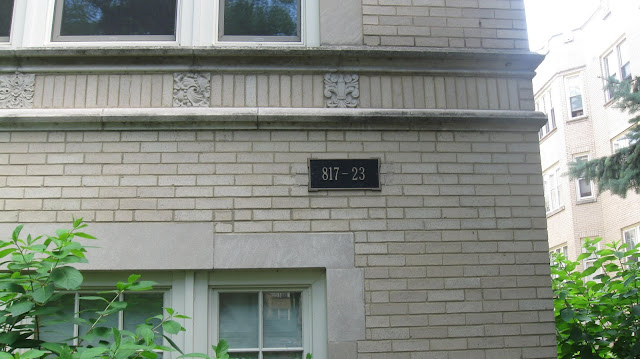
Friday July 26, 2019 was a hot summer day in Chicagoland - a beautiful day to take some photographs.  Here are some photos of 817-823 Forest I took this past Friday:
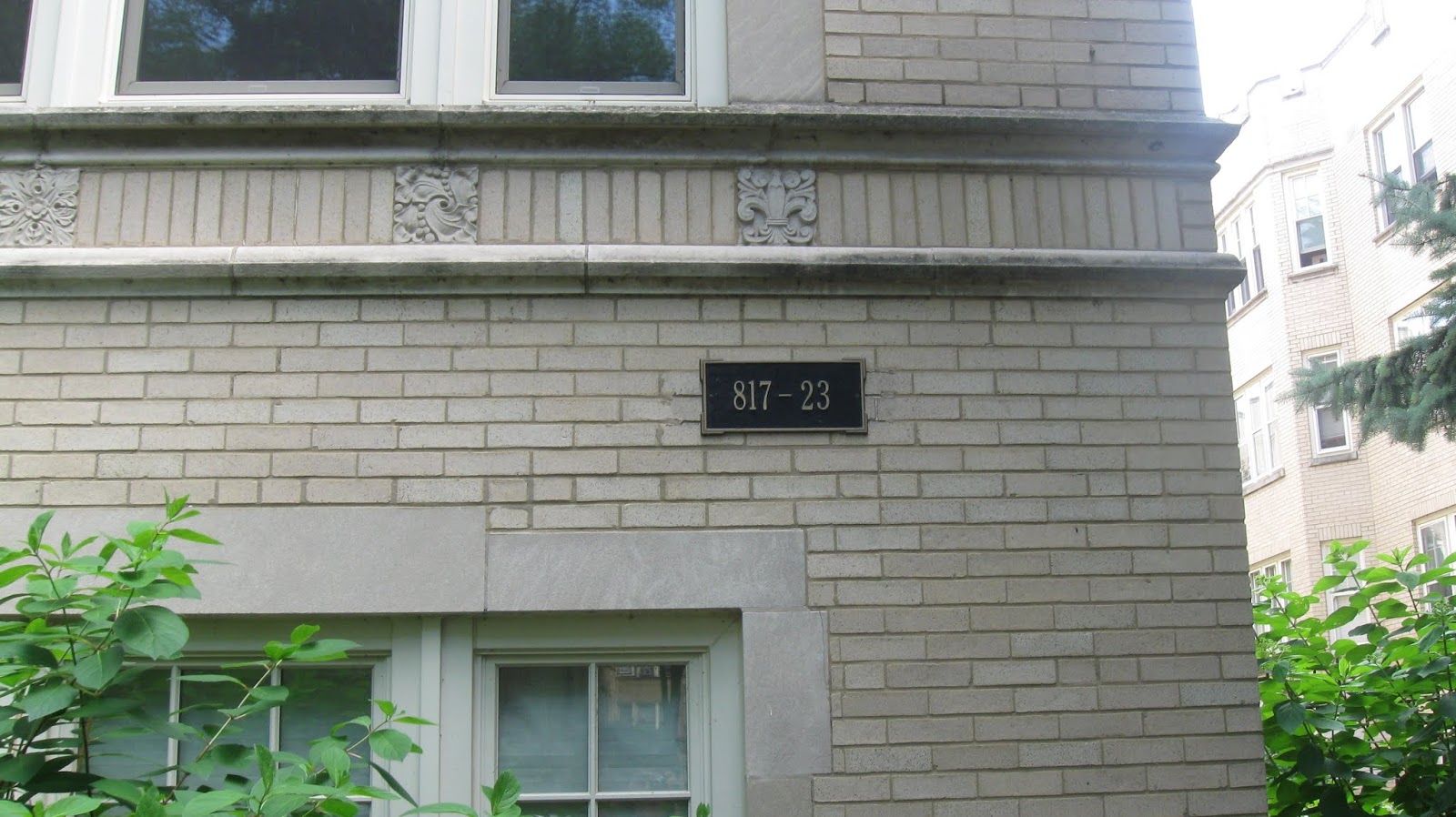


821 Forest is on the left side of this photo


Bryan Ripp lives on the first floor at 821 Forest.

I enjoyed seeing the beautiful vintage building at 821 Forest but that got me no closer to my goal of finding out who had lived at 821 Forest - First Floor, who had received an invitation to Henrietta Cooley's party.

I remember that Bryan had sent some additional photos so I thought I'd take a look at them again:

Bryan's email said: "FYI...Pictures of some bridge cards found along with the invitation."  


I took a look at the cards and saw that one had a monogram on it:


"cGe"  that didn't match anyone on my list from the 1935 Polk's directory for 821 Forest.  But wait a minute - the directories were always one year in arrears.  The 1935 Polk's Directory listed where people had been living in 1934.  To see who had been living at 821 Forest Avenue in 1935 I needed the 1936 Polk's Directory. 

Unfortunately ancestry.com does not have the 1936 Polk's Directory so I had to look elsewhere.  I decided to check the Chicago newspapers in newspapers.com for "821 Forest Avenue" in 1935.  And here's one of the entries I found:


Mrs. Edyth Cabeen Griffin, 821 Forest Avenue.  So now we know it was Edyth Cabeen Griffin who had been invited to Henrietta Cooley's bridge party and lost her invitation under the bookcase.  How did she lose it?  Perhaps she had hosted a bridge party at her apartment where Henrietta passed out the invitations to her upcoming party.  Cleaning up after the party Edyth may have gathered up a bunch of papers, etc., and unbeknownst to her some of the papers fell on the floor and slipped under the bookcase.  She may not have even known she misplaced the invitation or knew that it had slipped under the bookcase and was not retrievable. 

Now that we have solved the mystery of who misplaced their invitation to Henrietta Cooley's Bridge Party, let's see what we can "dig up" about Edyth Cabeen Griffin. 

Edith May Cabeen was born on November 22, 1878 in Abington, Illinois.  Her parents were Robert Jackson Cabeen (1822-1894) and Mary Elizabeth Pinkerton (1837-1905).  Edith had six siblings:  Samuel (1860-1862), Joseph (1862-1940), McClellan (1863-1929), Mary Violet (1867-1900), Harriet Elizabeth (1870-1960), and Robert Jr. (1876-1938).  Edith and her siblings were descended from Revolutionary War patriot Joshua Wright (1748-1819) of Pennsylvania.  Their father Robert was a farmer by trade. 

On June 27, 1906 Edith May Cabeen married Truman Alvah Griffin (1875-1940) in Aledo, Illinois.  Truman Griffin was a dentist.  He had been previously married to Bertha Ethel Auld who had died in 1902 from complications of the birth of their son Truman Aulden Griffin (1902-1970).  Truman Griffin was raised by his aunts.

Edith and Truman Griffin were blessed with four children:  Jackson Cabeen (1908-1909), Robert Cabeen (1910-1987), Mary Harriet (1912-1973) and Betty Jane (1920-1990).  The Griffin family was members of the Presbyterian Church.

After their marriage, Edith and Truman Griffin relocated to Macomb, Illinois.  All of their children except Betty Jane were born in Macomb.  I was unable to find the Griffin family in the 1910 US Census.

By 1917 the Griffin family relocated to Cedar Rapids, Iowa where Dr. Griffin established his dental practice in the American Trust and Savings Building.


The 1920 US Census finds the Griffin family living at 1727 Grande Avenue in Cedar Rapids, Iowa:

1727 Grande Avenue, Cedar Rapids, Iowa
   
The family consisted of Truman, Edith, Robert and Mary Harriet.  They were also renting rooms to two stenographers:  Helen Robb and Laura Tunley.  They told the census taker that they owned the house.  Dr. Griffin was a dentist, the children were at school and Edith was a homemaker.  Betty Jane Griffin would not arrive on the scene until December 20, 1920.  There must have been a problem with the registration of Betty Jane's birth because she had to get a Delayed Birth Certificate in 1972.

By 1930 the family had surprisingly moved to an apartment building at 1238 Fourth Avenue in Cedar Rapids:

1238 Fourth Avenue, Cedar Rapids, Iowa
  
Their rent was $65.00 per month.  The family now consisted of Truman and Edith and their three children.  Dr. Griffin was still a dentist.  Interestingly, Edith Griffin is now spelling her name "Edyth."

By 1933 Edyth and Truman Griffin were divorced.  Both were still living in Cedar Rapids, but separately.  By 1934 Edyth Griffin had left Cedar Rapids and by 1935 was living at 821 Forest Avenue, Evanston along with her three living children: Robert, Mary Harriet (now going by Harriet) and Betty Jane.  History does not record why she picked Evanston as her new home and we know that she did not stay in Evanston for too long.

In 1939 Edyth Griffin was reporting herself as the "Widow of T. A." although T.A. Griffin did not die until 1940 - wishful thinking, or a premonition?   

By the 1940 US Census Edyth Griffin was no longer living in Evanston - she had moved to Aledo, Illinois with her sister Harriett Sells.  Edith did not say she was a widow, she correctly reported that she was divorced.  They lived in Harriett's home at 408 S. College Avenue in Aledo:

408 S. College Avenue, Aledo, Illinois
  
Edith Cabeen Griffin died on April 17, 1949 at the home of her daughter Betty Jane (Mrs. Sheldon Allen) in Shaker Heights, Ohio.  She was 70 years old.  It is not reported what caused her death, nor was it reported if she was playing bridge when she died.  Here is her obituary from the Freeport Journal-Standard on April 18, 1949:


As mentioned in her obituary, Edith Griffin was interred in the Aledo Cemetery.  There was no Find a Grave record for her, and Aledo is 211 miles from where I live, so driving out to get a grave photo was unlikely.  I reached out to Find a Grave volunteer Matt Van Winkle and he was very willing to go to the Aledo Cemetery and take the appropriate photos for me.

Edith Griffin is interred in the Community Mausoleum in the Aledo Cemetery below the crypts of her sister and brother-in-law:


We'll never know who won the bridge game at Henrietta Cooley's on May 22, 1935, or if Edyth Cabeen Griffin was even able to attend.  But I'm sure we do know that a good time was had by all.

May Edyth Cabeen Griffin and all Henrietta Cooley's bridge players rest in peace.


Monday, July 1, 2019

CIVIL WAR HERO LIES IN NORTHFIELD CEMETERY IN AN UNMARKED GRAVE - Amanda "Manda" Dunlap

Recently Northwestern University in conjunction with the Evanston History Center made arrangements to have several vintage Evanston newspapers scanned and posted online for anyone who might be interested.  The line starts here!


I am enjoying every minute I spend going through these vintage newspapers page by page. At some point I am sure I will come across mentions of my Mother's family the Kramers who came to Evanston in 1905.  In the meantime I am adding obituary information from the newspapers to Find a Grave memorial pages.  While reading The Evanston Daily News issue from April 19, 1912 I came upon the following article:


Before we try to find the burial site of Amanda Dunlap, let's see what we can "dig up" about her.

Note:  I have mentioned in the past that genealogical research can be challenging at times.  As challenging as it is to try trace a White person's genealogy, trying to trace the genealogy of an African American can be even more frustrating.  Remember before the Civil War, slaves were thought of as chattels.  Very few births/death/marriages of slaves were recorded and often they had to depend on family lore for ages, dates, etc.  Even if they had wanted to record an event, many slaves and free females of the era could neither read nor write.  I mentioned in one of my blog stories about my own family that my great-grandmother Margaret O'Brien Donohue (1844-1915) could neither read nor write.  When she married Michael Donohue in 1866 she made an "X" in the Parish Register and witnesses swore that she had made "her mark."  So please keep in mind as we go forward with Amanda's story that any dates she related were from her own memory and probably not from a recorded source.

Amanda Johnson was born in Tennessee either in January of 1834 or February of 1845.  She reported both as her date of birth.  Additionally, the Evanston Daily News article above said she was eighty-seven when she died in 1912, making her year of birth 1825.  Her father was Joshua Johnson, a slave.  The Evanston Daily News article erroneously lists her maiden name as "Jackson."

Amanda Johnson told the census taker that she married George Dunlap in 1872.

The 1880 US Census shows a Black woman, Amanda Dunlap, living with her White husband, George Dunlap in the Village of Evanston, Illinois.  Evanston was not large enough in 1880 for residences to have individual addresses.  The census taker was Philo P. Judson, noted Evanstonian.  They told the census taker that George was twenty-six years old and had been born in Vermont, and that Amanda was forty-four years old and had been born in Tennessee.  George said he was a "Teamster," Amanda was "Keeping House."  Neither George nor Amanda could read or write.

The 1890 US Census for Illinois is, of course, lost.

The Evanston City Directory from 1895 lists George and Amanda Dunlap:


living at 919 University Place.  Senior housing occupies that address today.

The Chicago Chronicle newspaper ran a story about George Dunlap on January 30, 1897.  It told about the trouble he was causing due to his "periodical spasms of madness":


By the 1900 US Census Amanda was living alone.  According to the Evanston Daily News article, George had been admitted to the Elgin Hospital for the Insane.  Amanda said she was married, but George is not listed.  Amanda said she was living at 1610 Grant Street in Evanston.  This site is under the North Shore Channel today.  She said she had been born in Tennessee in February of 1845 which would make her 55 years old at the time of the census.  She said she was Female and Black and that she was a "Laundress."  She said she had been married twenty-eight years, and had never had any children.  She could neither read nor write, but she did speak English.  Finally she said that 1610 Grant was a house, and that she rented it.  Interestingly, she seemed to be the only Black person in the neighborhood.

The Evanston City Directory for 1900 shows both George and Amanda living at 1610 Grant, which, of course, is not true.

The 1900 US Census for the Illinois Northern Hospital for the Insane in Elgin shows George Dunlap as a patient.  It shows his age as 49, which would make his year of birth 1851.  It shows that he was married, was a Laborer, could neither read nor write but that he could speak English.


The 1910 US Census would be the last one for Amanda Dunlap.  She was living at 1732 Oak Avenue in Evanston as a boarder of a Black couple William and Lizzie Kincaid.  New apartments are on that plot today.  Amanda said she was 76 years old, and a widow.  She did not report any occupation but by this time could now both read and write.  Her landlord William Kincaid was a janitor at the YMCA.  According to the Census, both William and Lizzie Kincaid were born in Tennessee.  It's possible they knew Amanda during her time in Tennessee, or they may even have been distantly related.

The 1910 US Census for George Dunlap shows him in the same place as he was in 1900, but it is now called the Elgin State Hospital.  It shows his age as 59, but everything else for him is unchanged.  This is surprising in that Amanda told the 1910 Census taker that she was a widow. 

We know that Amanda died in 1912, but after the 1910 US Census the trail for George Dunlap grows cold.  I found a George Dunlap who died in Elgin in 1898 but we know from the US Census that George was still alive in 1910.  George Dunlap is not listed in the 1920 US Census as an Inmate at the Elgin State Hospital.  Having been a patient there for so long it is highly unlikely that he would have been released, so we should be able to find a death record for George in Kane County, Illinois for the period between 1910 and 1920. 

The Illinois Statewide Death Index shows only two George Dunlaps who died in Kane County (where the State Hospital was located):

 The first one died in 1898 and the second in 1909 - neither can be "our" George.  And the one who died in 1909 was only nine years old when he died.  Unfortunately we seem to have come to a brick wall for the end of the story of Amanda Dunlap's husband George.

Back to Amanda.  According to the newspaper clipping at the beginning of this article, Amanda Dunlap died on April 16, 1912 at St. Francis Hospital in Evanston.  Here's how St. Francis Hospital looked at that time:


Here is the information from her Death Record:

I had ordered a copy of her Death Certificate from Cook County, but they were unable to find it.
   
When I had originally read the Evanston Daily News story I decided that Amanda Dunlap would be a good subject for this blog, so I set out to find and photograph her grave.  Her Death Record said she was buried in "Northfield, Illinois."  I then checked Find a Grave and found that FAG volunteer L. Winslow had already set up a Find a Grave page for Amanda that shows that she was buried in the Northfield Oakwood Cemetery in Northbrook, Illinois.  There was no photo of the grave, nor any burial location information.  The Northfield Oakwood Cemetery is a small rural cemetery not far from where I live.  The cemetery is too small to have an office, so I looked online to try to find the burial location.  It turns out that the Glenview Public Library has the burial records for the Northfield Oakwood Cemetery online. Here is the burial Records for "Mauda" Dunlap:

Lot Number "Unk" - Unknown.  So I cannot show you Amanda Dunlap's grave.  I would guess that the Lot Number is unknown because there is no marker on her grave.  The Northfield Oakwood Cemetery is not too large so I decided to "mow the rows" to verify that Amanda's grave is unmarked.

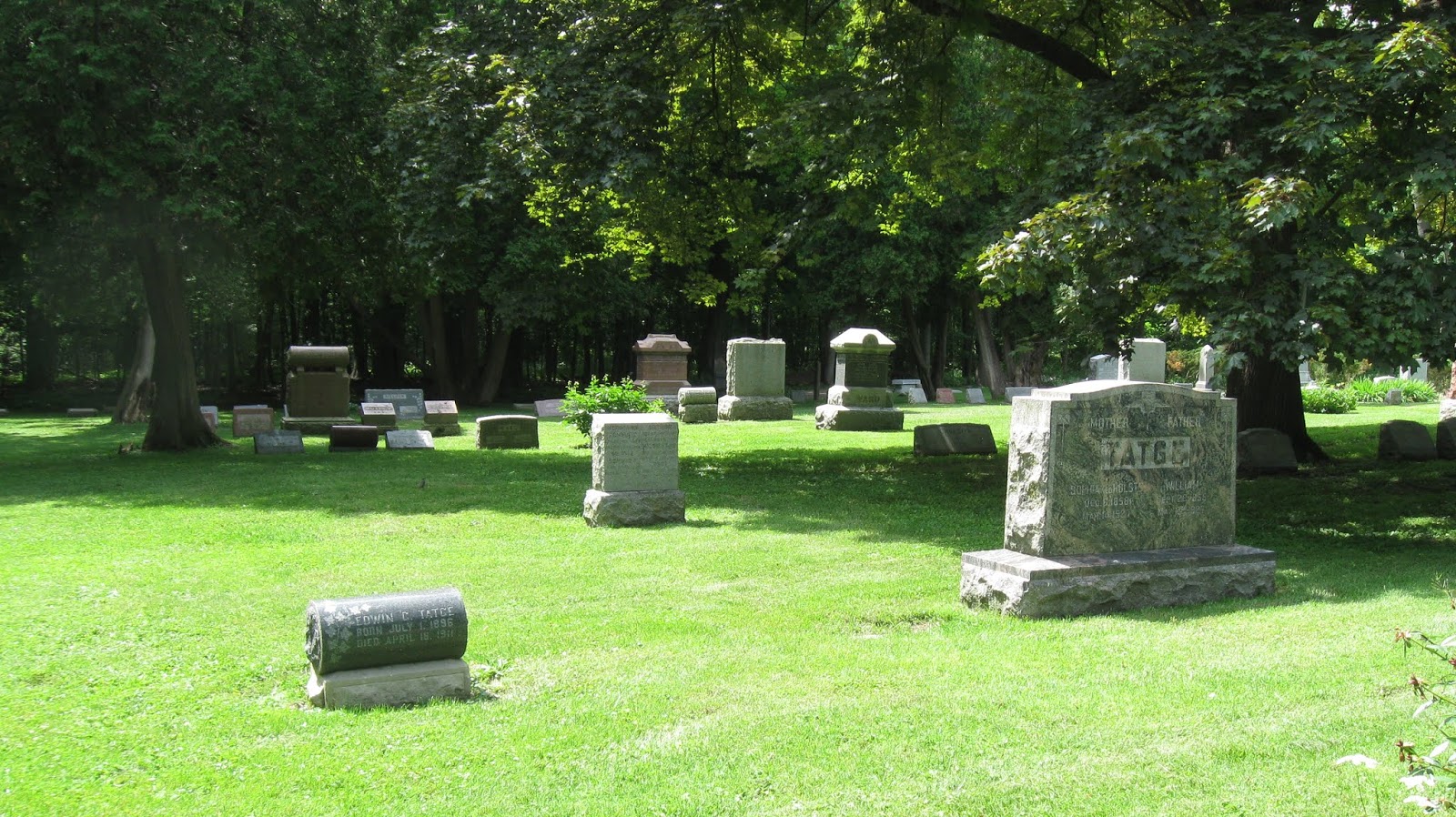
Here are some snapshots to give you an idea of the beauty of this little country cemetery tucked into the woods off of Milwaukee Avenue:


As luck would have it, as I was searching the cemetery the other day, a woman approached me and asked if she could help.  It turns out that she is Debbie Wendt, the Sexton of the Northfield Oakwood Cemetery:

I gave her the short version of the Amanda Dunlap story, and not surprisingly she knew nothing about it.  She immediately contacted her assistant and asked what records they had, if any, on Manda Dunlap.  Her assistant responded with a copy of Manda's Burial Permit:


The Burial Permit tells us that Manda's remains were being handled by longtime Evanston undertaker J. L. Hebblewaite (sic); that she died in St. Francis Hospital on April 16, 1912 at the age of 78 of Organic Heart Disease; and that her remains would be in a cemetery in Northfield, Illinois.  The Burial Permit was signed by beloved Evanston physician Ernest J. Ford.  

There is some interesting information on the Burial Permit.  First, the Place of Death: St. Francis Hospital.  In 1912 there were only two hospitals in Evanston: Evanston Hospital and St. Francis Catholic Hospital.  When Amanda Dunlap died, African Americans were not able to be treated in Evanston hospitals except for emergency situations.  This was the case until Isabella Garnett and her husband opened The Evanston Sanitarium and Training School in their home at 1918 Asbury Avenue in 1914.

Secondly the Undertaker:  J.L. Hebblethwaite was typically the undertaker used by wealthy White Protestant Evanstonians, not poor Black Evanstonians.

Thirdly the Cemetery:  Northfield Oakwood Cemetery.  The Northfield Oakwood Cemetery was not a cemetery for African Americans in 1912.  In fact, Debbie Wendt told me that except for Amanda Dunlap there were no other African Americans buried there to this day, although of course the cemetery is currently open to all who wish to buy a plot there.

Lastly the Physician:  Dr. Ernest J. Ford was a physician for White Evanstonians, not Black Evanstonians. 

I can't explain how Amanda Dunlap was able to receive the services typically denied to Black Evanstonians.  Perhaps she had a White "guardian angel" - a friend or previous employer who made sure she received the care she needed.  Amanda's husband was White, but there is no indication that any of his family was nearby. And truth be told, mixed race marriages were definitely frowned upon in those days.  How Amanda received these services will have to remain a mystery.   

Debbie Wendt and her associate checked the cemetery records and were unable to come up with the location of Manda Dunlap's grave, which brings me to the purpose of this article:  I think it is terrible that Civil War hero Manda Dunlap lies in an unmarked grave, 107 years after her death.  If she did have a guardian angel who supplied a burial plot, how come they didn't also provide a tombstone?

Go back to the beginning of this article and read Manda Dunlap's story again.  She was an escaped slave who attached herself to the Union Army as the cook for Colonel James Cameron.  During a bloody attack from the Rebel Army, she jumped on a horse and escaped, becoming attached to the camp of General John Schofield, becoming the general's personal cook.  During the siege of Knoxville, Tennessee she risked her life to travel behind the lines to procure food for Gen. Schofield and as far as I could tell, stayed with him until the war's end.

As we all know "An army travels on its stomach" and it is a grave injustice (no pun intended) that Manda Dunlap who served faithfully and even risked her life for the Union was denied a pension from the US Army, and it is even worse that that brave heroine lies in an unmarked grave, forgotten to this day. 

The Northfield Oakwood Cemetery has a monument on which is inscribed the names of all persons buried in that cemetery who served in the US military.  Debbie Wendt assured me that now that they know the story of Amanda Dunlap, her name will be added to the monument.


Perhaps someone who reads this story will have the ability to have a military tombstone provided for Amanda Dunlap.  Unfortunately we don't know where in the cemetery her grave is, so the tombstone would have to be set somewhere else in the cemetery that is appropriate.  When the Sons of the American Revolution had a new tombstone issued for my 4th great-grandfather Francis Malone in the Helts Prairie Cemetery in Hillsdale, Indiana the exact location of his grave was unknown, so they erected the new tombstone next to the flagpole.  I suggest that something similar could be done at the Northfield Oakwood Cemetery for Amanda Dunlap.

The purpose of this blog is to see that the subjects I write about are not forgotten.  Once something is on the Internet it's out there forever, so hopefully Amanda Dunlap will finally get the recognition she deserves. 

May Amanda Dunlap and her husband George rest in peace.

PS - According to Debbie Wendt, burial plots are still available in the beautiful Northfield Oakwood Cemetery.  You do not need to be a resident of Northfield or Northbrook to buy a plot there.  In addition to the beautiful surroundings, grave prices are significantly lower at Northfield Oakwood than at other local cemeteries.  Check it out!