Monday, July 1, 2024

THE UNUSUAL BURIAL SERVICE OF W. B. Daniels - Part One

When writing these articles about people of long ago, I usually leave the details about their funerals and burials until the end of the story.  This time, however, I will begin the story with the description of the funeral and burial of W. B. Daniels as reported by the Chicago Inter Ocean Newspaper of January 3, 1891:


William Bradley Daniels


AN UNUSUAL BURIAL SERVICE.

A funeral service of a very unusual character took place at Rosehill Cemetery New Year's Morning.  It was the burial of the cremated remains of W. B. Daniels, the millionaire dry goods merchant of Denver, Col., whose death occurred a few days ago.

A year or so before his death, Mr. Daniels wrote over his duly attested signature minute instructions for the disposition of his body.  It was addressed to three well-known and trusted friends, one of whom was Judge Benedict, of the law firm of Benedict & Phelps, of Denver, and another one was the deceased gentleman's partner in the firm of Daniels & Fisher.  

It was directed that after his death his body should be placed in a coffin and carried by expressly named pall-bearers to a depot, and thence to a crematory to be approved and chosen by these three friends, and there, under their personal observation, cremated.  After cremation, the ashes were to be placed in an urn and taken to Chicago, there to be deposited by the side of his wife, in Rosehill Cemetery.  All these directions the three friends faithfully and minutely followed.  The body was cremated at Detroit under their personal inspection, and the ashes were brought to Chicago for burial.

Under a pitiless downpour of rain New Year's morning, these three gentlemen, with some of the relatives of the deceased millionaire, stood around the family vault, while in the arm of one man was held a vase about the size of a silk hat, about half full of what looked like chalk in tiny bits, some very porous, others close and stony, and none of them larger than a green pea.  The service was that of the Episcopal Church, conducted by the Rev. H. Digby Johnston, late of Denver, but now of this city, and despite the solemnity of the occasion it was impossible to repress some of the grotesque as the reverend gentleman endeavored to adapt the familiar service to the particular case.  

The urn, being placed in the vault, was covered by a marble lid, which was cemented in its place.

It is said that the deceased gentleman has left an only child, a delicate son now in Japan, and that in the event of his decease under thirty years of age the bulk of the great fortune, estimated at $3,000,000, ($103.4 million in today's funds) is to go to Dean Hart, of St. John's Cathedral, Denver, or his successor, for the benefit of the Episcopal Church.


Before we re-examine the last wishes of W. B. Daniels, let's see what we can "dig up" about him.

Many sources say that William Bradley Daniels was born in Fabius, Onondaga County, New York.  However, when he applied for a United States Passport in 1872 he said that he had been born on the 6th of January, 1825 in the Town of Franklin, New York.  Franklin, New York is in Delaware County.  His parents were William Daniels, sometimes reported as Isaac Daniels (1799-????) and  Cornelia "Ella" Bradley (1800-1881).  William Daniels had one sister:  Sarah Matilda Daniels/Mrs. George Kenyon (1830-1929). 

Daniels makes his first "official" appearance in the 1850 US Census when he was twenty-six years old.  He is living in Friendship, Alleghany County, New York with merchant William Collwell.  He is also working as a Clerk for Collwell who owned a general merchandise store.  William B. Daniels reported that he owned personalty worth $100.00 ($4,198.00 in today's money).  

By 1856 Daniels had moved to Iowa City, Iowa.  Henry Potwin, the prominent Chicago merchant took him in as a partner in his Iowa City commercial operations.  Daniels ended up managing the business for eighteen years maintaining homes in Iowa, New York and Chicago.  In the 1856 Iowa Census he was thirty-one years old but reported that he was only twenty-six.  He listed his trade as "Merchant."

The 1860 US Census shows Daniels as still living in Iowa City, Iowa.  He reported that he was thirty-five years old, was a Merchant, and had real property valued at $100.00 and also personalty valued at $100.00 ($3,770.00 in today's money).  

Wedding bells rang for W.B. Daniels when he was married on February 27, 1861 in Cook County, Illinois.  The bride was named Elizabeth Phrosenis "Libby" Coon (1836-1881) and was the daughter of D.L. Cook of Chicago.  Some sources spell her last name "Cooke."  The groom was thirty-six; the bride was twenty-five.

Elizabeth Coon Daniels


Chicago Tribune - 27 Feb 1861

Was Libbie's last name "Coon" or "Cook"?  The Tribune referred to her as "Mrs. Libbie Coon" implying that she had been married previously.  They also said the bride's father was "D.G. Cook".  I was not able to find any evidence that Libbie had been married before she married W.B. Daniels.  When she and Daniels had a son, they named him "William Cooke Daniels."  My educated guess is that her name was Libbie Cooke and that Daniels was her first husband.  Newspapers have been known to make mistakes.  If anyone has information to the contrary, please pass it along.

In 1862, Daniels branched out on his own.  William B. Daniels & Company was founded in Iowa City, Iowa, moving into a former stove store in the Powell Block.  The company was listed as offering wholesale and retail dry goods and groceries.  It was said that Daniels did an extensive business with merchants from towns as far as 40 or 50 miles from Iowa City.  They would be lined up outside his store with their teams and wagons when he opened for business in the mornings to purchase merchandise for their stores.  1862 was in the middle of the Civil War, and business in the North was booming.

Speaking of the Civil War, W.B. Daniels registered for the Draft in July of 1863.  He was listed as: Daniels, William B., 38 years old, White, from Iowa City Township, and a Merchant who had been born in New York.  There is no record of Daniels actually serving in the military.

Even though his business in Iowa City was doing very well, Daniels must have determined that there was even more money to be made by going further west.

First he moved to Fort Leavenworth, Kansas establishing the mercantile firm of Daniels, Millington & Co.  Fort Leavenworth was on the direct stagecoach and wagon road to the Pikes Peak gold diggings in Denver.  Daniels shipped many a wagonload of merchandise to Denver, finally making the decision to relocate to Denver permanently.  

In 1864 Daniels moved his enterprise to Denver, Colorado, at that time considered in the middle of nowhere.  At the beginning, W. B. Daniels & Company was comprised only of W. B. Daniels, and his brother-in-law W. R. Kenyon as manager in charge.  At its founding, it was housed in a little store near Fifteenth and Blake Streets.  The business quickly grew and soon new quarters were established on Larimer Street near Fifteenth and in 1869 still larger quarters at 390 Larimer Street became necessary. 

By 1865 in addition to Denver, W. B. Daniels was the principal owner of the Daniels & Cohen clothing store in New York City, and stores in Iowa City and Leavenworth, Kansas.

In 1870 W.B. Daniels and his wife moved to New York City.  Elizabeth Daniels was due to have a baby and perhaps she wanted to be near her husband when her time came due.  At that time Daniels was spending six months of every year in New York.

William Cooke Daniels (1870-1918) was born in New York on March 29, 1870.  He was to be their only offspring.

The Census Enumerator for the 1870 US Census visited the Daniels family on June 23, 1870.  They were living in the 1st Election District of the 22nd Ward in New York City.  The Daniels Family was living with Joseph Cutter, a lawyer.  The family consisted of  William Daniels (45 years old), Libbie (34) and their son William (2/12).  They told the Census taker that William had been born in April, but he had actually been born in March.  Also living with them were two servants:  George Brown (23) and Annie Emory (50).   W. B. Daniels did not report any occupation to the Census Taker.

By 1872, Daniels had returned to Denver.  He now partnered with William Garrett Fisher (1844-1897) to form Daniels, Fisher & Company.  By doing this, he transformed his business from a dry goods store to a prestigious department store.  From the time the doors first opened,  the store was said to have "an unmatched reputation for excellence in fashion and fabric, in ware and utensil, in stock and garment." 

Daniels, Fisher & Co.

There was not a shoddy article in stock, and everything was well worth the price it brought.  Besides, it was tastefully displayed, and the business, though small, gained a reputation of reliability and square dealing.  Miners and plainsmen realized that conditions made them somewhat subject to the exploitation of tradesmen.  The tradesmen considered that they had done well to even assemble any fairly good stock at a point so far remote from the settled borders of civilization.  Once established, the business grew and grew.  In 1875 they moved to Sixteenth and Lawrence Street and changed their name to just Daniels & Fisher.  It was not long before D & F was being compared to Marshall Field's in Chicago or John Wanamaker's in Philadelphia.

In 1875 Daniels was taken seriously ill and went to Europe for his health, staying there three years.    

The 1880 US Census finds the Daniels family living in 1/2 of a double house in Denver, Colorado, at 354 Champa Street.  That number no longer exists on Champa Street today.  The family consisted of William B. Daniels (55 years old), wife Libbie E. (43) and son William C. (10).  William listed his occupation as "Dry Goods - Wholesale and Retail."  Libbie was "Keeping House" and young William was "At School."  They also have a Servant/Housekeeper living with them:  Mary E. Palmer (24).

Although he spent six months of every year in New York, it was said that Daniels made his headquarters in Denver to accommodate his wife who suffered from lung trouble, and his son who was said to be "none too robust."  Apparently the dry sunshiny atmosphere of Denver was more conducive to their health than other areas of the US.

Newspapers of the time described Daniels as "a man of most vigorous temperament, in business affairs considered a peer of any man in the West.  His manner is rather austere, not given to flattery or any form of deceit, yet generous, sympathetic and kind."  Every month Daniels turned over $500.00 to his partner Fisher to distribute to "those who really need it," on the condition that no one ever know who the money came from.

William Daniels' mother Cornelia Bradley Daniels died March 16, 1881 in  Iowa City, Iowa.  She was 80 years old.  I was unable to determine when or where Daniels' father died.

William Daniels' wife, Elizabeth Cooke Daniels had suffered on and off from lung trouble for years. She left Denver for New York in January of 1881.  In May of that year as her health worsened she had sought treatment from a Cleveland doctor who specialized in lung-related illnesses.  The treatment was unsuccessful and Mrs. Daniels died on June 22, 1881 at 401 Superior Street in Cleveland, Ohio from consumption (tuberculosis).  Her husband was at her side when she died.   She was forty-five years old.  401 Superior is now the Cleveland Arcade, built in 1890.  She was buried in Rosehill Cemetery in Chicago.  She was described as "a lady of culture and refinement and beautiful character."  Her estate totalling $71,000.00 ($2.18 million in today's funds) was left to her husband and son.  

This appeared in the Iowa City (IA) Morning Democrat of October 29, 1885:


Apparently W.B. Daniels did not like being single.  Less than one year after the death of his wife, he became enamored with his son's elocution teacher.  She was known as "Lillian B. Abbott" and also by the more exotic name of "Donna Madixxa."  Daniels was said to have been infatuated with her from the moment they met.  

Lillian B. Abbott/Donna Madixxa

Newspapers of the time described her as "gay and gorgeous." She had been married twice previously.  Her first husband died, and she was divorced from her second husband.  She then attained some prominence as an elocutionist and was said to be a tall, splendid looking lady when Mr. Daniels met her.  

Daniels may have been infatuated but she said she was going to make him marry her, and she did.  From then on, her life was a poem.  Her dresses, all made in Paris, cost from $500 to $1500 each ($15,000 to $46,000 in today's funds).  Her carriage and team of horses was the amazement of Denver.  She was beautiful, witty, lively, fascinating.  She was said to be a crack shot and a daring rider, a fairly good boxer and a splendid talker.  She enjoyed all sorts of company and at all sorts of hours - but she was virtuous.  At least they never succeeded in proving the contrary after the most exhaustive research.  

On December 26, 1881 Daniels arranged to have the following letter published on Page 1 of the Denver News:

Mrs. Lillian B. Abbott:

Dear Madam - The reputation as an elocutionist which your efforts for the benefit of your classes here have gained for you, has impressed us with a desire that the public be afforded an opportunity to witness an exhibition of your accomplishments in that branch of literary exercises.

We therefore earnestly request you to give an evening entertainment of dramatic reading at the Grand Opera House in Denver at such time as will suit your convenience.

The letter was signed by fourteen of Colorado's foremost citizens, including Daniels.

William Bradley Daniels and Mrs. Lillian Abbott/Donna Madixxa were married in Old Lyme, Massachusetts on July 8, 1882.

The Second Mrs. W. B. Daniels

In 1885, perhaps due to the influence of his business partner W. G. Fisher, Daniels became interested in the breeding and raising of "trotters."  Trotters are horses used for harness racing.  Virtually forgotten today, harness racing was a very popular sport in the late 1800s.  Chicagoans may remember Sportsman's Park "Where the great ones ride" that was a racetrack dedicated to harness racing.

By 1886 as far as his second wife was concerned, the bloom was off the rose and Daniels decided he wanted a divorce.  He sent Mrs. Daniels to Europe to get her out of his hair (what little hair he had), and while there she spent $75,000 ($2.5 million today).  In the divorce negotiations, the second Mrs. Daniels asked for $25,000 yearly alimony ($861,000 in today's funds).

The negotiations did not seem to be going very well because on March 8, 1885 Mrs. Daniels sent Mr. Daniels the following letter:

Windsor Hotel, Denver - February 28

To:  Mr. Daniels -

I have this moment heard that you have contemplated, or already have made defamatory statements about me.  You know, and I know that you know, that they are false, and are made for the sole purpose of shielding yourself from the consequences of the many wrongs I now suffer at your hands.  If such statements have been or shall be made by you, or through your agency, as there is a God above, I will kill you the first time I meet you.

(Signed)                                                                    "LILLIAN DANIELS"


The divorce was finalized in Denver on March 16, 1886.  Not all of the terms of the divorce were made public but it is known that Daniels paid his former wife a lump sum payment of $50,000 plus he deeded several parcels of Denver real estate to her.  In exchange he demanded in addition to an end to the marriage, that Lillian leave Denver, never to return.  

After the divorce was final, Daniels continued running Daniels and Fisher and breeding champion trotters, and the former Mrs. Daniels joined a little theatre group - the Helen Blythe Creole Company - that traveled around the US and Canada.  It was reported that Lillian Daniels/Donna Madixxa received $10.00 for each performance ($334.12 in today's funds).  

In 1888 while driving his famed team of black stallions Daniels was thrown from the carriage and incurred serious injury when the horses ran away.  He had suffered an apoplectic stroke but it was never determined whether the stroke caused the runaway or the runaway caused the stroke.  The stroke left him partially paralyzed for several months.

An article from the Valley Falls (KS) New Era newspaper from November 15, 1890 talks about Daniels' continuing interest in the breeding and raising of trotters:


In November of 1890 Daniels suffered another stroke, which left his right side paralyzed.  He was bedridden and confined to his home, where in mid-December he was victim of a severe attack from which he failed to rally.  On Christmas Eve, December 24, 1890 W. B. Daniels died in Denver, Colorado of "paralysis."  He was sixty-five years old. 

At the time, his son Willie, now nineteen years old, was in Yokohama, Japan. 

From the very beginning, as had been his request, the death and funeral arrangements of W. B. Daniels were shrouded in secrecy.  There was no grand obituary on the front page of major newspapers, or anywhere else for that matter.  Just a few minor mentions.  

In Denver, his obituary was on Page 6 of the Rocky Mountain News under the title "Another Has Gone - The Men Who Built Up Denver's Greatness Are Very Rapidly Passing Away." 

Here's a typical notice from the Scranton (PA) Republican from December 25, 1890:


Here is a mention from the Quad City Times of December 30, 1890:


There is a mystery surrounding where Daniels was cremated.  Why was Daniels, who died in Denver, cremated in Detroit?  In 1890 Denver had no crematory.  Forbes Parkhill in his book Donna Madixxa Goes West says that two of the three hand-picked trustees of the estate, Judge Mitchell Benedict and Daniels' former partner William G. Fisher were not satisfied with the Detroit crematory and proceeded to Chicago, where Daniels' body was cremated.  That is not possible. 

I asked my friend Jason Ryan Engler "The Cremation Historian" if one wanted to have a body cremated in Chicago in 1890, what crematoriums were available?  He told me that Chicago did not have a crematory until 1893 when the one at Graceland was built.  Daniels' cremains were ultimately buried at Rosehill but he was not cremated there.  Rosehill did not have a crematory in 1890 and still does not have one today.  Bodies slated to be interred at Rosehill were routinely cremated at Graceland Cemetery which did have a facility for cremations but not until 1893. History does not record where the actual cremation of Daniels' body took place, but it was not in Chicago.  

So, as indicated at the beginning of this article, Daniels was cremated, then the cremains (were) placed in an urn.  "In the arm of one man was held a vase about the size of a silk hat, about half full of what looked like chalk in tiny bits, some very porous, others close and stony, and none of them larger than a green pea."  This is extremely unlikely.  The urn would not have been uncovered, leaving it open to the elements, nor would mourners be able to see the cremains as described by the News Index account.  The account continued that the "urn, being placed in the "family vault" in Chicago's Rosehill Cemetery, was covered by a marble lid, which was cemented in place."  

This ends the story of the life of William Bradley Daniels - or does it?????

Come back next month for the rest of the story.  You will notice that unlike most of my stories, I have not provided a photo of the final resting place of W.B. Daniels and his first wife.  Why not a photo of the "family vault in Rosehill Cemetery?"  Because there isn't one.  Neither the Daniels nor the Cooke families had (or have) a vault in Rosehill Cemetery.  There is a Daniels burial plot and a Cooke burial plot, but no family vault.  Furthermore, the Community Mausoleum at Rosehill was not completed until 1914.  Are Daniels and his first wife at Rosehill, and if so, where?  Another issue to be examined is what happened to Daniels' considerable estate?  Were his assets distributed as he had directed in his will?   Was his divorce from his flamboyant second wife valid?  If not, was she entitled to a 50% share of the considerable estate per Colorado law?  Here's a taste from the Kansas City Times of December 29, 1890:


And what about Little Willie Daniels?  Would he ever return to the United States?  Would he take over his father's role in running Daniels & Fisher?  How much of the estate would he end up with - if any?  Well, as Al Jolson said in 'The Jazz Singer' "You ain't seen nothing yet!"

See you next month.

Oh - and I promise to include a photo of where the remains of W.B. Daniels and his first wife actually ended up.

Saturday, June 1, 2024

VICTIM OF THE 1906 EVANSTON GAS WORKS FIRE - Isaac Tarry

This clipping is from the Freeport (IL) Journal-Standard from December 24, 1906:


The fire took place at the Northwestern Gas-Light and Coke Company located on Maple Avenue extending from Clark Street north to University Place in Evanston.  On December 23, 1906, there was a tremendous explosion and fire that started at 10:00 in the morning and was still burning at the end of the day.  Luckily it was a Sunday so the number of potential victims was greatly reduced but the explosion woke up many Evanston residents who may have been dozing as they were attending church services at 10 AM on a Sunday.  It could have been much worse but unfortunately there was one fatality.  A forty-two year old employee of the utility Isaac Tarry (some sources spell his last name "Terry"),  was killed in the explosion.

Before we recount the particulars of the explosion and fire, let's see what we can "dig up" about Isaac Tarry.  

Isaac Tarry was probably born in May of 1864 in Paris, Henry County, Tennessee, but there is no "official" record of his birth.  Although Henry County, Tennessee has been around since 1821, births were not recorded until 1881 and statewide births records were not required until 1908.  Other sources say he was born in 1866.  His parents were Samuel A. Tarry and Mary Graham.  Samuel Tarry was a Farmer by trade.  

Isaac Tarry does make an appearance in the 1870 US Census.  The Tarry family lived in Dukedom, Weakley County, Tennessee.  The family consisted of:  Samuel A. Tarry (64 years old, Mulatto), Mary A. (57, Mulatto), John F. (23, Mulatto), Rox Ann (20, Mulatto),  Manerva (6, Mulatto), and Isaac (4, Mulatto).  In addition there were two of Samuel's sisters living with them:  Clarisa (44, Black), and Rozita (43, Mulatto).  Samuel Tarry listed his occupation as "Farmer", Mary was "Keeping House", Manerva and Isaac were "At Home" and Clarisa and Rozita were "Domestic Servants."  John F. Tarry did not have an occupation listed but it was reported that he was an "Idiot."  The census form indicated that John did not have the right to vote, but it was because of his mental state, not due to "rebellion or other crime."  Remember, times were different in 1870 and it is never appropriate to judge the events of the past by the standards of today.  Samuel Tarry reported real estate of $360.00 ($8,500.00 in today's funds) and personalty of $1,500.00 ($60,000.00 in today's funds).  

The 1880 US Census finds Isaac Tarry still in Dukedom, Weakley County, Tennessee but he is now living with his Aunt Clarisa and Clarisa's daughter Rachal.  All three are now classified as "Black."  Clarisa is 55 years old, Rachal is 30 and Isaac is 16.  Clarisa is a Widow or Divorced, and none of the three could read or write.  Clarisa reported her occupation as "Keeping House," there is no occupation listed for Rachal or Isaac.

In 1886, Isaac Tarry married Ellen Branch.  She was born in about 1867 in Kentucky.  Her father's name was Robert and her mother's name was Julia.  Robert Branch was a Farm Laborer by trade.

Isaac Tarry and Ellen Branch Tarry had five children:

Annie     born 1887
Jessie/Mrs. James Williams  1890-1916
Catrina   born 1892
Willie     1894-1942
Eunice   1895-1940

All five of them were born in Tennessee. 

By the time of the 1900 US Census, the Isaac Tarry family was living in beautiful Evanston, Illinois at 1500 Dewey Avenue:

1500 Dewey Avenue, Evanston, Illinois


The family consisted of:  Isaac Terry (36 years old), Ellen (37), Jessie (9), Catrina (7), Eunice (4), Willie (2) and Annie (13).  In addition, Ellen's mother Julia Branch (56) was living with them.   Isaac reported that he was a "Cab Driver" and that he could neither read nor write.  His wife Ellen reported that she could both read and write.  She also said she had given birth to five children, and that they were all still alive in 1900.  The three older children were "at School."  The Terry family said they were renting their home which was a house and not a farm.  

The 1900 Evanston Directory reported the same information as the census with the additional information that Isaac Tarry was a driver for noted Evanstonian Theo Butler.

The Evanston Directories for 1901-1905 all reported that Isaac Tarry and family were now living at 1715 Greenwood in Evanston:

1715 Greenwood Street, Evanston, Illinois

The Directories also reported that Isaac was a "Driver for Butler's Livery."

That brings us to the fateful day of Sunday, December 23, 1906.  I have combined accounts from several places to give the most complete story of the disaster.  Here's what happened:

At the time of the accident Isaac Terry was an employee of the Northwestern Gas-Light and Coke Company.  Sometime in the late morning (accounts differ as to the time) he was wheeling a wheelbarrow full of live cinders across the top of the coal tar vat.  The dimensions of the vat differed depending on who was reporting the information.  The Evanston Index newspaper reported that the vat was 45 feet across, 15 feet deep and contained 20,000 gallons of coal tar.  The Chicago Tribune reported that the vat was 24 feet in diameter, 8 feet deep, and containing an estimated 12,000 gallons of coal tar.  The Evanston Fire Department History website reported that the vat was 45 feet across, 15 feet deep, with 80,000 gallons of oil in the well. The vat was sunk level with the ground and the top of the vat was crossed with iron girders and covered with heavy planking to form a walk from the door of the engine room to the dump pile. 

The exact cause of the explosion was unknown but is was suggested that perhaps some of the live ashes from the wheelbarrow somehow fell into the coal tar vat, causing a tremendous explosion. 

The shock of the explosion hurled Isaac Tarry thirty feet against the side of the main building.  He died en route to the hospital.  The main building and the retort house suffered heavy damage.  The windows were all broken, doors were blown from their hinges, and part of the roof of the main building was blown off and sent flying a hundred feet.  The force of the explosion was felt throughout Evanston.  On Maple Avenue opposite the plant, David Hendricks was hurled against a fence and stunned.  Richard Hargraves was passing at the time and was thrown against a building, and Edward Smith was injured by flying glass.  Pansy Smith, working in the south end of the yard was struck by a flying timber but escaped without serious injury.

When the three Evanston fire companies arrived, Fire Marshall Carl Harrison saw that nothing could be done to check the blazing tar and the efforts of the pipemen were confined to throwing streams of water on the surrounding structures.  No effort was made to pour water into the tar vat.  It was recognized that it must burn out and that to pour water into it could only result in making the fiery flood overflow upon the ground.

The Evanston Fire Department History website says "Initial firefighting efforts were hampered when the horses pulling Engine 1’s hose-wagon became frightened and ran away immediately upon arriving at the scene after one of the many explosions thundered from the pit, with the horses and the hose cart eventually ending up at Greenwood Boulevard and the lakefront where the fully loaded hose wagon overturned."   

The explosion caused a crowd of bystanders to form.  Churches had just let out and a vast throng of spectators crowded about and watched the firemen work.  It was necessary for the authorities to stretch rope to keep the throng back, since it was feared that there could be other explosions from escaping gas as the fire spread throughout the complex.  The following map shows where the gas works was situated:   


Here is the Sanborn Map from 1899 for the area that encompassed the gas works.  It will give a better idea of the placement of the buildings and other structures on the lot:


For those unfamiliar with the term, a gasometer is a large storage tank for natural gas.

The volume of smoke from the fire was said to be tremendous.  It poured out until the sky was darkened with its blackness.  Here is a photo taken at the time:


There was not much wind blowing and the smoke was carried south at first.  People in Chicago saw the darkened heavens, heard that Evanston was burning up and came out in crowds all afternoon.  The wind veered later in the afternoon and took the smoke right over downtown Evanston and its trail of soot could be seen everywhere.  The fire burned well into the night before it was finally struck out.

The Evanston Fire Department History website says "The entire Evanston Fire Department, most of the Wilmette Fire Department — who responded to the blaze aboard their brand new Seagrave combination truck — and two engine companies from the Chicago Fire Department battled the conflagration until 8 PM, with firefighters pouring nearly a million gallons of water onto the inferno. Chicago F. D. Truck Co. 25 changed quarters to Evanston Fire Station # 1 at the height of the blaze."

The inquest concerning the death of Isaac Tarry determined that the death of Tarry and the explosion were probably due in great part to his own carelessness.  A plank walk was laid over the top of the vat which was level with the ground, and across this the dead ashes from the boilers were wheeled.  A hose was provided and strict orders were in force to have all the ashes thoroughly cooled before they were taken away.  It was surmised that Tarry had taken a load of ashes on his wheelbarrow that were still hot and that a coal from them dropped into the tank as he was crossing it, causing the explosion and fire.

Of course Isaac Tarry was not present at the inquest to give his side of the story.

Isaac Tarry was buried in Chicago's Rosehill Cemetery on Wednesday December 26, 1906.  He was buried in Section 6, Row 62, Grave 18.  Unfortunately his grave is not marked.    


It is not surprising that blame for the explosion and fire was laid at the feet of Isaac Tarry.  The Northwestern Gas Works was owned by rich and powerful men who wanted to minimize or eliminate any potential liability they may have had as a result of the accident.

May Isaac Tarry rest in peace.


Amazingly, I believe some of the buildings from the Northwestern Gas Works that were there at the time of the fire in 1906 are still standing today, 118 years later.  Here is an enlargement of one part of the photo of the 1906 fire:


Here is a current photo of the building on the northeast corner of Maple Avenue and University Place:


Here it is from another angle:


and another:


The round windows and arched windows line up perfectly.  The building is currently being used as the Carpenter and Paint Shop for Northwestern University.  


Amazing that the building is still standing and still being used after all these years.


The Evanston Fire Department History website referenced above is part of the chicagoareafire.com website and can be found starting here:

http://chicagoareafire.com/blog/2021/01/evanston-fire-department-history-part-1/


When I was doing the research for this article I found that the 1906 fire was not the first fire to occur at the Northwestern Gas Works in Evanston.  There had been a similar explosion and fire at the site on January 21, 1893.  There were no fatalities in this incident.  One man, Thomas Kern was seriously injured but recovered.  A good portion of Evanston was left in the dark for four days after the fire until gas service could be restored.  The story of that calamity may be covered in a future article for this blog.  

Wednesday, May 1, 2024

THE FATHER OF HOWARD STREET - Charles W. Ferguson

Back in 2012 I told you the story of the man Howard Street in Chicago was named after:  Howard J. Ure.

https://undereverytombstone.blogspot.com/2012/11/he-was-howard-of-howard-street-howard-j.html

Recently, Mike Kelly, the world's greatest researcher, sent me a selection from The Howard News newspaper from July 10, 1930 with the following headline:


Although I lived within walking distance of Howard Street for most of my life, I had never heard of C. W. Ferguson, or of anyone being called "The Father of Howard Street."  I realized that he would probably be a good subject for this blog, and I was right.  So this month I will tell you the story of Charles W. Ferguson, the Father of Howard Street.    

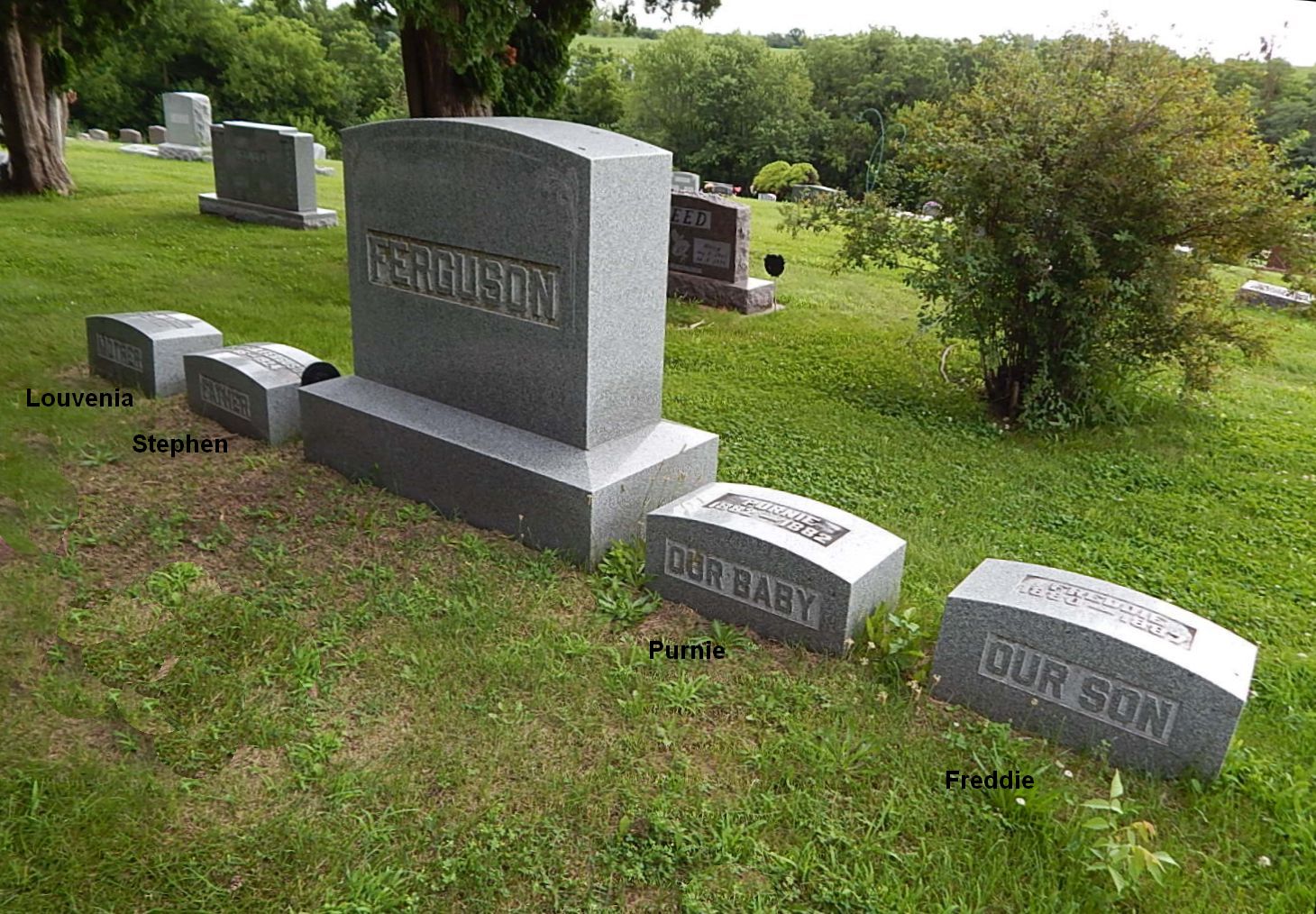
Charles William Ferguson was born April 3, 1870 in North English, Iowa to Rev. Stephen Robert Ferguson (1845-1924) and Louvenia Elizabeth Thomas (1850-1933).  Stephen and Louvenia had married in Iowa in 1869.  They were the parents of seven children:  Charles William (1870-1930), Luella Helen/Mrs. Edwin W. Lanham (1872-1910), Mary Elizabeth/Mrs. George L. Hess (1877-1963), Freddie (1880-1887), Robert W. (1881-1900), Purlie (1882-1882) and Donald Vincent (1886-1937).  Stephen Ferguson was a farmer and a Methodist minister by trade.

The first time we see Charles W. Ferguson is in the 1870 US Census.  The Ferguson Family lived in South English, English River Township, County of Keokuk, State of Iowa.  The family consisted of: Robert (25 years old), Livinia (sic) (20), and Charles W. (3/12).  Robert Ferguson listed his occupation as "Farmer," Livinia was "Keeping House."  They reported that they owned no Real Estate but they did report $565.00 in Personalty ($13,659.00 in today's funds).  

The 1880 US Census finds the Ferguson Family still in Iowa - but this time in Chester Township, Poweshiek County, Iowa.  The family now consists of:  S.R. Ferguson (34 years old), Louvinia (30), Chas. W. (10), Luella H. (7), Mary L. (3) and "Babe" (2/12).  Charles' father listed his occupation as "M.E. Clergyman."  Louvinia is "Keeping House," and the older children are "At School."  

The 1885 Iowa Census shows the Fergusons now living in Cedar Township, Washington County, Iowa.    

In about 1888 Charles Ferguson enrolled at Cornell Academy, then four years later at Cornell College, in Mount Vernon, Iowa - not to be confused with Cornell University in Ithaca, New York.  Now a liberal-arts institution, at that time Cornell College was mostly a seminary for the Methodist Church.  It looks like Charles was considering following his father into the Methodist ministry.


He did take time off from school in 1892 and 1893 to take a job as a Guard at the World's Columbian Exposition in Chicago.

In later years he described his time at Cornell in this way:  I had to work my way through Cornell.  I tended fires in the dormitories and was the caretaker of the president's vineyard.  I also operated a lunch stand at the edge of the campus and raised my own vegetables for the stand.  Before dawn I was out to weed my garden and hoe the plants in the first glimpse of the sun.  

This increased his revenue, but he needed it.  He related that by the time he graduated from Cornell in 1898 he had assumed the responsibilities of providing for a wife and daughter. 

On December 29, 1896 Charles Ferguson had married Lucinda "Lucy" Corbin (1878-1960) in Knoxville, Illinois.  The groom was twenty-six; the bride was eighteen.

Lucinda "Lucy" Corbin was born February 14, 1878 in Illinois.  Her father was Edwin A. Corbin (1845-1915) and her mother was Elizabeth Utter (1855-1915).  They married in 1880.  They had four children:  Lucy (1877-1960), Lee (1883-1973)  and twins Hortense/Mrs. Kenneth C. Hawkins (1889-1943) and Harold (1889-1914).  Edwin Corbin was a Lawyer by trade.      

Charles and Lucy were living in Mount Vernon, Iowa when their first child was born.  On September 22, 1898 they were blessed with a daughter they named Dorothy Maye Ferguson.  They had three children altogether:  Dorothy Maye (1898-1966), Robert Edwin (1901-1937), and Stephen Bentley (1904-1979).

Note:  At birth, Stephen was named Stephen Bentley Ferguson.  Up through the 1920 US Census he continued to be referred to as "Stephen B. Ferguson."  Sometime later he started calling himself "Stephen Corbin Ferguson,"  Corbin being his mother's maiden name. 

Dorothy Ferguson married several times.

1915:  John C. Schmidt, Jr.  

1923:  Edir Donald Hargroeves

1931:  Charles A. Jardine

1937:  John C. Schmidt, Jr.

After graduation Charles Ferguson took on his first "real" job - the rehabilitation of a country newspaper.  Neither history nor extensive research has revealed the name of the newspaper.  The paper's only chance for survival was to collect on its overdue subscriptions.  None of the farmers had any available funds to pay their overdue bills so Ferguson borrowed a truck and tooks cords of firewood, bushels of corn, eggs, chickens, or anything else that could be traded or turned into money. 

The 1900 US Census dated June 6, 1900 finds William and Lucy Ferguson living with William's parents in Albion Township, Parkersburg, Iowa.  The family consisted of:  S. R. Ferguson (54 years old), Louvenia (49), Charles W. (30), Luella (27), Mary (23), Donald V. (13), daughter-in-law Lucinda (21), and granddaughter Dorothy (2).  William listed his occupation as "Traveling," and traveling he was.

After saving the newspaper, Ferguson moved on - selling books for a while but then he came to Chicago in the second half of 1900 and organized Ferguson's Dixie Jubilee, six African-American singers in a program of the spirituals and folk songs of the South.  


This was so successful it evolved into the Chautauqua Managers' Association, an important booking agency for lyceum attractions.  Ferguson was President, and handled the bookings for over 150 attractions.  Former President William Howard Taft, William Jennings Bryan, Billy Sunday and the great Houdini were just some of the people that Ferguson represented.  Lucy Corbin Ferguson had originally been a lyceum bureau organizer - perhaps that is where Charles Ferguson met his future wife.

Chicago Tribune - 10 Oct 1906


History does not record what first attracted Charles Ferguson to the Rogers Park neighborhood of Chicago.  It had been around for a long time - since Phillip Rogers from Ireland purchased 1,600 acres between 1830 and 1856 but the northernmost part - up toward the Evanston border had not been developed and this was the area Ferguson felt had so much potential.  The Rogers Park Women's Club opened the first library in 1894 and this turned out to be the first piece of real estate that Ferguson bought in Rogers Park after the Women's Club had outgrown it.  He was a "flipper" before the concept had even been dreamt of.  He bought the cottage, remodeled it and sold it.  He then bought several more, renovated, remodeled and sold them.  Then he bought Birchwood Subdivision, between Rogers and Howard, Ashland and Greenview.  

The Birchwood Subdivision - Rogers to Howard and Ashland to Greenview


It was a success and then he bought the land called "North of Howard" - the area from Howard Street north to Calvary Cemetery.  Others looked and only saw the cemetery and said nobody would go there but the dead.  Ferguson instead saw the great future population that would come there at the end of the elevated line where there was sunshine, open spaces and the lake for their children.

North of Howard


Howard Street is the border between Chicago and Evanston, so technically the land North of Howard that Ferguson bought was part of Evanston, not part of Chicago.  This was unsatisfactory to Ferguson.  In those days with its conservative government and one of the strictest zoning codes in the country, Evanston (rightly) earned the reputation of being very hard for developers to deal with.  Charles W. Ferguson was used to doing business in "one hand washes the other" Chicago.  Something had to be done, and Ferguson set out to do it.  He figured that the best way to proceed was to convince Evanston that the land North of Howard had little value.  It was already referred to as "No Man's Land" and had not had streets laid out, nor utilities brought into the area.  It was raw prairie and Ferguson began his project in 1912 to have Chicago annex the 80 acres from the Howard "L" Station east to the lake, and from Howard north to Calvary Cemetery.        

In November of 1912, Ferguson as president of the Birchwood Improvement Association asked the City of Evanston to locate a site for a school in the No Man's Land parcel to meet the needs of the rising population of the nearby community.  In addition, they asked Evanston for police and fire protection, and that paved streets, sidewalks, sewers, water, gas and electrical infrastructure be installed.  Perhaps due to the large number of German settlers in this area the parcel began to be referred to as "the Germania Addition," and then as just "Germania." 

The controversy came to a head over the delivery of mail.  The few residents of Germania at first asked Chicago for mail service and were refused because Germania was not part of Chicago, it was part of Evanston.  Then they asked for Rural Free Delivery but were refused because there was no RFD route in the area.  Then the residents began using Evanston as their return address.  Mail addressed to Evanston got as far as the Evanston post office where it was held for pickup since there were no postal routes in Germania.  When the residents asked that their mail be delivered to them like it is to everyone else, the Assistant Evanston Postmaster, Margaret Hermes refused.  She said,  "This Germania place has appeared since our postal routes were mapped out.  It is way out of the way of our carriers.  It has no street signs.  Besides, we do not have enough carriers (to add Germania to our territory)."

The population of Germania also had problems with the phone company.  If they called Chicago, it was a 10 cent toll call.  When they called Evanston it was also a ten cent toll call.  It was even worse when someone tried to call into Germania.  They were transferred around all over the place.  They were shifted to Evanston, then back to Chicago, to the local exchanges then to the toll department.  Finally they are transferred to the Rogers Park Exchange, then to a Birchwood sub-exchange.  The Chicago Tribune reported that one must really want to speak to someone badly if they were willing to to go through all the rigamarole necessary to speak to a Germania resident.   

Evanston seemed more than willing to let Germania go.  Ald. James Turnock of Evanston's 4th Ward said, "Take 'em in.  They've pestered us for lights and policemen and firemen and schools and all sorts of things.  We gave 'em two street lights and a cop and they still aren't satisfied.  Let Chicago have 'em."

Under Illinois state law in effect at that time, a section of one city could separate from the city and merge with an adjoining city with two-thirds approval of the City Councils of both cities. 
 
On May 6, 1913 the Evanston City Council voted to let Germania go "only if the sale of intoxicating beverages was forbidden in Germania in perpetuity."  Remember, Evanston was founded by tee-totaling Methodists and was the national headquarters of the Women's Christian Temperance Union.  

Illinois passed a law effective July 1, 1913 that provided that the city councils of both effected cities could vote approval if one-half of the voters and one-half of the property owners of the district petitioned for annexation.  Each of the city councils would have to approve the annexation petition by a two-thirds majority.  

The matter bounced back and forth between Evanston and Chicago for several years.  Charles Ferguson then wrote a 12 page booklet: An Evanston Problem, and mailed a copy to every Evanston voter.

Finally the separation of Germania was approved first by the City of Evanston and on Monday, February 8, 1915, by Chicago’s City Council.  Germania was now officially part of Chicago and the liquor prohibition was gone.  Now Charles W. Ferguson was ready to make a lot of money.  He bought and sold over 300 parcels of real estate in the district.  By 1922, a local newspaper described Germania as the “busiest spot in the city from a building viewpoint.”

Where was Charles Ferguson living while all this was happening?  All over the place.  I was unable to find Charles W. Ferguson or his family in the 1910 US Census.  Records show these addresses as where Ferguson was living during the period from 1911 to 1916:

1911:  1615 Farwell, Chicago:

1615 W. Farwell, Chicago

1913:  6733 Bosworth, Chicago - a school occupies that parcel today

1914-1915:  133 Shurtz Court, Evanston (now 7633 N. Bosworth, Chicago)  Some sources spell the street name "Shurz."

133 Shurtz Court, Chicago


In 1916, Charles Ferguson built a 4 bedroom, 2 bathroom house containing 2,154 square feet of area at 1542 Juneway Terrace, Chicago, in the heart of the "North of Howard" neighborhood he loved so much:

1542 W. Juneway Terrace, Chicago, IL


Charles W. Ferguson's next big project was the construction of a theater on Howard Street.  It would be the first commercial building built on Howard Street and established it as a business district.  You may remember from the article I wrote about Howard Ure that the land used to build the theater had originally been part of the Ure Family's dairy farm.  

To design his theater Ferguson hired noted architect Henry L. Newhouse.  Newhouse has designed twenty-one theaters in the Chicago area, mostly for the Ascher Brothers theater chain.  Unlike many of Ferguson's other projects, the theater was not built on land that was part of Germania - the theater was built on the south side of Howard, from Marshfield west to the Howard El Station.  The theater was built with commercial spaces on the first floor and two floors of apartments above. 

Here is the architect's rendition of the Howard Theater - or as they preferred to spell it the Howard Theatre:


The Howard Theatre opened for business on May 4, 1917 (some sources say May 4, 1918).  To say the the building was ablaze with lights would be an understatement.  Here is a photo of the building at night, shortly after it opened:


You can see the vertical sign on the Norshore Theater in the background on the other side of the elevated tracks.
 
Charles Ferguson's son Robert said that the Howard Theatre would always be a monument to his father.  

The building still exists, though no longer as a theater (or theatre).  In 1999 the auditorium was razed and only the commercial spaces and the apartments remain.  Here is a recent photo:


The 1920 US Census found the Ferguson Family living in the house Charles built at 1542 W. Juneway Terrace in Chicago.  The family consisted of:  C.W. (49 years old), Lucy (39), Dorothy (22), Robert (18) and Stephen (15).  Charles listed his occupation as "Real Estate Salesman."  They of course, all could read and write and speak English.  Charles and Lucy were married, the boys were single, and Dorothy reported that she was divorced (from John C. Schmidt, Jr. who she had married in 1915).  Charles said that they owned their home and that it did not have a mortgage.  Charles' parents, Rev. Stephen and Louvenia lived just up the street from them at 1500 W. Juneway Terrace in a house that Charles had built in 1916.

Very often people who work as hard as Charles W. Ferguson worked don't have a lot of time for their family.  Over time this can lead one of the married partners to stray.  Unfortunately this was splashed all over the newspapers in August of 1922 when Charles W. Ferguson filed for divorce from his wife Lucy.  According to Ferguson, Lucy had been engaging in an illicit love affair with Herschel L. Bradshaw.  Lucy was forty-four years old, her paramour was twenty-seven.

The first notice of this was in the Waukegan (IL) News from August 10, 1922:


I have personally been to Fox Lake numerous times but I have never seen the infamous "love bungalow."  Of course once the news of the scandal got out, all of the newspapers were quick to pick it up.  This is from the Chicago Tribune, also from August 10, 1922:


Here is a photo of Herschel L. Bradshaw from the Philadelphia Enquirer of September 5, 1922:


When he registered for the draft in 1917 he was described as "medium height, slender build, gray-blue eyes and auburn hair."  He was not bald and had no noticeable physical defects.

Further details were available in the Waukegan (IL) News-Sun on August 11, 1922:


The Lake County (IL) register went into even more detail when they wrote about the triangle on August 12, 1922:


By November 20, 1922 Lucy Ferguson decided she had had enough of her illicit affair and vowed that she would "never leave" her husband as reported in the  Chicago Tribune of November 21, 1922:


Charles Ferguson's father The Rev. Stephen R. Ferguson died July 13, 1924 in Chicago.  I was unable to locate an obituary in any of the Chicago newspapers; here is one from the Davenport-Rock Island-Moline Daily Times from July 18, 1924:


He was buried in the North English Cemetery in North English, Iowa:


Charles W. Ferguson did not limit his efforts to Rogers Park.  While all of his real estate business was going on, he was also one of the organizers and a vice president of the Phillip State Bank.  Ferguson's son Stephen Ferguson was also a developer.  He was developing 1800 acres in swampy Florida when he got malaria and had to return to Chicago for his convalescence.  His father Charles stepped in and completed the Florida development.  Charles Ferguson also rebuilt his sister Helen F. Lanham's hotel in Belle Glade, Florida after is was destroyed by a hurricane, and he rebuilt his brother Donald's gas station also in Belle Glade.
   
The 1930 US Census found what remained of the Charles Ferguson Family still living in the home he built at 1542 W. Juneway Terrace in Chicago.  The family now consisted of just Charles and Lucy.  Charles said he was sixty years old and Lucy said she was fifty-eight.  They owned their home which they said was worth $20,000.00 ($372,000.00 in today;s funds).  Just a FYI - the house is currently valued at  $1,037,000.00.  They did own a radio.  Charles listed his occupation as "Real Estate Broker." 

Charles William Ferguson died in Chicago on July 8, 1930.  He was sixty years old.  Here is his obituary from the Chicago Tribune of July 9, 1930:


He is buried in Chicago's Rosehill Cemetery:


On August 20, 1930 the Chicago Tribune reported about Charles Ferguson's estate:


A $2 million estate in 1930 would be equivalent to an estate of $37.2 million today.  Not just chicken feed, as they say.

Charles W. Ferguson "The Father of Howard Street" - may he rest in peace.