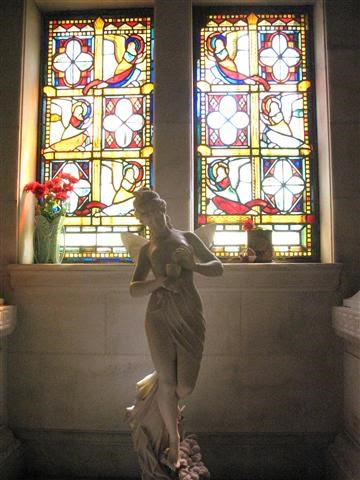
Longtime readers of this blog know I have always been interested in the life and career of silent film star Rudolph Valentino. Here I am at his crypt:

He died on August 23, 1926 and to this day (although probably not this year) there is still a memorial service for him every year at the Hollywood Cemetery on August 23rd. For many years I attended the service each August and I was also a featured speaker several times.
The service was actually run by a Hollywood publicist with the unusual name of Wolfgang Gerdes-Testa (he went by "Bud"). Before we look at Bud's work in Hollywood as publicist for the living and the dead, let's see what we can dig up about him.
Wolfgang Alexander Gerdes-Testa was born March 19, 1912 in Bremen, Germany to Anna Marie Gerdes (1872-1964) and Hungarian Mano W. Testa (1868-????). Anna Marie and Mano had been married in London on August 8, 1910, but the records also show that they had a daughter Edith who was born in 1897.
I have run into very few Germans who hyphenated their name with their mother's maiden name and their father's name, but Wolfgang and his family were doing this when they emigrated to the United States, leaving Hamburg on April 5, 1913 and arriving in New York on April 18, 1913 on the SS Pennsylvania. They reported they were "Maria Gerdes-Testa, age 41, no occupation; Edith Gerdes-Testa, age 16, no occupation and Wolfgang Gerdes-Testa, age 1." They said their destination was St. Paul, Minnesota, and their nearest relative was Maria's mother, Meta Gerdes in Bremen. Interestingly while Maria Gerdes-Testa could read and write, sixteen year old Edith could not.
The elusive Hungarian Mano W. Testa did not come over with them and does not seem to be mentioned again.
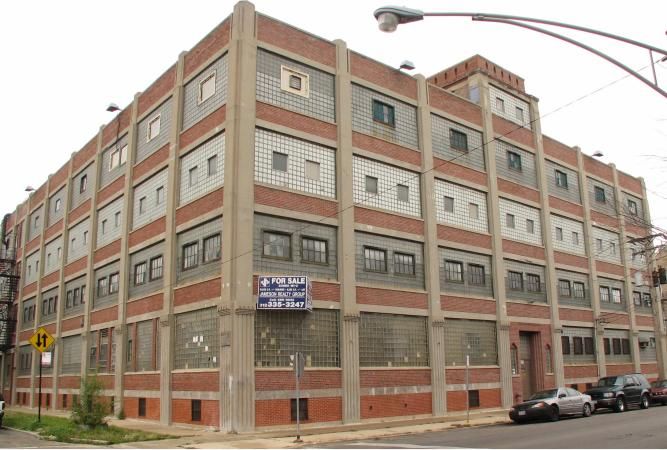
I was unable to find the Gerdes-Testa family in the 1920 US Census, but my friend and expert researcher Mike Kelly was. The family was living at 4223 W. Grand Boulevard (now King Drive) in Chicago:

4223 S. King Drive, Chicago
The census taker was at their address January 12-13, 1920. "Marie Testa" said she was was 40 years old (she was 48) and a "Lodger". She was employed as a "Teacher of Piano." She had "Submitted Papers" to apply for her US citizenship. Living with her was 22 year-old Edith who did clerical work for a chemist, and 8 year-old "Wofgan." German was their mother tongue.
I don't know if they ever made it to Minnesota, but I know that later in the 1920's they were living in the Rogers Park neighborhood of Chicago because Bud told me that when he found out I was from Evanston. He recounted many happy memories of Rogers Park (except for the winters) and he remembered especially the Adelphi Theater on Clark Street.
Wolfgang's sister Edith Gerdes-Testa (1897-1980) has an interesting story herself. Like her mother and brother she came to the US in 1913. While they were living in Chicago on March 7, 1923 she married Indian professor Jogesh Chander Misrow (1889-1930). Misrow was referred to in the press as "Dr. Swami Misrow, a Brahmin philosopher and teacher." When he died suddenly in 1930 his funeral was conducted by the famous yogi Paramahansa Yogananda (1893-1952) who was an Indian monk, yogi and guru. The Yogananda introduced millions to the teachings of meditation and Kriya Yoga through his organization Self-Realization Fellowship (SRF) / Yogoda Satsanga Society (YSS) of India, and who lived his last 32 years in America. The Yogananda is interred in the Great Mausoleum of Forest Lawn in Glendale, California.
While she was married to Misrow, Edith started referring to herself as "Edith Indira Misrow," and then "Indira Misrow". When she applied for US Citizenship in 1930 and married Alfred Ruhe in Los Angeles in 1932 she called herself "Mrs. Indira E. Misrow."
When Edith died in Los Angeles in May of 1980 her Social Security Death Record reported birth dates of March 17, 1900 and March 16, 1901 and her parents as "Robert" and Maria Gerdes.
I don't know exactly when or why the family relocated to Los Angeles but based on Bud's recollections to me I suspect the weather was a factor. By 1928 the family had settled in the mecca of the west, Hollywood, California. Bud must have heard the call of the press at a young age because the Los Angeles Times of February 9, 1928 reported he was a member of the Hollywood Boy Scout Press Association.
At the time of the 1930 US Census, Bud and his mother were living with Edith in a house at 2042 North Beachwood Drive in the Hollywood Hills. There is an apartment building on this site today that was built in 1964. Edith was the Head-of-Household; she reported that she was 31 and a widow. They rented the house for $70.00 per month. They had a radio. Edith was a "Teacher of Psychology," and reported that she could now both read and write. Maria reported that she was 57 and also a widow. She taught piano. Eighteen year old Bud was not employed. They all reported German as their native language.
Bud Testa of Hollywood's name appears in newspapers frequently in the early 1930s because he was a champion ping pong player. He was also an officer of the Pacific Coast Ping Pong Association.
By the late 1930s Bud must have taken up his profession of publicist because items started showing up in the papers mentioning him or attributed to him. Here's something from the Los Angeles Times from March 13, 1938:

And another from Braven Dyer's column in the Times of March 25, 1939:

He did not limit his publicity to the Los Angeles papers. Here's one from the Knoxville (TN) News-Sentinel from December 15, 1939 (looks like he still hasn't decided what to call himself):

By the 1940 US Census Bud Testa was living on his own - sort of. He was a "Lodger" at 6133 Glen Tower in Los Angeles. He said that he had been living in the same place in 1935. His sister had remarried in 1932 to Alfred Ruhe (1898-1955), a Production Control Expert for North American Aviation, so I'm sure Bud decided it was time for him to move on.

6133 Glen Tower Street, Los Angeles, California
Bud told the census taker that he was Single, 28 years old, that he had two years of college, and was a Naturalized US Citizen. He listed his occupation as "Free Lance Publicity."
There was a rumor going around that at one time Bud had been a Hollywood agent to the Stars. I found no evidence of him ever working at anything other than publicity, including public relations and advertising, but never as a Hollywood agent.
Here is Bud's Draft Card from October 16, 1940:

Strangely he listed his sister as the "Person Who Would Always Know Your Address" instead of his mother.
During this period, notice that he drew an arc over the "Gerdes-Testa" when he signed his name. This was to indicate that his last name was the whole thing "Gerdes-Testa."
Bud enlisted in the US Army on June 15, 1942. On January 5, 1943 the Army sent him to Bermuda. He served as a TEC-5. Technician fifth grade was a United States Army technician rank during World War II. Those who held this rank were addressed as corporal, though were often called a "tech corporal". Technicians possessed specialized skills that were rewarded with a higher pay grade, but had no command authority.
Bud finished his stint and was released from the Army on November 16, 1945. He returned to Los Angeles and to his job as Publicist.
Once the war was over, publicity notices with Bud's name on them started showing up in the newspapers again. Here's one from March 22, 1946:

It was about this time that Bud took the job that he was best known for, and how he and I came to meet, providing publicity and acting as Master of Ceremonies for the Rudolph Valentino Memorial Service held on August 23 of every year at the Hollywood Cemetery where Valentino was interred in the Cathedral Mausoleum.
There are two different stories about how Bud came to be hired for the Valentino service. In one interview, Bud said that after the war when he was back in Hollywood, he was approached by Jules Roth who owned the Hollywood Memorial Park Cemetery on Santa Monica Boulevard in Hollywood. Roth asked Bud to provide publicity for, and to host the service. There had been a memorial service for Valentino every year at the cemetery since Valentino died on August 23, 1926. Frankly Roth felt that the services were getting out of control and wanted some structure added to them.
Another time, Bud related that he had been approached by the Valentino Memorial Guild to organize and host the service because they felt it had become quite disorganized.
I would tend to believe the first story because I know that Bud was paid for the service and the Valentino Memorial Guild did not have any money. There is one thing that is beyond dispute, however, and that was that the service had deteriorated into a circus.
The memorial service which had begun in 1927 as a small gathering of family and friends turned into a real Hollywood spectacle with Hollywood wannabees dressed as sheiks, and women who professed to have slept with Valentino either while he was alive or with his ghostly apparition after he departed. Things got so bad that Ditra Flame' the original "Lady in Black" stopped coming to the services after 1954 when there were so many "Ladies in Black" at the service that you couldn't tell one from another.

Ditra Flame' the one-and-only original "Lady in Black"
Enter Bud Testa. He did not eliminate the circus atmosphere of the service, instead he gave it some structure. He drew up a program for the service:

and sent out a publicity notice to let all the media know what was coming up:

The memorial services as run by Testa were all pretty much alike. The service would promptly begin at 12:10, the time that Valentino died. Bud acted as the Master of Ceremonies and introduced all of the guest speakers.

Bud Testa as Master of Ceremonies
After Bud gave a few opening remarks, he would introduce the chaplain who would say an opening prayer. Bud had come up with the idea of having a Protestant minister appear at the service to offer a prayer for the soul of the departed. (Valentino was of course, Catholic. I don't know if Bud ever invited a priest to attend, but even if he did I'm not sure he could have gotten one to agree to participate, such was the reputation of the service.) For many years it was Troupers Chaplain Jack Kelley:

Troupers Chaplain Jack Kelley
After Kelley's death Rev. Pilson Potter attended:

Rev. Pilson Potter
Bud also asked his friend Bob Mitchell, founder and director of the Bob Mitchell Boys Choir to attend and bring some of his choristers to sing at the service. I told Bob's story in this blog several years ago:

Bob Mitchell
Here's Mitchell with Silent Movie owner Laurence Austin:

Early in the program Mitchell himself would tell stories about defying his mother and sneaking out to see Valentino's movies, and ultimately playing the organ accompaniment for Valentino's films which were all, of course, silent.
Next up were the guest speakers. Back in the 1940s it was still possible to get speakers who had known or worked with Valentino. As the years went by this of course became more and more difficult. Guest speakers through the years included actors Rudy Vallee, Lew Ayres, Richard Arlen, Virginia O'Brien, Vivian Duncan, George Jessel, Franco Nero, Anthony Dexter, James Kirkwood, Raymond Massey, Mady Maguire, Argentina Brunetti and Patricia Medina, author Jack Scagnetti, Lorenzo Tucker "The Black Valentino," silent stars Mary Philbin and Mary McLaren, film historian Mike McKelvy, Valentino biographer Emily Leider, theater owner Laurence Austin, Hollywood Historian Marc Wanamaker, Valentino Newsletter author Patricia Lampinen, psychic and philosopher Anthony Norvell, and yours truly.
Marc Wanamaker:

Jack Scagnetti:

Patricia Lampinen:

Yours truly:

(Bud did have his little quirks. He knew film historian Mike McKelvy very well, and Mike spoke at most all of the services through the 1980s and 1990s but each and every time Bud introduced him as "Film Historian Mike Kelvy.")
After the speakers a guest performer would appear. This was usually someone with a musical background who would sing songs associated with Valentino such as "The Sheik of Araby," "The Kashmiri Song" (Pale Hands I Loved), or "El Relicario."
At the first service I attended in the 1980s the featured soloist was the famous opera star Ken Remo who sang "The Sheik of Araby." He has a magnificent voice, and with the acoustics of the all-marble mausoleum, he made the rafters shake!

Ken Remo
After the soloist, members of the Bob Mitchell Boys Choir would sing.

Bob Mitchell Choir Boys
As the years passed the number of choristers at the service dwindled and finally was down to only one in 2008, the last year Bob Mitchell would be involved with the service.
Lastly the chaplain would say a closing prayer and Bud Testa would thank everyone for coming and declare the (fill in the number) Valentino Memorial Service officially ended and invite everyone back for the service the next year.

Bud at Valentino's crypt being interviewed for television
The "Lady in Black"
It would be impossible to tell the story of Bud Testa and the Valentino Memorial Service without mentioning the famous "Lady in Black", the woman who appeared at Valentino's crypt every year dressed all in black and heavily veiled.
The one-and-only original Lady in Black was Ditra Flame'. The story was that when young Ditra was dying in the hospital Valentino came to see her. He told her she would recover, but then asked her to remember him after he was gone. Ditra balked at this and reminded Valentino that he was famous and adored by millions. He would never be forgotten. Valentino persisted and Ditra promised she would never forget him. A short time later Ditra had recovered and Valentino was dead.
True to her word Ditra spent the rest of her life making sure Valentino was remembered - and every August 23rd she would appear at his crypt and leave roses (because Valentino had brought her a rose) never speaking a word to anyone who was there. She only told her story in 1947 when phony "Ladies in Black" began to show up and claim to be the original. Eventually the circus atmosphere and phony Ladies in Black became too much even for Ditra Flame' and she did not attend the services after 1954.
The phony "Ladies in Black" persisted even after Flame's death in 1984. In the 1980s and 1990s a woman named Estrellita del Regil claimed to be the daughter of the original Lady in Black (Ditra Flame' had no children). Adding to the mystery Estrellita also claimed to be the wife (or mistress, the story varied) of the Argentinian singer and tango-dancer Carlos Gardel. At the service Estrellita would display memorabilia of both Valentino and Gardel.
There was never any doubt in Bud Testa's mind about who was the original Lady in Black. During an interview toward the end of his life he said “The true ‘Woman in Black’ was Ditra.”
Bud Testa did such a good job arranging the Valentino Memorial Service that in 1958 the cemetery hired him to also produce the Tyrone Power Memorial Service every November 15th. For the Power service Bud was able to get Power's daughter Taryn Power and actors Francis Lederer, Lawrence Tierney, Tom Brown, John Philip Law, and many more.
But it was not all Memorial Services for Bud Testa. The Hollywood Citizen-News noted on July 6, 1965 that Wolfgang Gerdes-Testa "recently" had married Florence Beatrice Mellian (1923-1999), complete with a photo of the happy couple:

Sadly, the couple divorced in October of 1972.
During the period that Bud Testa ran the Valentino and Power Memorial Services he also kept his publicity agency going. He managed to make a good living and have fun doing it. He even wrote a column for the Hollywood Independent newspaper with bits of gossip about the Hollywood stars. He would also use that platform to tout the upcoming Valentino service every year:

Sometimes they even included a caricature of him atop his column:

Ever the publicist, Bud always made sure important newspapers were informed of the upcoming memorial:

Bud had remained a happy bachelor since his divorce for most of his life but Cupid finally caught him again on May 17, 1974 when he married the lovely Veronica R. De la Rosa in Los Angeles. The groom was 62, the bride was 27.
Bud and Veronica were blessed with a beautiful daughter Leah, who was born in Los Angeles on December 31, 1993.
On January 4, 1998 Hollywood Cemetery owner Jules Roth died. By that time the cemetery was in dilapidated condition. In fact things were so bad that on August 23, 1998 the Valentino Memorial Service was not allowed to be held at the Hollywood Cemetery - it was held at the Silent Movie Theater on Fairfax which was owned by the late Laurence Austin. Other than the location the service remained virtually the same - Bud was the MC:

Rev. Pilson Potter gave the invocation:

and Film Historian Mike McKelvy talked about one of Valentino's leading ladies:

By the time of the 1999 service Tyler Cassity and his family had purchased the cemetery and began its restoration and transformation. Tyler Cassity related some years later that after he bought the cemetery Bud Testa gave him a call. Bud told Tyler his history with the cemetery and especially the Valentino Memorial Service. He asked if Tyler would be willing to hire him to publicize the service and act as MC as he had done for so many years. Although Tyler Cassity and his family changed many things at the Hollywood Memorial Park Cemetery (including the name - the cemetery was now called Hollywood Forever) they also wanted to preserve those traditions they felt were worth saving. Tyler happily hired Bud Testa to do his usual magic. Tyler told a friend that he found Bud to be a throwback to the 1950s including charging "1950s prices" for his services.
The first major change to the service was that they placed a curtain over the window at the back of the mausoleum. You can see from previous photos that the window let in so much light behind the speakers that it was very hard to get a photo of them without it ending up all washed out. Simply placing a curtain over the window solved that problem. The cemetery also commissioned an original work of Rudolph Valentino as the Son of the Sheik:

Tyler Cassity our host started out by saying a few words:

Psychic to the Stars Kenny Kingston:

Mike McKelvy:

Marc Wanamaker:

and Ken Remo:

Many long time attendees were there as well:
Estrellita del Regil:

Michael and Virginia Back:


By the 1999 memorial service Bud Testa was 87 years old. His health had deteriorated significantly, but Tyler Cassity insisted he attend even in his wheelchair, and sent a limousine to pick Bud up at home and deliver him to the cemetery:


Unfortunately not long after that Bud's health had worsened to the point that his wife had to move him to a nursing home.
Wolfgang Alexander Gerdes-Testa died in the Sun Valley neighborhood of Los Angeles on February 4, 2003. He was just short of his 91st birthday.
Bud was buried on February 26, 2003 in the Riverside Cemetery in Riverside. Here is his military issue tombstone:

His tombstone mistakenly gives his last name as "Gerdestesta". There was confusion about his name to the very end.
Wolfgang Alexander Gerdes-Testa - as a publicity man he was in the entertainment industry but not of it. Instead he spent most of his life making sure that a silent film star who died in 1926 was remembered appropriately every August 23rd. Not too bad for a boy from (for a short time) Rogers Park.
Bud Testa was an interesting man and he led an interesting life. I'm glad I had a chance to know him.
May Wolfgang Gerdes-Testa aka Bud Testa rest in peace - and we will remember him every August 23rd when we remember Rudolph Valentino.