Friday, May 16, 2014

UNDER THE ARCH - Wolf, Mattie and Louis Goldstein

Last Sunday, as a favor to a Find a Grave friend, I drove way out to the south side of Chicago to Oakwoods Cemetery, the final resting place of many famous Chicagoans.  But I wasn't looking for a grave in Oakwoods; instead I was searching in the small Jewish Cemetery just adjacent to Oakwoods, but not owned or managed by them.

The trip was unsuccessful in that I did not find the grave I was looking for, and also because I managed to pick up several ticks who went up my pants legs as I was searching through the tall, untrimmed grass.  I did, however photograph roughly 400 graves from this forgotten cemetery.  As I was searching row by row, I came across an interesting monument to the Goldstein family:


The arch covered three graves:  Mattie Goldstein (1855-1917), Wolf Goldstein (1854-1935) and Louis Goldstein (1898-1903).  I decided that the Goldsteins would probably provide an interesting story for this blog, and so I set out to find out what I could "dig up" about them.

Wolf Goldstein was born March 17, 1853 (even though that does not agree with his tombstone) in Vilna, which was then a part of Russia. He arrived in the United States in 1872 when he was nineteen years old.  In 1875 Wolf Goldstein married Mattie Grobgeld who was born August 2, 1854 (that doesn't agree with her tombstone either) in Russia-Poland.  Mattie had come to the US in 1870 when she was sixteen.

As early as 1877 Wolf Goldstein is shown in the Chicago Directory as a merchant of "Notions" at 447 Clark Street (now 1200 N. Clark Street).  The building that was there in 1877 is long gone.

The 1880 US Census shows the Goldstein family living at 415 Clark Street (now 1124 N. Clark Street).  A highrise building now occupies that spot.  Wolf worked at a clothing store, Mattie (or "Mite") was "Keeping House", and they had been joined by son Israel/Theodore (1875-1964) and daughter Minnie (1877-1964). 

By 1887 he was listed in the Chicago Directory as "W. Goldstein & Co. - Shirts" at 154 Fifth Avenue (now 647 N. Wells Street) in Chicago (now a parking lot) with his residence still at 415 Clark Street.  The 1890 US Census for Illinois is, of course, lost. 

On October 18, 1892, Wolf Goldstein registered to vote.  He listed his address as 1256 Wabash Avenue (now a gas station).  He said he had been at that address for two years, in Cook County for nineteen years, and the State of Illinois for twenty-three years.  He was not allowed to vote, however because his papers were "Suspect."

For the 1900 US Census the Wolf Goldstein Family was living at 3248 Wabash Avenue (now the Illinois Institute of Technology).  However, the family has grown significantly.  Joining Wolf, Mattie, Israel/Theodore and Minnie are  Meyer/George (1884-????), Louis (1886-????), Harry (1888-????), Katie (1891-????), and Anna/Annette (1897-????).  Missing is Bernard (1880-1882).

Tragedy struck the Goldstein family in May of 1903 when seventeen year old Louis Goldstein died of scarlet fever.  He died at 155 East 33rd Street (now 411 E. 33rd Street) on May 21, 1903 and was buried the same day - either because of the worry of scarlet fever contagion or because of the Goldstein family's Jewish faith.  Louis had been ill only seven days.  411 E. 33rd Street is now part of the Lake Meadows housing complex.


It was at that time that the Goldstein family bought the cemetery plot at the small Jewish cemetery adjacent to Oakwoods Cemetery, although the large arch had not been erected yet.


The 1904 Chicago Directory showed Wolf Goldstein at 504 63rd Street in Chicago (now a vacant lot).  The 1906 Directory has him at 512 63rd Street (another vacant lot).

The 1910 US Census shows the Goldsteins living at 3436 South Park Avenue in Chicago (the 3400 block of Park Avenue no longer exists).  Wolf listed his occupation as "proprietor of a department store."  The only ones left at home with Wolf and Mattie were Theodore, Katherine and Annette.  The Goldsteins also had a live-in servant, Nellie Belt.

Mattie Grobgeld Goldstein died on March 1, 1917 at the age of sixty-two. 


She died of myocarditis complicated by diabetes. Her address was listed as 5138 S. Michigan Avenue, where she had lived for two years.

5138 S. Michigan Avenue, Chicago

Unfortunately today, it is a vacant lot.  Her previous address was listed as 5243 Michigan Avenue.

5243 S. Michigan Avenue, Chicago

Here is her Death Notice from the Chicago Daily Tribune of March 2, 1917:


When Mattie was buried next to Louis, Wolf Goldstein decided to commission the construction of the arch monument to commemorate his family:


On May 15, 1918 Wolf Goldstein married Ida Krom in Chicago.  Both were said to be sixty years old.

The 1920 US Census shows Wolf and Ida Goldstein living at 3349 Fifteenth Street in Chicago (there is a new apartment building on that site today).  Wolf listed no occupation but told the census taker that he was sixty-nine years old and his wife was sixty-two.  Both said they were from Russia and their mother tongue was Yiddish.
 
By the 1930 US Census, Wolf and Ida Goldstein were living at 6805 N. Sheridan Road in Chicago. 

680-5 N. Sheridan Road, Chicago

Seventy seven year old Wolf listed his occupation as a retail merchant of dry goods.  Ida was listed as being seventy four.  Wolf told the census taker that he had come to the US in 1864; Ida in 1880.  Wolf said that he had been nineteen when he was first married; he actually had been twenty two.  As the years pass, people's memories for dates tend to get "fuzzy."

Wolf Goldstein's second wife, Ida Krom Goldstein died January 26, 1933 in Evanston, Illinois, leaving Wolf a widower for the second time.  Ida was buried at Jewish Waldheim Cemetery in Forest Park, not "under the arch." 


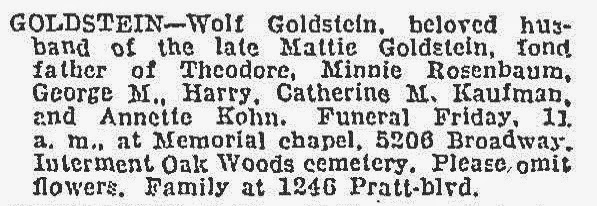
Wolf Goldstein died on October 16, 1935 at 1246 Pratt Boulevard in Chicago.

1246 W. Pratt Boulevard, Chicago

The cause of death was myocardial degeneration with generalized arterio-sclorosis.  He was 82 1/2 years old.  He had had this heart disease for eight years, according to his doctor.  Here is his Death Notice from the Chicago Daily Tribune of October 18, 1935:


Wolf Goldstein was laid to rest under the arch, beside his first wife and son.  


As a retired merchant of note, the death of Wolf Goldstein merited a special article in the Chicago Daily Tribune on October 18, 1935:


Today, Wolf, Mattie and Louis Goldstein rest "under the arch" in a forgotten corner of the forgotten Jewish Cemetery next to Oakwoods Cemetery in Chicago.

Well, maybe not forgotten anymore...

May they rest in peace.

Friday, May 9, 2014

KILLS HIMSELF IN VAIN FEAR OF LOSING HIS JOB - Professor David Halfant

Dartmouth College has put together what they call the "The Life Change Index" but what is more commonly known as "The Stress Test".  It ranks life events by the amount of stress they cause in one's life.  The top 10 stress-producing events are: 


1.  Death of spouse
2.  Divorce
3.  Marital Separation
4.  Jail Term
5.  Death of close family member
6.  Personal injury or illness
7.  Marriage
8.  Fired at work
9.  Marital reconciliation
10.  Retirement 


These events cause stress in our lives to be sure; however sometimes even the possibility of the event is enough to cause stress that can sometimes be overwhelming.

The Chicago Daily Tribune from May 24, 1928 carried this shocking story:

KILLS HIMSELF IN VAIN FEAR OF LOSING HIS JOB

The body of a young teacher of Columbia University who shot himself because of fear that he was going to lose his job was found in his department today when he was to have been notified of his reappointment.

He was David Halfant, instructor in economics and a former teacher at the University of Missouri.  Halfant, described as an able instructor and a brilliant scholar, formerly attended the University of Chicago.  He had completed two-thirds of a course for a doctor of philosophy degree at Columbia and was also engaged in research work.

Columbia University authorities indicated Halfant was of a melancholy disposition.  His library, they said, consisted chiefly of German philosophic works of a generally pessimistic nature.  Two sealed letters found near the body were addressed to Bessie Halfant, 2601 Douglas boulevard, Chicago, and to Russell Bander, University of Missouri.  

This is a tragedy, to be sure.  Let's see what we can find out about David Halfant before his untimely death.

David Mandel Halfant (sometimes spelled "Helfant" or "Helfont") was born in Russia on November 17, 1897 to Max Halfant (1868-1941) and Lena  (1879-1948).  He would be joined by a sister, Bessie (1903-1993), in 1903.  The Halfants left Russia in July of 1904, travelling to New York, and then on to Chicago.  Max Halfant was "in the salvage business" which was a polite way to say that he was a junk man.

The Halfant family did not participate in the 1910 US Census, but when David registered for the draft in September of 1918 he listed his address as "1512 Edgemont Avenue" in Chicago.  Edgemont avenue was renamed Grenshaw Street, and the block where David lived is now known as "University Village" a housing development for students of the University of Illinois at Chicago. The entire neighborhood was razed for the building of the university in the 1950s.

As mentioned in the story about his death, David Helfant attended the University of Chicago, graduating January 15, 1920 with a Ph. B. degree.  He was also a member of the Phi Beta Kappa national honor society. 

The 1920 US Census has the Halfant family still living at 1512 Edgemont Avenue in Chicago.  The Halfant family owned the building and occupied one of the apartments, and rented out the three other apartments in the building.  They told the census taker that their mother tongue was "Jewish."  

After graduation from the University of Chicago, David Halfant stayed on for postgraduate studies.  In 1921 he won the prestigious Julius Rosenwald Prize for scholastic excellence and was awarded an A.M. degree.

After graduation he was employed as an instructor at the University of Missouri at Columbia from 1922-early 1928.  In February of 1928 he took up his position as an economics instructor at Columbia University in New York, renting an apartment at the rear of 44 Morton Street in the West Village neighborhood.  It was here that he took his own life on May 23, 1928.


44 Morton Street, New York City

Since the tragedy happened in New York, the New York Times carried a detailed story:


COLUMBIA TEACHER ENDS LIFE BY SHOT
David Halfant, Ph.D. Candidate, 30, Found Dead in Room With Glasses and Hat On.
Was About To Make Trip
Reading of Pessimists Blamed by University - Friends Say He Suspected Discrimination.

A light burned all day Monday in the room of David Halfant, graduate student and instructor in economics at Columbia University, in a three-story building in the rear of 44 Morton Street.  It was noticed again on Tuesday.  Acquaintances of Halfant rang his bell but obtained no response.


When the light was burning yesterday for the third consecutive day, a tenant thought something was wrong and went for Patrick Burns, the caretaker.  He opened the door with a pass key and found the student lying dead on a run in front of the mantelpiece.

The student was fully dressed and his spectacles were in place.  Just over the right eyebrow was the wound of a .45-calibre army bullet.  the revolver lay on the floor.  Several books on the mantelpiece had been knocked down, apparently by the recoil of the revolver.  The circumstances indicated that the student, whose belongings were all packed up for a trip to Washington in connection with research he was doing for the Institute of Economics, had suddenly changed his mind, abruptly decided to commit suicide, had steadied his arm by resting it on the mantelpiece and fired.  His hat lay beside him.  Apparently he was all dressed and ready to go out when the sudden decision to kill himself came upon him.


Two Letters Found.

Because the man was wearing his hat and glasses at the time that he was shot, Captain Athur A. Carey of the Homicide Squad personally visited the room with several detectives, thinking it might be a murder case.  There were no signs of the presence of a second man, however.  Two letters were found on the table in the room, one addressed to his sister Bessie Halfant of 3603 Douglas Boulevard, Chicago, and the other to Russell Bander, University of Missouri, Columbia, Mo.  Both of these were sealed and whether they disclosed an attempt to commit suicide was not learned.


Mr. Halfant had been worried, according to a statement made on behalf of Columbia University, by the fear that  he would not be reappointed to his position as an instructor in a Columbia University extension course of economics.  He had been so appointed, however, and a letter had been sent to him to notify him of the fact before it was known that he had taken his life.  According to members of the Faculty in economics, Mr. Halfant was a brilliant student and a good instructor.  He had completed two-thirds of his work for a degree of Doctor of Philosophy at Columbia and seemed to be assured of a successful academic career.


 Among the books thrown to the floor, apparently by the recoil of the revolver were Conrad's "Lord Jim," Adam Smith's "Wealth of Nations" and a volume of Nietzsche.  A report was given out at Columbia University that the reading of Nietzsche, Schopenhauer and other pessimists had induced a pessimistic state of mind in the student.


Suspected Discrimination.

Friends said, however, that his worries were about his own future rather than about the speculations of the German philosophers.  It was said that he had sought appointments, conditional on his obtaining his Ph.D. in New York University, the University of Oklahoma and Brown University, but that he had met with refusals and that he believed these refusals were due to discrimination against him because he was a Russian Jew.  He apparently surmised erroneously that he was in danger of losing his Columbia post on the same grounds.


Mr. Halfant was educated at the University of Chicago, where he received his Ph.B. degree in 1920 and his A.M. in 1921.  Before coming to Columbia he had been an instructor at the University of Missouri, Columbia, Mo.  He came to Columbia last February, obtained his instructorship and enrolled as a candidate for the Ph.D.

Maybe I am just suspicious by nature (or I have seen too many Perry Mason programs) but this sounds fishy to me - and not just to me.  I gave a draft of this article to a co-worker to read and without any prompting she said "It looks like murder to me."  Perhaps if we knew what the contents of the two letters were, that might change things, but suicide is rarely a spur of the moment act.  Halfant was packed and had his hat on ready to leave for his trip.  How often does someone lean against a mantlepiece and shoot themselves with their hat and glasses on?  If Halfant had received the rejection letter from Columbia that would be different - but he hadn't.

The New York Times had a small follow-up article about the death of David Halfant:


No matter who did it, or why it was done, the fact remained that Professor David Halfant was dead.  The family now had the grim task of getting all of his possessions out of the apartment where he died, and transporting his body back to Chicago for burial.

There was a small Death Notice in the Chicago Daily Tribune on May 26, 1928:


Professor David Halfant was buried at Gate 8 - Chevra Shomer Hadas of Jewish Waldheim Cemetery in Forest Park.  His family gave him a beautiful tree-type monument with his information enclosed in a heart.  I'm sure his family and friends were bereft.


Professor David Halfant, a brilliant scholar and respected teacher - may he rest in peace.

Friday, May 2, 2014

MUSIC WAS HIS LIFE - Saul Feldman

I have mentioned before that I find it interesting when someone has a quote put on their tombstone. However, there is as much, if not more thought as to which photo of the deceased to put on their tombstone. How would they want world to remember them?  What sort of impression would they want to make upon people who stand before their tombstone in future years?  One day last summer when I was "mowing the rows" at Jewish Waldheim Cemetery I came across this photo:


I'm sorry for the glare, but on a sunny day it is very hard to photograph grave photos that have a glossy finish without picking up some glare.

It is obvious from this photo that this young man loved his violin, and wanted to be remembered as a musician.  The young man's name was Saul Feldman and he died December 25, 1926 at the age of nineteen. Let's see what we can "dig up" about Saul Feldman the violinist.

Saul Feldman was born in 1907 in Chicago to Julius Feldman (1881-1946) and Sarah, nee Shapiro (1890-1951).  Saul was the first child of Julius and Sarah.  He was ultimately joined by Paul Edward (1909-1968) and Esther (1912-1993).  Julius Feldman was a tailor of ladies clothing by trade.

Julius Feldman was born in Pinsk, Russia and came to the US in 1903; Sarah Shapiro was also born in Pinsk, and came to the US in 1901. Julius and Sarah met in New York but were married in Chicago about 1906.

The 1910 US Census shows the Feldman family living in Chicago, at 1939 W. Taylor Street.  On that site today is a parking lot for the University of Illinois at Chicago.  There were Julius and Sarah, Saul (Called "Sollie") and his brother Paul.  Julius' brother Max Feldman was also living with them, as well as his cousin Max  Lerman.  Max and Max were also in the ladies' clothing business.  

By the 1920 US Census, the Feldmans were living at 1535 S. Ridgway Avenue in Chicago.  The house that occupies that spot now was built in 1998, so it is too new to have been the Feldman's home.  The Feldmans have now been joined by their daughter Esther who had been born in 1912. 

Sometime between 1920 and 1926 the Feldman family moved to 1865 S. Avers in Chicago:

1865 S. Avers, Chicago
                
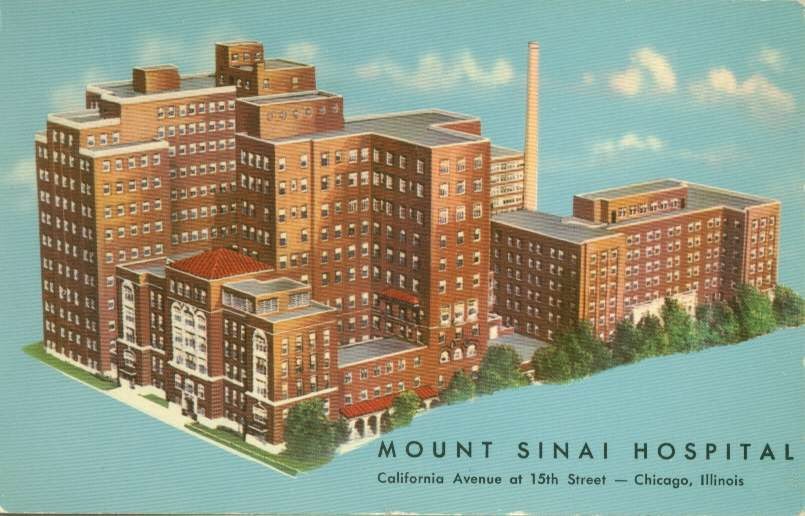
Saul Feldman died at Mt. Sinai Hospital on December 25, 1926 of peritonitis due to a strangulated hernia. He had been ill for only nine days.  


Here is his Death Certificate:

Here is his Death Notice from the Chicago Daily Tribune of December 27, 1926.  He was only nineteen years old:


Saul (Sol) Feldman was buried at Jewish Waldheim Cemetery in Forest Park, Illinois in Gate 8 - Chevra Shomer Hadas under a tree-type tombstone:


His tombstone says "Gone But Not Forgotten" and features a photo of him gazing lovingly at his violin:


His death certificate says that he worked as a musician for the Balaban and Katz theatre chain.  1926 was the height of the era of silent films and theater chains such as Balaban and Katz featured live orchestras to accompany their films.  While today we might not think of a theater orchestra as prestigious, the Balaban and Katz theaters were the "top of the line."

Here is a view of the audience from the orchestra section of the Roxy Theater in New York.  It is similar to the view that Saul Feldman would have had looking out from the orchestra area toward the audience in one of the Balaban and Katz Theaters:

    
In addition to his work for Balaban and Katz, Saul joined the Chicago Symphony Orchestra in 1925 as a violinist.  He was obviously a young man of great talent, which makes his loss that much more painful.

The untimely death of Saul Feldman was not the end of tragedy for the Feldman family.  Readers of the Chicago Daily Tribune from May 8, 1951 we greeted with the following article:


Saul Feldman, who only lived for nineteen years, spent his time on earth bringing beauty to the world through music.

May he rest in peace.

Friday, April 25, 2014

FATHER OF THE TOWNSHIP HIGH SCHOOL - Henry L. Boltwood

The name "Boltwood" is familiar to every Evanstonian.  One of the divisions of Evanston Township High School is named Boltwood and one of the largest parks in Evanston was named Boltwood until someone with money came along and asked that it be named after a member of their family instead.  So when I was in Rosehill Cemetery recently and came upon this tombstone:


I knew who was buried under that stone.  Who was Henry L. Boltwood and why is his name important to the history of Evanston?  Let's find out.

Henry Leonidas Boltwood was born in Amherst, Massachusetts on January 17, 1831 to William Boltwood (1802-1875) and Electa, nee Stetson (1808-1899).  Henry was one of ten children born to William and Electa Boltwood:  Sarah (1827-1908), Caroline Amelia (1829-1830), Henry Leonidas (1831-1906), Solomon (1833-1833), William Francis (1837-1896), Edmund (1839-1903), Rizpah (1842-1883), John Emerson (1844-1903), Harriet Newhall (1848-1872), and Robert (1852-1919).  William Boltwood was a farmer by trade.

Henry Boltwood attended Amherst College in his home town, and worked summers on the local farms to pay for his education.  While attending Amherst he joined the Alpha Delta Phi fraternity.  The 1850 US Census shows nineteen year-old Henry Boltwood living at home where he listed his occupation as "Student." After graduation he taught in several New England colleges and academies. 

Henry Boltwood was a changed man by the time the 1860 US Census was taken.  He was living in Derry, New Hampshire.  He gave his occupation as "Primer. Teacher Academy".  He was also a married man in 1860, with a wife named Helen, and a son, Charles who was four years old in 1860. 

On July 31, 1855, Henry L. Boltwood of Amherst, Massachusetts had married Helen Eugenia Field (1830-1919) of Charlemont.  Helen had been born June 18, 1830 to Eugene Field (1800-1881) and Abigail, nee Hawkes (1798-1893).  They had been married by "Joseph Field, Minister of the Gospel", probably a relation of Helen's.  Helen's father Eugene was a farmer like Henry Boltwood's father had been. 

Helen Field Boltwood had four siblings, only two of whom lived to adulthood:  Charles Edward (1825-????), Helen Amelia (1828-1829), Theodore Lyman (1832-1833) and Edward Augustine (1837-????).  
   
Henry and Helen's only child, Charles Edward Boltwood (1856-1884) had been born April 28, 1856.  

When the Civil War broke out, Boltwood  joined the United States Sanitary Commission where he remained to the end of the war.  It was said that although he was not a combat soldier, that Henry Boltwood saw as much of the routine work of a soldier as many of the regular enlisted men. He was present in campaigns through Alabama and Georgia acting in the capacity of a nurse for North and South alike. Here is a photo of Henry Boltwood from the time when he was with the Sanitary Commission:


While part of the Sanitary Commission, Boltwood also served informally as the chaplain of the 67th United States Colored Infantry.

After the war, Professor Boltwood came to Illinois and took charge of the public schools at Griggsville.  In 1867 he organized the first township high school in the state at Princeton.  Great importance was attached to the study of the English language and a reference library was established.  At one time there were ninety students from abroad enrolled and it was said that one third of all the teachers in the state of Illinois had been students of Professor Boltwood at one time or another.

In 1878, Professor Boltwood established the township high school at Ottawa, Illinois.

He came to Evanston in 1883, and in September of that same year became principal of the Evanston Township High School.  At the very beginning he strengthened the curriculum. He extended the course of study from three years to four. As the school grew and prospered, he added new teachers to the original staff of five. Gradually it became evident that the old high school building was insufficient for the needs of the growing student population and so in 1899 a new high school building was built around the old high school on Dempster Street at Elmwood:


It has been said that there are educators who dream, and there are educators who do.  Boltwood's life shows him to be of the latter classification. 

For instance, it came to his notice that the study of spelling was being sadly neglected in many otherwise excellent high and preparatory schools.  Investigating, he found that there was an out and out indifference on the part of many instructors to the importance of spelling.  But there was also the lack of a manual of spelling which should contain not only the simple but even the more unusual and technical words to be met in modern occupations.  Where others might have written an article lamenting the problem, Boltwood instead wrote a spelling manual which quickly came to be used in high schools and academies all across the country.

Boltwood not only was a scholar, speaking five foreign languages and having written textbooks on spelling, grammar and history, he also enjoyed sports.  In college, he was a long-distance runner and often took walks of up to 20 miles. He played baseball and football until he was 45, and had a lifelong fondness for hunting and fishing. 

Students of his said that Professor Boltwood used to mingle freely with them in their play, taking all the chances of the game just like any boy.  They said he was very kind to anyone needing help of any kind, and many a pupil is under lasting obligation to him, not only for the general inspiration of his teaching, but also for judicious advice and help.

It was said of Boltwood that in his general management of the school he was a leader rather than a driver.  He attended very thoroughly to what was especially his own work, and he expected others to do likewise with theirs.”

It has been estimated that during his lifetime, Boltwood instructed some 6,000 students. Of those, nearly 1,000 went on to 40 different colleges and became doctors, lawyers, financiers, missionaries, businessmen and educators.

The 1900 US Census showed the Boltwood family living at 1218 Benson (now Elmwood) Avenue in Evanston just up the street from the high school:


1218 Benson (now Elmwood) Evanston

The Census shows sixty-nine year old Henry, Helen, also sixty-nine and an "adopted daughter" twenty-three year old Gertrude Boltwood. Henry's occupation was listed as "Principal High School", Helen had no occupation listed and Gertrude's was "Stenographer."  Helen said that she had given birth to one child, who was not living in 1900.  (Their son Charles had died in 1884).

On July 31, 1905, Henry and Helen Boltwood celebrated their 50th Wedding Anniversary.  Here is an announcement of the happy event from the Chicago Daily Tribune of August 2, 1905:


January 23, 1906 was a Tuesday.  After the school day was over, Professor Boltwood told his family that he would be spending several hours at the Evanston Club, of which he was a member, and walked to the building, about one half mile away.  On the way he met several friends with whom he talked, seeming to be in a cheerful mood and saying he was enjoying good health.

After arriving at the Club, he started a game of pool with his friend Professor W.H. Cutler.  Boltwood was an avid pool player and for years it was his usual afternoon recreation.  Having just made a shot, he turned from the table, staggered, and collapsed into the arms of Prof. Cutler.  Cutler and J.F. Ward  carried Boltwood to a couch and sent for a doctor, but by the time the doctor arrived, Henry Boltwood had already expired.  He was 75 years old.

Professor Boltwood was said to have been in good health, although his doctor had warned him that an affection of his heart could cause a collapse.  He had only missed one day in the last decade in his attendance at the school.  The cause of death was "Mitral Insufficiency."  Here is his death certificate:


The body, it was decided, would lie in state from 1:00 to 2:30 p.m. Thursday, January 25, in the assembly hall where he had often led services. Twelve high school boys were grouped about the coffin as a guard of honor— classes had been suspended for the week.  Hundreds trooped through the hall that Thursday. The faculty arrived in a body for the services and moved to a special section.  Hymns were sung, a "prominent school athlete" breaking into sobs during "Nearer My God To Thee."  The Rev. J. F. Loba of the Congregational Church spoke of Boltwood's "high personal integrity" and concentration of "all powers on teaching."  Then, in the "yellowish light of the late winter afternoon," Henry Leonidas Boltwood was buried in Rosehill Cemetery just after the five o'clock sunset.

Henry Leonidas Boltwood

May he rest in peace.

Friday, April 18, 2014

FULFILLING WELL LIFE'S MISSION - Thomas F. Dowd

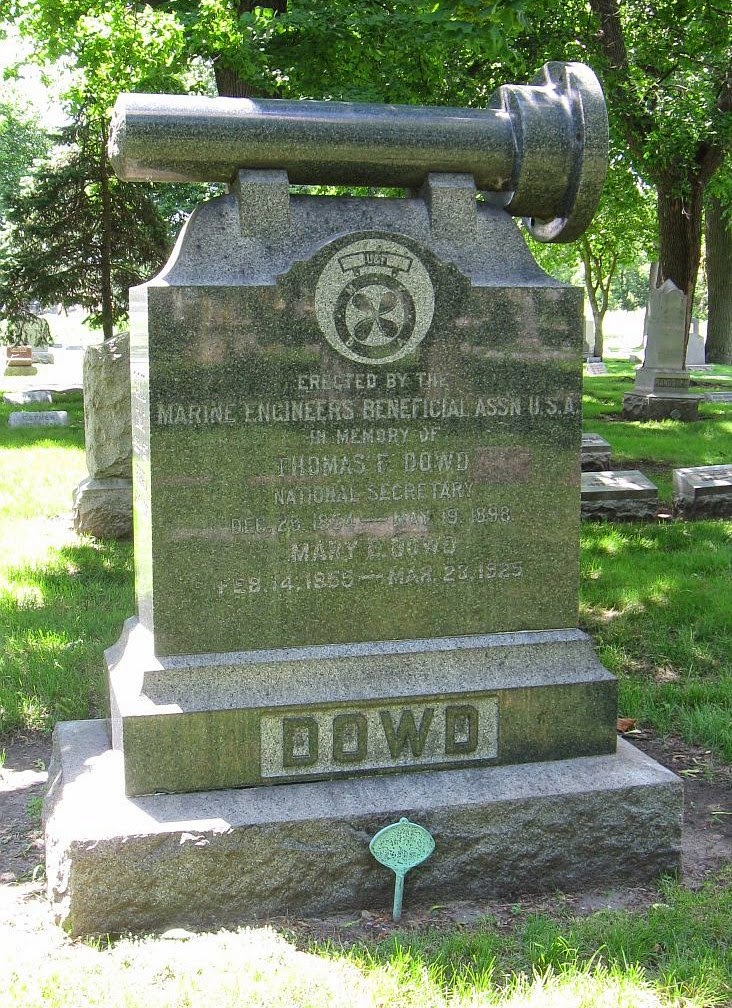
I have mentioned previously that when I am in Rosehill Cemetery I like to look around for unusual or historically significant tombstones.  On a recent summer Sunday I found the following unusual monument:


It is the tombstone for Thomas F. Dowd and his wife Mary.  The monument says:

Erected by the
Marine Engineers Beneficial Assn. USA
in Memory of
Thomas F. Dowd
National Secretary

I thought perhaps with a little "digging" I could find an interesting story, and maybe also find out what that is supposed to be on top of the tombstone.

Thomas F. Dowd was born on Christmas Day, 1857 in Manchester, Lancashire, England to Owen and Bridget Dowd.  He was their first child, but would be followed by a sister Ellen (b. 1859) and a brother James (b. 1861).  At some point in his life to make him appear older, Thomas started using 1853 as his birth date, but the English BMD records and the 1861 English Census show that he was actually born in 1857. Both Owen and Bridget had been born in Ireland; Owen listed his occupation on the census as "Hawker," and the census spelled their surname as "Doud".

By the time of the 1870 US Census, sixteen year-old Tom had come to America.  He was living on a farm in Hamilton, Illinois as a "Farm Laborer" with the Peter Egbers family. 

On January 9, 1879, Thomas Dowd married Mary Hall (1855-1925) in Red Wing, Minnesota.  The bride was twenty-three; the groom was twenty-one.  Mary was the daughter of Samuel Hall (1828-1901) and Betsy, nee Marshall (1825-1897),  both of who were born in Ireland.  Samuel and Betsey had eight children:  Jane, Mary, William, Robert, Sarah, George, Fred, and Frank.  Samuel Hall listed his occupation as "Farmer". 

The 1880 U.S. Census shows the Dowds living at 189 Milwaukee Avenue (now 483 N. Milwaukee Avenue):

483-85 N. Milwaukee Avenue

Thomas listed his occupation as "Engineer Tug Boat."   Thomas and Mary were blessed with two daughters:  Dora M. (1880-????) and Edna G. (1885-????).

The Chicago Daily Tribune of May 20, 1898 carried the shocking news: 

THOMAS F. DOWD IS DEAD

Thomas F. Dowd, National Secretary of the Marine Engineers Beneficial Association, died yesterday at his residence, 982 Francisco street, of pneumonia.  He was 43 years old and had been secretary of the organization for many years.

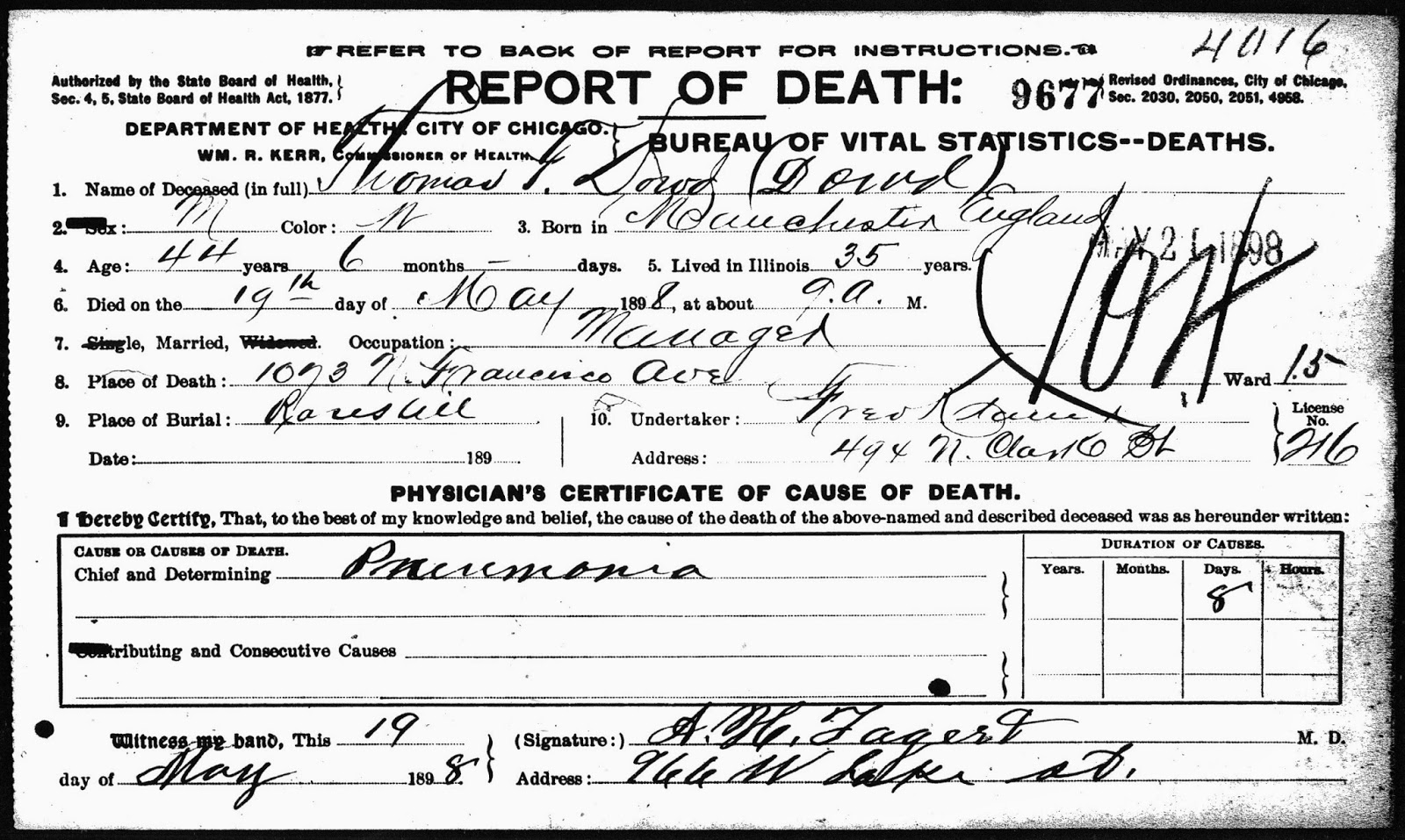
Here is his death certificate:


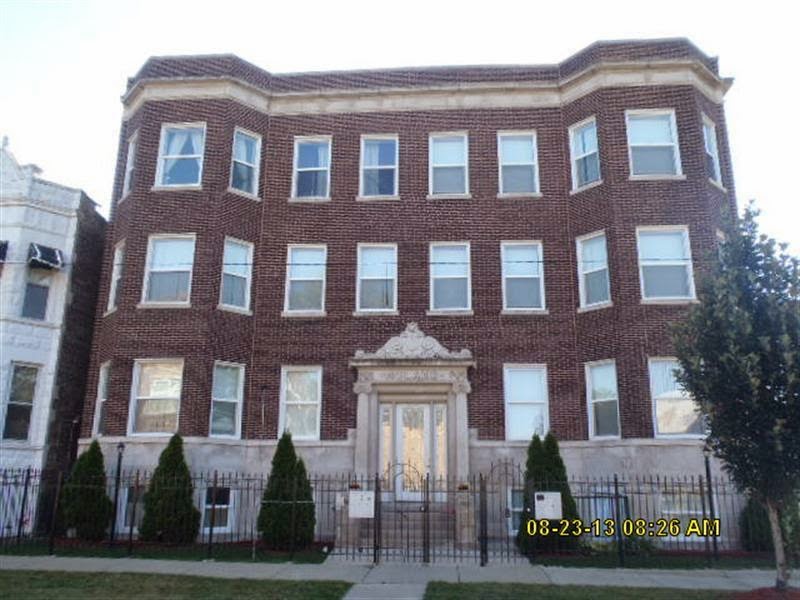
His death certificate shows him living at 1073 (now 1938) N. Francisco Avenue in Chicago.

1938 N. Francisco, Chicago
  
Marine Engineering Magazine from June, 1898 carried the following:

An official announcement of the death of Thomas F. Dowd, National Secretary of the Marine Engineers Beneficial Association has been made by George Uhler, the national president under date Chicago, May 21 in these words:

To the order wherever found, greeting: With a feeling of profound sorrow I announce the death from pneumonia after an illness of only six days of Brother Thomas F. Dowd national secretary at his home in this city at 9:30 AM Thursday the 19th instant.  It is not my desire at this time to enter into any detailed eulogy of the official life and services of our deceased brother but with a sincere appreciation of his untiring zeal and interest in the affairs of the organization with which he has been officially connected for so many years I simply make this brief announcement.  The national president will be in Chicago for some days in connection with the office made vacant by the demise of our brother. Any important communications can be addressed to the Sherman House, Chicago.  To fill out the unexpired term of our late Brother Dowd I have this day appointed as National Secretary Brother George A Grubb of M.E.B.A. No. 4, whose address will be No 1537 George street, Station B Chicago, to whom all communications should be addressed and to whom all remittances should be forwarded.

Marine Engineering Magazine carried the following in their May, 1901 issue:

M.E.B.A. MEMORIAL.

The Marine Engineers' Beneficial Association has just performed a most graceful act, and one which is worthy of emulation by every fraternal order. For many years Thomas F. Dowd of Chicago was national secretary of the association, which, as is well known, involved a large amount of work which, all too often, is thanklessly received.

Mr. Dowd died in 1898, still holding the office of secretary and the association, acting under the auspices of No. 4 of Chicago, immediately set about to provide some suitable memorial for their late brother.

It was decided that it should be a memorial tablet in Rose Hill cemetery, his last resting place, and contributions poured in from every section of the country until the shaft was erected and dedicated upon Sunday, March 31st, with appropriate ceremonies.

The dedicatory speech upon that occasion was made by James Henry Harris, well known in N. A. S. E. circles, and will certainly be read with interest by all association members. It is as follows:

Memory is a mirror in which we see reflected the scenes of the past. The green fields of youthful sports and joys, the hardships and misery of other days are pictured there.

In the mirror of memory we see the sunlit hills of hope painted by the inexperienced hand of youth. We behold the crags and breakers over which our impetuous feet were eager to walk, and we are charmed by the picture of youthful exultation when the lowering clouds of adversity had been burned away, and we had tasted the first sweets of success.

In this beautiful looking-glass—memory—we look upon the face, the form, the smile and the frown of those we love. In its magic depths we can hear the merry rippling laughter that thrilled our souls with delight, and we listen again to the words that pointed out the way that our feet should trod.

To prevent the accumulating dust of time from dimming the mirror of memory and in order that we may perpetuate a recollection of the dead we build monuments upon which we inscribe the names of those we would honor and we chisel words that shall tell future generations of their good deeds.

"When a great man dies the angels weep," the poet has said. Greatness is, however, measured by no definite standard.

The soldier who upon the field of battle yields up his life in defense of his country, the statesman who in the forensic arena defends the rights of the people, the scholar who from the caverns of learning brings light to the mind, the actor who snatches from the grave of tradition visions of the dead and rehabilitates them in the garb of living beings, the painter who fills the galleries of the mind with the beautiful creations of his genius or the musician who floods the corridors of the soul with the sweet melodies of song are great only as we are influenced by their deeds.

Someone has said that true greatness consists in fulfilling well life’s mission, in doing our duty as it is pointed out to us. We are here today, brothers and friends, to unveil a monument erected to the memory of one who fulfilled, to the fullest measure, the mission of his life so far as opportunity offered.

We have two classes of men. One class asserts their personality in every act, while the other shrink from public gaze. Of the latter class Brother Dowd was a faithful example, for he was modest though determined, enthusiastic and yet unobtrusive. His nature was sunny and bright, and he carried into the midst of his associates happiness and joy.

He who inspires laughter is a public benefactor, for from out of the gloom and blackness of sorrow he brings happiness and comfort, he illuminates the dungeon of despair with the holy light of hope.
No man could long associate with Thomas F. Dowd and not be influenced by the subtle magic of his laughter the potency of his good nature. A man of rare humor who found in the most trivial circumstance the foundation for merriment, and as the sunlight warms the budding verdure into blossom so did the exuberance of his nature better fit him to face the serious side of life by enabling him to cope with its exigencies with a warmth and geniality that was wonderful.

We who have gathered here today to pay a tribute to the memory of our late brother need no words of mine to bring back to our hearts remembrances of his kindly deeds, his determination and his zeal in the promotion of the principals that as a member of the Marine Engineers ' Beneficial Association he espoused.

Let the monument be unveiled. A magnificent tribute of a fraternal brotherhood. However, Thomas F. Dowd, whose mortal remains are resting in tranquil peace beneath this canopy of roses, does not require this shaft of stone to remind us of his worth nor must we gaze upon the inscription, that is carved upon it, to keep aglow the sacred fire of fraternal love upon the altar of our hearts, for that will die out only when we rest with him in the tomb.

And with that, they unveiled the stunning monument that still marks the grave of Thomas Dowd.


It is obvious that Thomas Dowd was beloved by all in the Marine Engineers Beneficial Association.

Thomas F. Dowd - May he rest in peace.

PS - I never did find out what that is at the top of his monument.