In my blog entry dated May 16, 2014, I told the story of
Wolf, Mattie, and Louis Goldstein, buried under an impressive arch-tombstone in
the small Jewish Cemetery next to Oakwoods Cemetery in Chicago. In telling their story I was limited to
information I could find on the Internet, through ancestry.com or the newspaper
archives. Recently I was contacted by Meta Cohen, a
granddaughter of Wolf and Mattie who pointed out a few things I had reported
incorrectly. But more importantly she
was able to “flesh out” my story by telling me things that would be known only
by a member of the Goldstein family.
Thanks to her generosity I am now able to provide you with a much more
well-rounded story of Wolf Goldstein and his family including some rare family photos. So, here is my retelling of the tale of Wolf,
Mattie, and Louis Goldstein buried “Under the Arch.”
Last Sunday, as a favor to a Find a Grave friend, I drove way out to the south side of Chicago to Oakwoods Cemetery, the final resting place of many famous Chicagoans. But I wasn't looking for a grave in Oakwoods; instead I was searching in the small Jewish Cemetery just adjacent to Oakwoods, but not owned or managed by them.
The trip was unsuccessful in that I did not find the grave I was looking for, and also because I managed to pick up several ticks who went up my pants legs as I was searching through the tall, untrimmed grass. I did, however photograph roughly 400 graves from this forgotten cemetery. As I was searching row by row, I came across an interesting monument to the Goldstein family:

The arch covered three graves: Mattie Goldstein (1855-1917), Wolf Goldstein (1854-1935) and Louis Goldstein (1886-1903). I decided that the Goldsteins would probably provide an interesting story for this blog, and so I set out to find out what I could "dig up" about them.
Wolf Goldstein was born March 17, 1853 (even though that does not agree with his tombstone) in Vilna, which was then a part of Russia. We know his father's name was Israel and his mother's name was Libby, but that's all we know about them. Wolf arrived in the United States in 1872 when he was nineteen years old. In those days, to be allowed into the U.S., an immigrant had to have a sponsor – someone already in the U.S. who would vouch for the immigrant, provide them with a place to live, and help them find a job. Family lore says that young Wolf did not have anyone to sponsor him, so he “became one of the sons in a family whose name was probably Goldstein.” Supposedly his surname was originally Schine.
Wolf's granddaughter told me that Wolf had three brothers and a sister: Harry Louis Goldstein, Raphael Goldstein, Hillel Goldstein and Rachel Goldstein. Other than their names, not much is known about them today.
In 1875 Wolf Goldstein married Mattie (also known as "Meta") Grobgeld who was born August 2, 1854 (that doesn't agree with her tombstone either) in Russia-Poland. There are several conflicting stories about Mattie’s arrival in the U.S. Although in later years Mattie said she had come to US in 1870, her daughter related that she was told that Wolf and Mattie met on the ship coming to America. Of course that would mean that they both came over at the same time, but there are also conflicting stories about where Mattie came from. In later years whoever was interviewed by the census taker told them that Mattie had been born in “Russia” or “Russia/Poland.” But the granddaughter of Mattie who contacted me said that she was always told that Mattie had immigrated “from someplace in Scandinavia.” We know for sure that the ship that brought Wolf to the U.S. from Russia/Poland would not have taken a side-trip to Scandinavia, so if that story is true, then Mattie probably met Wolf in New York.
Mattie Grobgeld had one sister: Kate. This is who she went to live with when she first came to the U.S. Kate went on to marry Levi Jacobs and had six children of her own.
We do know for a fact that Wolf Goldstein married Mattie Grobgeld in 1875. Family lore says that Mattie told Wolf she wouldn’t marry him unless he was employed. Since Wolf could speak Russian, Polish, and Yiddish, and was learning English, he became a translator. There was probably a great need for translators in those days because so many immigrants could not speak English. When Wolf and Mattie married they were “very much in love.”
Wolf and Mattie were blessed with ten children, and we know about nine of them:
Israel/Theodore (1875-1964)
Minnie (1877-1964)
Bernard (1880-1912)
Sarah E. (1882-1896),
George Meyer (1884-1964)
Louis (1886-1903)
Harry (1888-1926)
Catherine Gertrude (1891-1975)
Annette (1897-1970)
The family says that when Wolf came to Chicago he became affiliated with a bank – perhaps as a translator.
As early as 1877 Wolf Goldstein is shown in the Chicago Directory as a merchant of "Notions" at 447 Clark Street (now 1200 N. Clark Street). The building that was there in 1877 is long gone.
The 1880 US Census shows the Goldstein family living at 415 Clark Street (now 1124 N. Clark Street). A high-rise building now occupies that spot. Wolf worked at a clothing store, Mattie (or "Mite") was "Keeping House", and they had been joined by son Israel/Theodore (1875-1964) and daughter Minnie (1877-1964).
By 1887 he was listed in the Chicago Directory as "W. Goldstein & Co. - Shirts" at 154 Fifth Avenue (now 647 N. Wells Street) in Chicago (now a parking lot) with his residence still at 415 Clark Street. The 1890 US Census for Illinois is, of course, lost.
On October 18, 1892, Wolf Goldstein registered to vote. He listed his address as 1256 Wabash Avenue (now a gas station). He said he had been at that address for two years, in Cook County for nineteen years, and the State of Illinois for twenty-three years. He was not allowed to vote, however because his papers were "Suspect."
Tragedy struck the Goldstein family on October 11, 1896 when Sarah died from endocarditis with complications. She was only 14 years and 5 months old. Here is her death certificate:

I have been told these heart problems can come after Rheumatic Fever. According to the death certificate she had these problems for one year, so it is unlikely she was born with a weak heart. Sarah Goldstein died at home which was 1418 S. Michigan Avenue. A newer commercial building occupies that site today.
Sarah was buried October 12, 1896, the day after she died. The family purchased a plot at the small Jewish cemetery that abuts Oakwoods Cemetery on Chicago's south side. Here is her tombstone:

For the 1900 US Census the Wolf Goldstein Family was living at 3248 Wabash Avenue (now the Illinois Institute of Technology). However, the family has grown significantly. Joining Wolf, Mattie, Israel/Theodore and Minnie are George, Louis, Harry, Catherine, and Annette. In the 1900 US Census, Meta Goldstein told the census taker that she had given birth to ten children, seven of whom were still alive in 1900. The list above gives information about nine children, but that still leaves one child unaccounted for. Wolf listed his occupation as "Clothing." In addition, the census shows that the family had three live-in servants: Mary Edelson a cook, Ida Edelson a maid, and John Huston a houseman.
Wolf’s granddaughter told me that “When my mother (Catherine) would go to school Mattie made certain that two of her brothers would accompany her. You see in those days there was a person who was dubbed, "Jack the Hair Clipper". Little girls had long braids and he would accost them and cut them off and sell the hair."
Tragedy struck the Goldstein family again in May of 1903 when seventeen-year-old Louis Goldstein died of scarlet fever. He died at 155 East 33rd Street (now 411 E. 33rd Street) on May 21, 1903 and was buried the same day - either because of the worry of scarlet fever contagion or because of the Goldstein family's Jewish faith. Louis had been ill only seven days. 411 E. 33rd Street is now part of the Lake Meadows housing complex.

Louis joined his sister Sarah in the family plot in the small Jewish cemetery adjacent to Oakwoods Cemetery, although the large arch had not been erected yet.

The 1904 Chicago Directory showed Wolf Goldstein at 504 63rd Street in Chicago (now a vacant lot). The 1906 Directory has him at 512 63rd Street (another vacant lot).
The 1910 US Census shows the Goldsteins living at 3436 South Park Avenue in Chicago (the 3400 block of South Park Avenue no longer exists). The family remembers it as a “big home on the south side of Chicago. Wolf listed his occupation as "proprietor of a department store." The only ones left at home with Wolf and Mattie were Theodore, Catherine and Annette. The Goldsteins also had one live-in servant, Nellie Belt.
Here is a photo of the Goldstein family from about that time:

The family relates that Wolf made a lot of money; he dealt in real-estate and bought much property on the south side of Chicago. Some of the property he owned was in a section that some would not consider desirable. His tenants however seemed to like him as he was always fair in dealings with them. He was taken aside once and told not to come near the property as there was trouble coming. There was, a big race riot which was something in those days.
The family told me that Wolf was involved politically with the then mayor of Chicago and they wouldn't be surprised if some shady deals were made. During the depression there was a run on the banks. Wolf Goldstein was said to have stopped the run on that bank, they believe it was the First National in Chicago, by telling everyone he had confidence in it and would not withdraw his money. Now the bank does have this authenticated in their archives to this day.
Mattie Grobgeld Goldstein died on March 1, 1917 at the age of sixty-two.

She died of myocarditis complicated by diabetes. Her address was listed as 5138 S. Michigan Avenue, where she had lived for two years.
Unfortunately, today, it is a vacant lot. Her previous address was listed as 5243 Michigan Avenue.
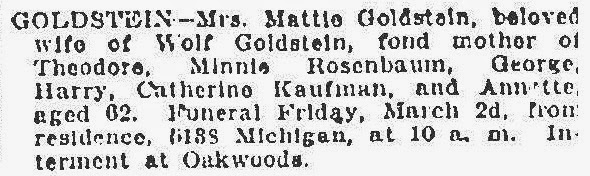
Here is her Death Notice from the Chicago Daily Tribune of March 2, 1917:

When Mattie was buried next to Louis, Wolf Goldstein decided to commission the construction of the arch monument to commemorate his family:


Wolf Goldstein was devastated at the loss of his wife. But as he got older and the children all went their way he took a second wife. It was very short lived. Supposedly after he married the woman he found out that she had married him to support her five children. He had no knowledge about them prior to the marriage. That led to a real quick divorce!
On May 15, 1918 Wolf Goldstein married again, this time to Ida Krom Jacobs, in Chicago. Both were said to be sixty years old.
The 1920 US Census shows Wolf and Ida Goldstein living at 3349 Fifteenth Street in Chicago (there is a new apartment building on that site today). Wolf listed no occupation but told the census taker that he was sixty-nine years old and his wife was sixty-two. Both said they were from Russia and their mother tongue was Yiddish.
By the 1930 US Census, Wolf and Ida Goldstein were living at 6805 N. Sheridan Road in Chicago.
Seventy-seven-year-old Wolf listed his occupation as a retail merchant of dry goods. Ida was listed as being seventy-four. Wolf told the census taker that he had come to the US in 1864; Ida in 1880. Wolf said that he had been nineteen when he was first married; he actually had been twenty-two. As the years pass, people's memories for dates tend to get "fuzzy."
Wolf’s granddaughter told me that “every Saturday my mother would take me to see him and he would give me a quarter. I remember him saying to me, ‘Your legs must get so cold because your socks only come up to your knees.’”
Wolf had brothers and sisters and nieces and nephews who lived on the West Side of Chicago. The family said that once a month they would come to see him and he would give them money because they were poor.
Wolf Goldstein's third wife, Ida Krom Jacobs Goldstein died January 26, 1933 in Evanston, Illinois, leaving Wolf a widower for the second time. Ida was buried at Jewish Waldheim Cemetery in Forest Park, not "under the arch."

Wolf Goldstein died on October 16, 1935 at 1246 Pratt Boulevard in Chicago.
Here is his Death Certificate:

The cause of death was myocardial degeneration with generalized arteriosclerosis. He was 82 1/2 years old. He had had this heart disease for eight years, according to his doctor. Here is his Death Notice from the Chicago Daily Tribune of October 18, 1935:

Wolf Goldstein was laid to rest under the arch, beside his first wife and son.

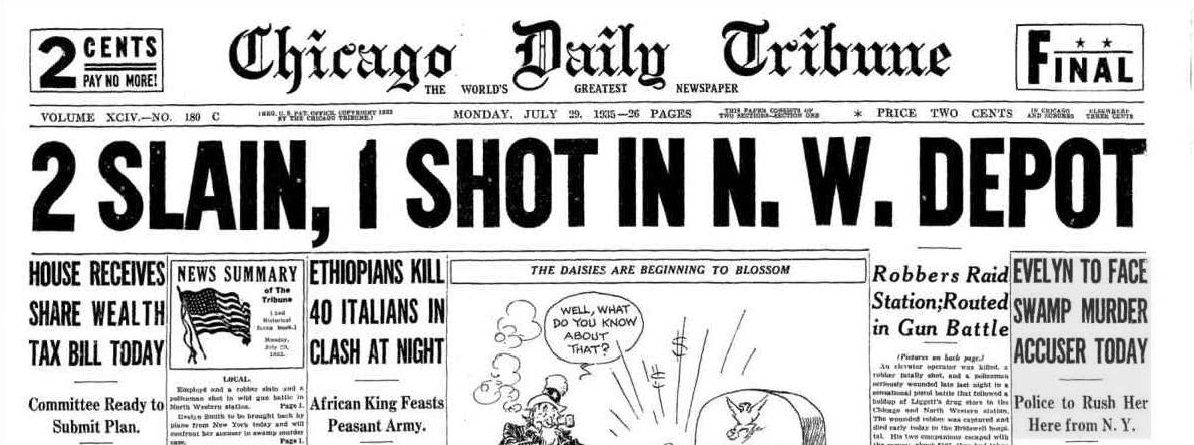
As a retired merchant of note, the death of Wolf Goldstein merited a special article in the Chicago Daily Tribune on October 18, 1935:

The family related that Wolf Goldstein left a lot of money to be equally divided among his children. That money sustained Wolf’s children and their families during the Great Depression.
Today, Wolf, Mattie and Louis Goldstein rest "under the arch" in a forgotten corner of the forgotten Jewish Cemetery next to Oakwoods Cemetery in Chicago.
Well, maybe not forgotten anymore...
May they rest in peace.
Note: A very special thank you to Meta Cohen, granddaughter of Wolf and Mattie Goldstein. Her willingness to share family information, stories and photos helped us to get a more complete picture of the life and times of Wolf Goldstein. Zayt gezunt, dear Meta!
The trip was unsuccessful in that I did not find the grave I was looking for, and also because I managed to pick up several ticks who went up my pants legs as I was searching through the tall, untrimmed grass. I did, however photograph roughly 400 graves from this forgotten cemetery. As I was searching row by row, I came across an interesting monument to the Goldstein family:

The arch covered three graves: Mattie Goldstein (1855-1917), Wolf Goldstein (1854-1935) and Louis Goldstein (1886-1903). I decided that the Goldsteins would probably provide an interesting story for this blog, and so I set out to find out what I could "dig up" about them.
Wolf Goldstein was born March 17, 1853 (even though that does not agree with his tombstone) in Vilna, which was then a part of Russia. We know his father's name was Israel and his mother's name was Libby, but that's all we know about them. Wolf arrived in the United States in 1872 when he was nineteen years old. In those days, to be allowed into the U.S., an immigrant had to have a sponsor – someone already in the U.S. who would vouch for the immigrant, provide them with a place to live, and help them find a job. Family lore says that young Wolf did not have anyone to sponsor him, so he “became one of the sons in a family whose name was probably Goldstein.” Supposedly his surname was originally Schine.
Wolf's granddaughter told me that Wolf had three brothers and a sister: Harry Louis Goldstein, Raphael Goldstein, Hillel Goldstein and Rachel Goldstein. Other than their names, not much is known about them today.
In 1875 Wolf Goldstein married Mattie (also known as "Meta") Grobgeld who was born August 2, 1854 (that doesn't agree with her tombstone either) in Russia-Poland. There are several conflicting stories about Mattie’s arrival in the U.S. Although in later years Mattie said she had come to US in 1870, her daughter related that she was told that Wolf and Mattie met on the ship coming to America. Of course that would mean that they both came over at the same time, but there are also conflicting stories about where Mattie came from. In later years whoever was interviewed by the census taker told them that Mattie had been born in “Russia” or “Russia/Poland.” But the granddaughter of Mattie who contacted me said that she was always told that Mattie had immigrated “from someplace in Scandinavia.” We know for sure that the ship that brought Wolf to the U.S. from Russia/Poland would not have taken a side-trip to Scandinavia, so if that story is true, then Mattie probably met Wolf in New York.
Mattie Grobgeld had one sister: Kate. This is who she went to live with when she first came to the U.S. Kate went on to marry Levi Jacobs and had six children of her own.
We do know for a fact that Wolf Goldstein married Mattie Grobgeld in 1875. Family lore says that Mattie told Wolf she wouldn’t marry him unless he was employed. Since Wolf could speak Russian, Polish, and Yiddish, and was learning English, he became a translator. There was probably a great need for translators in those days because so many immigrants could not speak English. When Wolf and Mattie married they were “very much in love.”
Wolf and Mattie were blessed with ten children, and we know about nine of them:
Israel/Theodore (1875-1964)
Minnie (1877-1964)
Bernard (1880-1912)
Sarah E. (1882-1896),
George Meyer (1884-1964)
Louis (1886-1903)
Harry (1888-1926)
Catherine Gertrude (1891-1975)
Annette (1897-1970)
The family says that when Wolf came to Chicago he became affiliated with a bank – perhaps as a translator.
As early as 1877 Wolf Goldstein is shown in the Chicago Directory as a merchant of "Notions" at 447 Clark Street (now 1200 N. Clark Street). The building that was there in 1877 is long gone.
The 1880 US Census shows the Goldstein family living at 415 Clark Street (now 1124 N. Clark Street). A high-rise building now occupies that spot. Wolf worked at a clothing store, Mattie (or "Mite") was "Keeping House", and they had been joined by son Israel/Theodore (1875-1964) and daughter Minnie (1877-1964).
By 1887 he was listed in the Chicago Directory as "W. Goldstein & Co. - Shirts" at 154 Fifth Avenue (now 647 N. Wells Street) in Chicago (now a parking lot) with his residence still at 415 Clark Street. The 1890 US Census for Illinois is, of course, lost.
On October 18, 1892, Wolf Goldstein registered to vote. He listed his address as 1256 Wabash Avenue (now a gas station). He said he had been at that address for two years, in Cook County for nineteen years, and the State of Illinois for twenty-three years. He was not allowed to vote, however because his papers were "Suspect."
Tragedy struck the Goldstein family on October 11, 1896 when Sarah died from endocarditis with complications. She was only 14 years and 5 months old. Here is her death certificate:

I have been told these heart problems can come after Rheumatic Fever. According to the death certificate she had these problems for one year, so it is unlikely she was born with a weak heart. Sarah Goldstein died at home which was 1418 S. Michigan Avenue. A newer commercial building occupies that site today.
Sarah was buried October 12, 1896, the day after she died. The family purchased a plot at the small Jewish cemetery that abuts Oakwoods Cemetery on Chicago's south side. Here is her tombstone:

For the 1900 US Census the Wolf Goldstein Family was living at 3248 Wabash Avenue (now the Illinois Institute of Technology). However, the family has grown significantly. Joining Wolf, Mattie, Israel/Theodore and Minnie are George, Louis, Harry, Catherine, and Annette. In the 1900 US Census, Meta Goldstein told the census taker that she had given birth to ten children, seven of whom were still alive in 1900. The list above gives information about nine children, but that still leaves one child unaccounted for. Wolf listed his occupation as "Clothing." In addition, the census shows that the family had three live-in servants: Mary Edelson a cook, Ida Edelson a maid, and John Huston a houseman.
Wolf’s granddaughter told me that “When my mother (Catherine) would go to school Mattie made certain that two of her brothers would accompany her. You see in those days there was a person who was dubbed, "Jack the Hair Clipper". Little girls had long braids and he would accost them and cut them off and sell the hair."
Tragedy struck the Goldstein family again in May of 1903 when seventeen-year-old Louis Goldstein died of scarlet fever. He died at 155 East 33rd Street (now 411 E. 33rd Street) on May 21, 1903 and was buried the same day - either because of the worry of scarlet fever contagion or because of the Goldstein family's Jewish faith. Louis had been ill only seven days. 411 E. 33rd Street is now part of the Lake Meadows housing complex.
Louis joined his sister Sarah in the family plot in the small Jewish cemetery adjacent to Oakwoods Cemetery, although the large arch had not been erected yet.

The 1904 Chicago Directory showed Wolf Goldstein at 504 63rd Street in Chicago (now a vacant lot). The 1906 Directory has him at 512 63rd Street (another vacant lot).
The 1910 US Census shows the Goldsteins living at 3436 South Park Avenue in Chicago (the 3400 block of South Park Avenue no longer exists). The family remembers it as a “big home on the south side of Chicago. Wolf listed his occupation as "proprietor of a department store." The only ones left at home with Wolf and Mattie were Theodore, Catherine and Annette. The Goldsteins also had one live-in servant, Nellie Belt.
Here is a photo of the Goldstein family from about that time:

The family relates that Wolf made a lot of money; he dealt in real-estate and bought much property on the south side of Chicago. Some of the property he owned was in a section that some would not consider desirable. His tenants however seemed to like him as he was always fair in dealings with them. He was taken aside once and told not to come near the property as there was trouble coming. There was, a big race riot which was something in those days.
The family told me that Wolf was involved politically with the then mayor of Chicago and they wouldn't be surprised if some shady deals were made. During the depression there was a run on the banks. Wolf Goldstein was said to have stopped the run on that bank, they believe it was the First National in Chicago, by telling everyone he had confidence in it and would not withdraw his money. Now the bank does have this authenticated in their archives to this day.
Mattie Grobgeld Goldstein died on March 1, 1917 at the age of sixty-two.

She died of myocarditis complicated by diabetes. Her address was listed as 5138 S. Michigan Avenue, where she had lived for two years.
 |
| 5138 S. Michigan Avenue, Chicago |
Unfortunately, today, it is a vacant lot. Her previous address was listed as 5243 Michigan Avenue.
 |
| 5243 S. Michigan Avenue, Chicago |
Here is her Death Notice from the Chicago Daily Tribune of March 2, 1917:
When Mattie was buried next to Louis, Wolf Goldstein decided to commission the construction of the arch monument to commemorate his family:


Wolf Goldstein was devastated at the loss of his wife. But as he got older and the children all went their way he took a second wife. It was very short lived. Supposedly after he married the woman he found out that she had married him to support her five children. He had no knowledge about them prior to the marriage. That led to a real quick divorce!
On May 15, 1918 Wolf Goldstein married again, this time to Ida Krom Jacobs, in Chicago. Both were said to be sixty years old.
The 1920 US Census shows Wolf and Ida Goldstein living at 3349 Fifteenth Street in Chicago (there is a new apartment building on that site today). Wolf listed no occupation but told the census taker that he was sixty-nine years old and his wife was sixty-two. Both said they were from Russia and their mother tongue was Yiddish.
By the 1930 US Census, Wolf and Ida Goldstein were living at 6805 N. Sheridan Road in Chicago.
 |
| 6805 N. Sheridan Road, Chicago |
Seventy-seven-year-old Wolf listed his occupation as a retail merchant of dry goods. Ida was listed as being seventy-four. Wolf told the census taker that he had come to the US in 1864; Ida in 1880. Wolf said that he had been nineteen when he was first married; he actually had been twenty-two. As the years pass, people's memories for dates tend to get "fuzzy."
Wolf’s granddaughter told me that “every Saturday my mother would take me to see him and he would give me a quarter. I remember him saying to me, ‘Your legs must get so cold because your socks only come up to your knees.’”
Wolf had brothers and sisters and nieces and nephews who lived on the West Side of Chicago. The family said that once a month they would come to see him and he would give them money because they were poor.
Wolf Goldstein's third wife, Ida Krom Jacobs Goldstein died January 26, 1933 in Evanston, Illinois, leaving Wolf a widower for the second time. Ida was buried at Jewish Waldheim Cemetery in Forest Park, not "under the arch."

Wolf Goldstein died on October 16, 1935 at 1246 Pratt Boulevard in Chicago.
 |
| 1246 W. Pratt Boulevard, Chicago |
Here is his Death Certificate:

The cause of death was myocardial degeneration with generalized arteriosclerosis. He was 82 1/2 years old. He had had this heart disease for eight years, according to his doctor. Here is his Death Notice from the Chicago Daily Tribune of October 18, 1935:

Wolf Goldstein was laid to rest under the arch, beside his first wife and son.

As a retired merchant of note, the death of Wolf Goldstein merited a special article in the Chicago Daily Tribune on October 18, 1935:

The family related that Wolf Goldstein left a lot of money to be equally divided among his children. That money sustained Wolf’s children and their families during the Great Depression.
Today, Wolf, Mattie and Louis Goldstein rest "under the arch" in a forgotten corner of the forgotten Jewish Cemetery next to Oakwoods Cemetery in Chicago.
Well, maybe not forgotten anymore...
 |
| Wolf and Mattie Goldstein |
May they rest in peace.
Note: A very special thank you to Meta Cohen, granddaughter of Wolf and Mattie Goldstein. Her willingness to share family information, stories and photos helped us to get a more complete picture of the life and times of Wolf Goldstein. Zayt gezunt, dear Meta!